Power · Oct 18, 2026, 16:55
AI memory chips can use a third more power than official tests show
Researchers at ETH Zürich and NYU tested 36 real memory chips of the kind used in AI processors. They found the industry's standard worst-case test misses how much power the chips can really draw.
Illustration (AI-generated)
Stacked memory beside a processor die.
Key takeaways
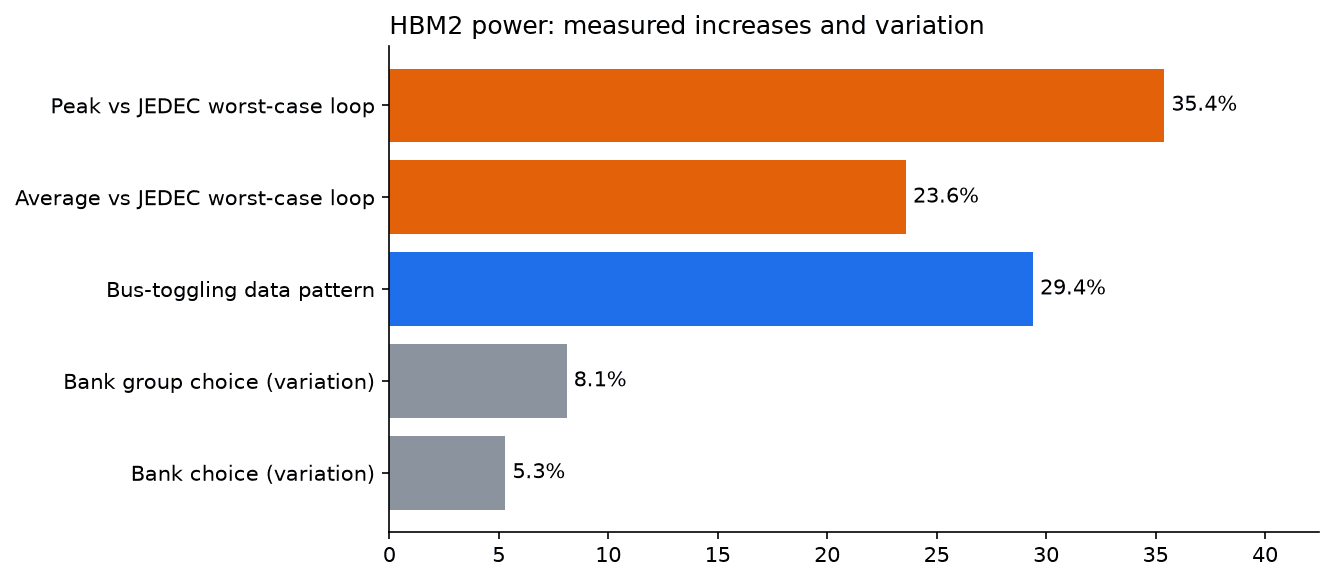
- HBM2 memory drew 23.6% more power on average, and up to 35.4% more, than the toughest official JEDEC test.
- Reading data uses about 3.1 times the current of the chip's routine refresh work, and the data itself changes power use.
- In NVIDIA H200 GPUs, this kind of memory uses about 248 W, roughly 35% of the card's 700 W budget.
- The team released a free power model that is far more accurate than existing ones.
- Next step: testing real HBM4 chips, since the HBM4 figures so far are only estimates.
What the researchers found
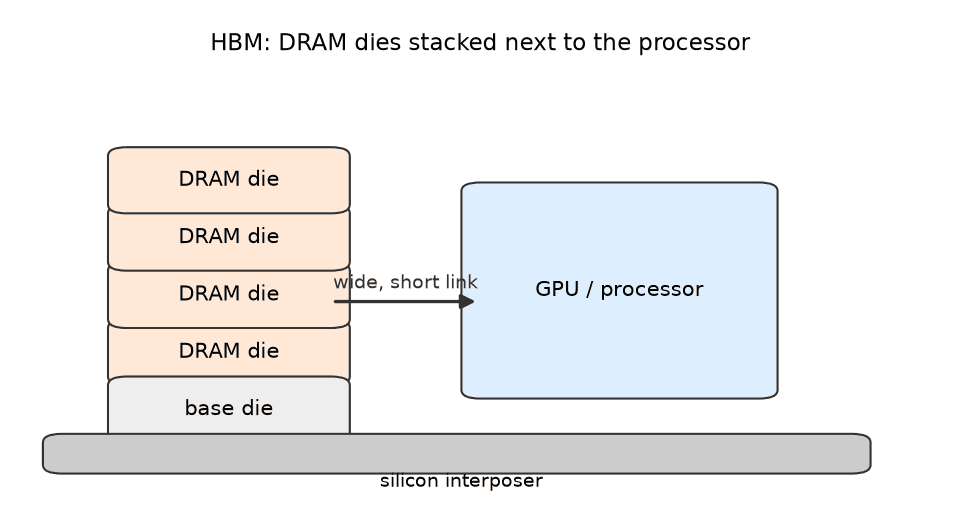
HBM, or high bandwidth memory, is fast memory stacked right next to AI processors. Researchers at ETH Zürich and New York University tested real HBM2 chips, an older generation of it. They found the chips can draw 23.6% more power on average, and up to 35.4% more, than the most demanding test in the JEDEC standard. JEDEC is the industry body that sets memory specifications.
The team calls this the first detailed power study of real HBM2 parts. It covered 36 chips on 18 AMD Alveo U55C FPGA boards, which are reprogrammable chip boards used for testing. Semiconductor Engineering flagged the paper.
Sources
- Characterization of HBM Power Consumption (ETH Zurich, NYU) · Semiconductor Engineering