Chips · Oct 21, 2026, 14:43
AMD Folds ZenDNN Into Intel's oneDNN for One PyTorch CPU Path
AMD is moving its ZenDNN CPU inference library into Intel-driven oneDNN and joining the UXL Foundation as a steering member, giving PyTorch a single x86 code path for AI inference.

The oneDNN backend PyTorch now shares across AMD and Intel CPUs already delivered 1.24x on Float32 and 2.21x on BFloat16 when added in late 2023.
Illustration (AI-generated)
Intel and AMD are folding their CPU optimizations for PyTorch into one library, according to Tom's Hardware. AMD's downstream ZenDNN library is moving into the open-source oneDNN, which is published by the UXL Foundation and driven by Intel, so PyTorch gets a single CPU inference path tuned for both vendors' chips.
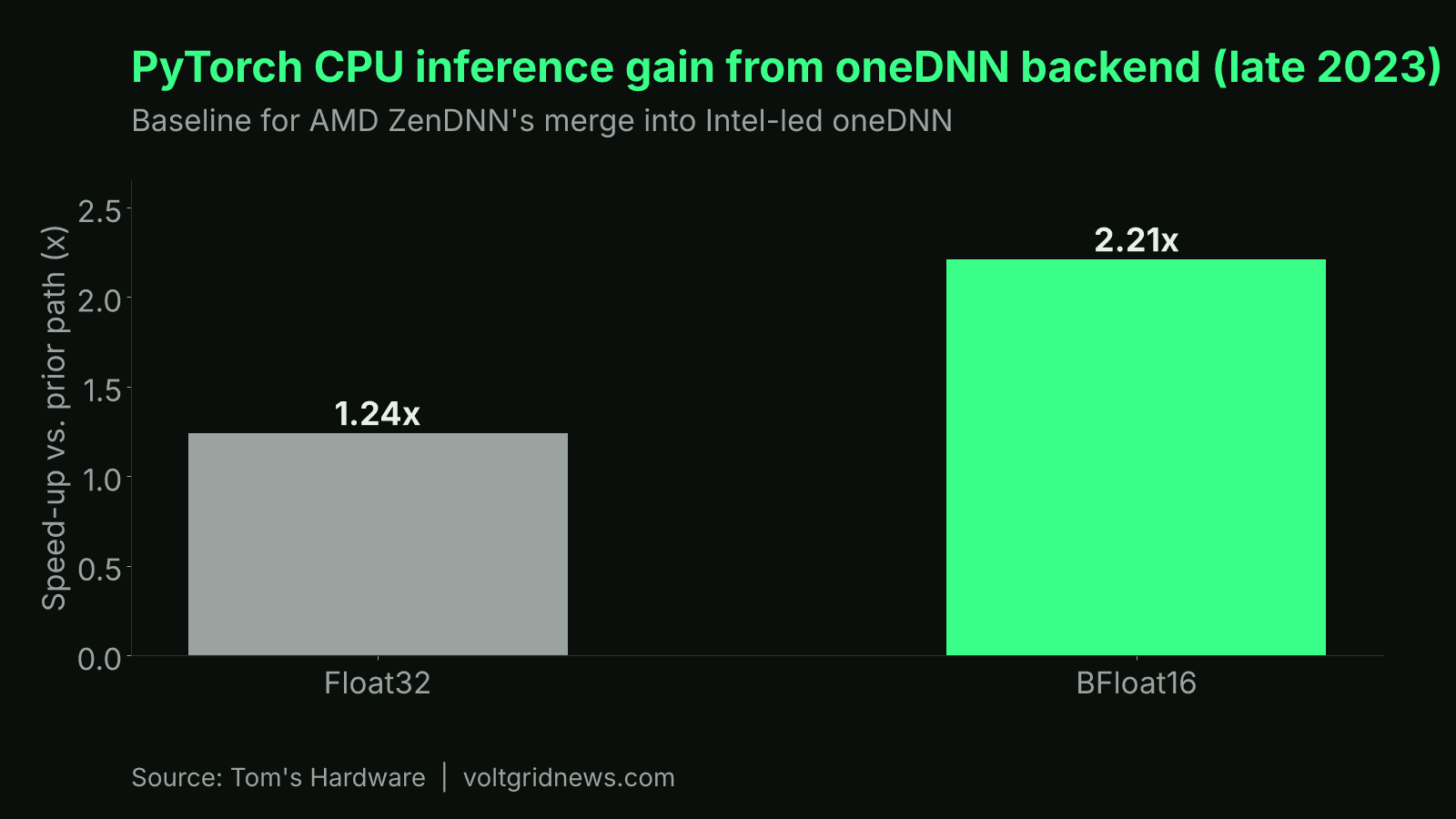
The oneDNN backend PyTorch now shares across AMD and Intel CPUs already delivered 1.24x on Float32 and 2.21x on BFloat16 when added in late 2023.
Illustration (AI-generated)
AMD also said it is joining the UXL Foundation as a steering member, in exchange for a contribution of $20,000 per year. The company said the move to unify under oneDNN was recommended by the x86 Ecosystem Advisory Group, a joint Intel and AMD initiative set up in 2024. The two companies have worked through that group before, including on the ACE extensions for x86.
oneDNN is the backend PyTorch uses for CPU inference. When it was added to PyTorch in late 2023, it showed a 1.24x improvement with the Float32 data type and 2.21x with BFloat16, Tom's Hardware reported. The library detects hardware features at runtime and generates optimized kernels for the platform, including low-precision data types and common operations such as matrix multiplication and convolution.