Arbol Launches Data Center Moratorium Insurance Amid 194 Local Restrictions
Arbol's policy, launched October 20, pays a set amount when a government halt on data center construction outlasts a waiting period; the waiting period, payout limits and premiums are not public.
3 min readAI-assisted

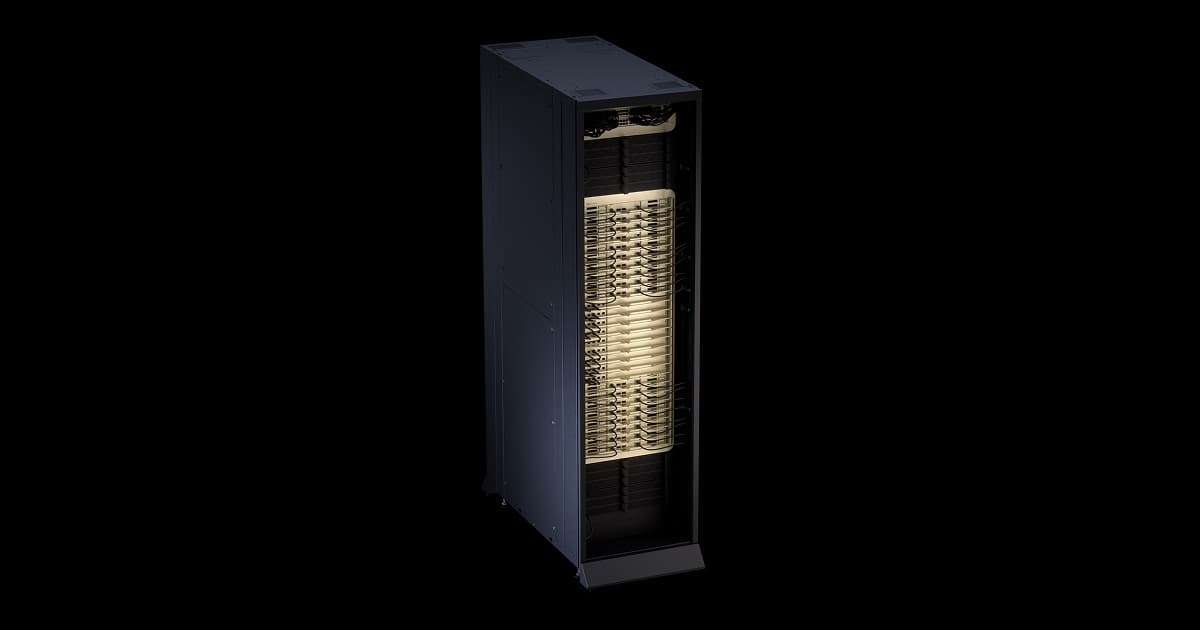
Concept art from Arbol's launch release, not a photograph: it shows a data center campus under a protective dome, standing in for the risk the cover insures.
Image: Arbol
Source · Press image from the Arbol newsroom, used for news reporting.
Arbol, a parametric insurer, launched a policy on October 20, 2026 that pays a set amount if a government halt on data center construction outlasts a waiting period, citing restrictions in 194 local jurisdictions.
Arbol said in its release that the product, which it names Data Center Regulatory Moratorium Protection, is the first to move onto an insurer the risk that a government order halts or suspends data center building; Reinsurance News and Artemis call it a Cover. It is meant to offset the capital sunk into a project and the holding costs that build while the site sits idle, and Arbol said it is sold through brokers. Standard policies do not respond, the company said, because property and builders' risk cover pays for physical damage and political risk cover targets foreign and sovereign exposures.
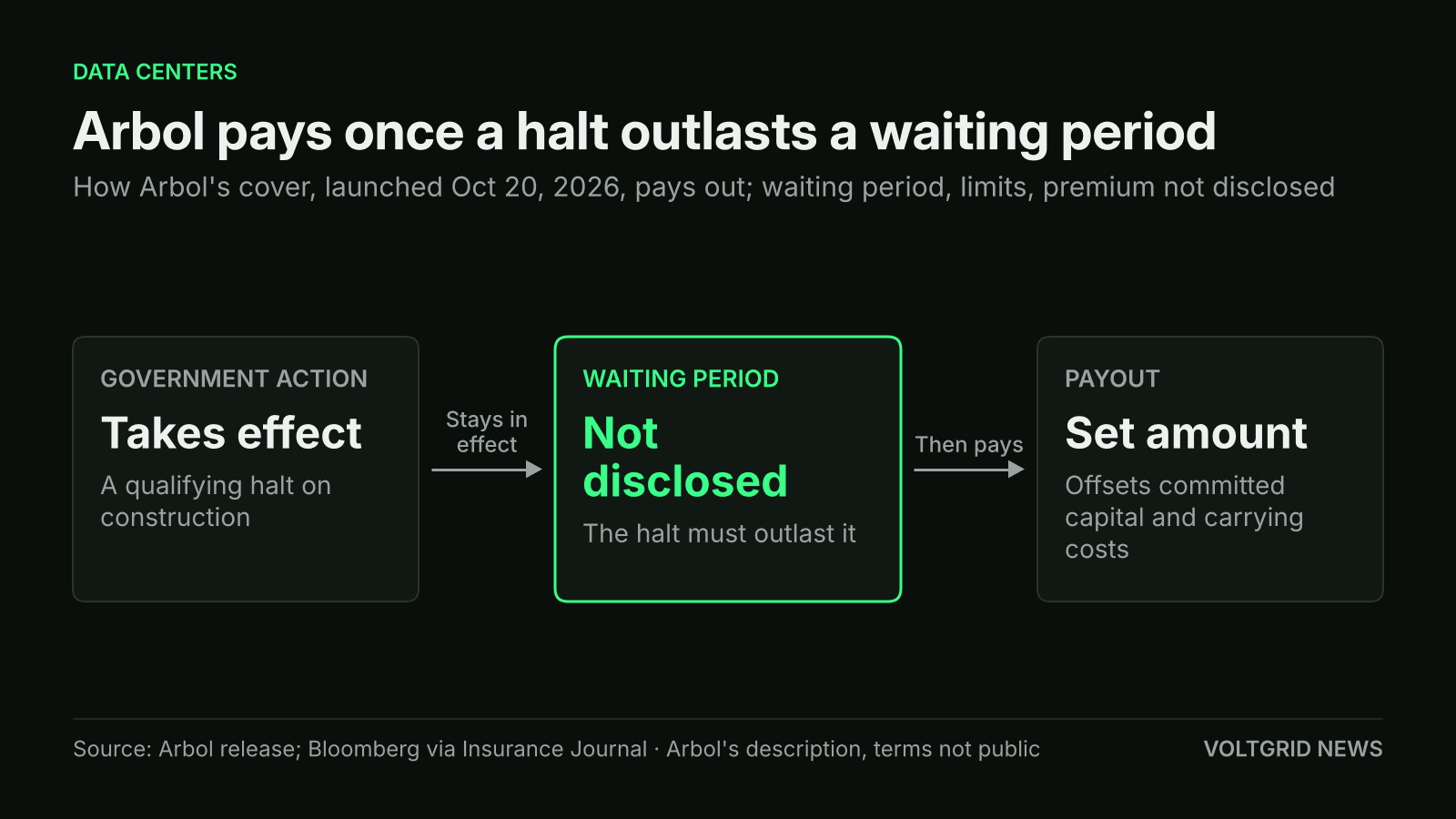
Arbol's cover pays a set amount when a government halt outlasts a waiting period, but the length of that period is not disclosed, according to Arbol's release.
Illustration (AI-generated)
The detail that matters for power and grid planners comes from Bloomberg's report of the launch, carried by Insurance Journal. Arbol sets terms for each policy from local data such as grid capacity, power rates, regional water availability and how the jurisdiction has treated data centers before, and premiums vary sharply by geography, permit category and project exposure. Arbol does not write the cover where a moratorium is already in force, citing prohibitive costs, so a developer in a jurisdiction that has already acted is not covered for that action. Grid capacity and power rates, which shape where a campus can be built, also feed the price of a halt.
The exposure Arbol is pricing
As of August 2026, Arbol tallied restrictions in 194 local jurisdictions and 45 measures at state level, spread over 36 states. It cited a March 2026 Gallup survey in which 71% of Americans opposed an AI data center in their own area, 48% strongly. Bloomberg added that Data Center Watch, a monitor run by 10a Labs, counted at least 106 projects, representing about $198 billion of investment, blocked or delayed by local opposition in the first half of 2026.
For lenders, Arbol argues, the cover turns an unhedgeable exposure into a budgeted cost. Sid Jha, its founder and chief executive, said a moratorium or construction hold can leave hundreds of millions of committed capital stranded, and told Bloomberg that companies representing tens of billions of dollars of data center construction value have lined up to buy policies since broker outreach began in September. Robert Hartwig of the University of South Carolina told Bloomberg the cover could calm jittery AI investors but will be difficult to roll out rapidly.
How it fits the wider moratorium picture
SemiAnalysis found that US moratoriums delay only about 2.3 GW, across three projects, in a review Voltgrid reported on October 18; that figure leaves out Texas, where the governor told the state environmental regulator to stop issuing data center permits. On October 20, the day of Arbol's launch, the Memphis council passed a 135-day pause. On October 22, San Diego's mayor signed an order directing a temporary pause, which goes to the City Council on October 26. SemiAnalysis tracks more than 400 local rules in 17 states, so its count and Arbol's 194 jurisdictions are not interchangeable.
What is not confirmed yet
Arbol's release and the reports Voltgrid reviewed give no waiting period, payout limit, premium or insured developer, and the demand figure is Jha's statement, not a count of bound policies. Arbol did not say which carrier or capital provider backs the cover. Artemis reports that the trigger is a halt on data center construction as a class, not a site-specific permit denial, with settlement from public records; Arbol's release does not define a qualifying action that way, or say whether a grid operator's refusal to connect, like the Dublin-region refusals by EirGrid that Arbol cites, would count. Arbol's figures on local restrictions and polling are its own and were not independently checked.