BLM Weighing 35 Data Center Applications on 24,000+ Acres of Public Land
A conservation group's October 20 count puts 35 data center applications on 24,000+ acres of federal land in six Western states, up from roughly 12 in September, with no dedicated permitting process.
3 min readAI-assisted
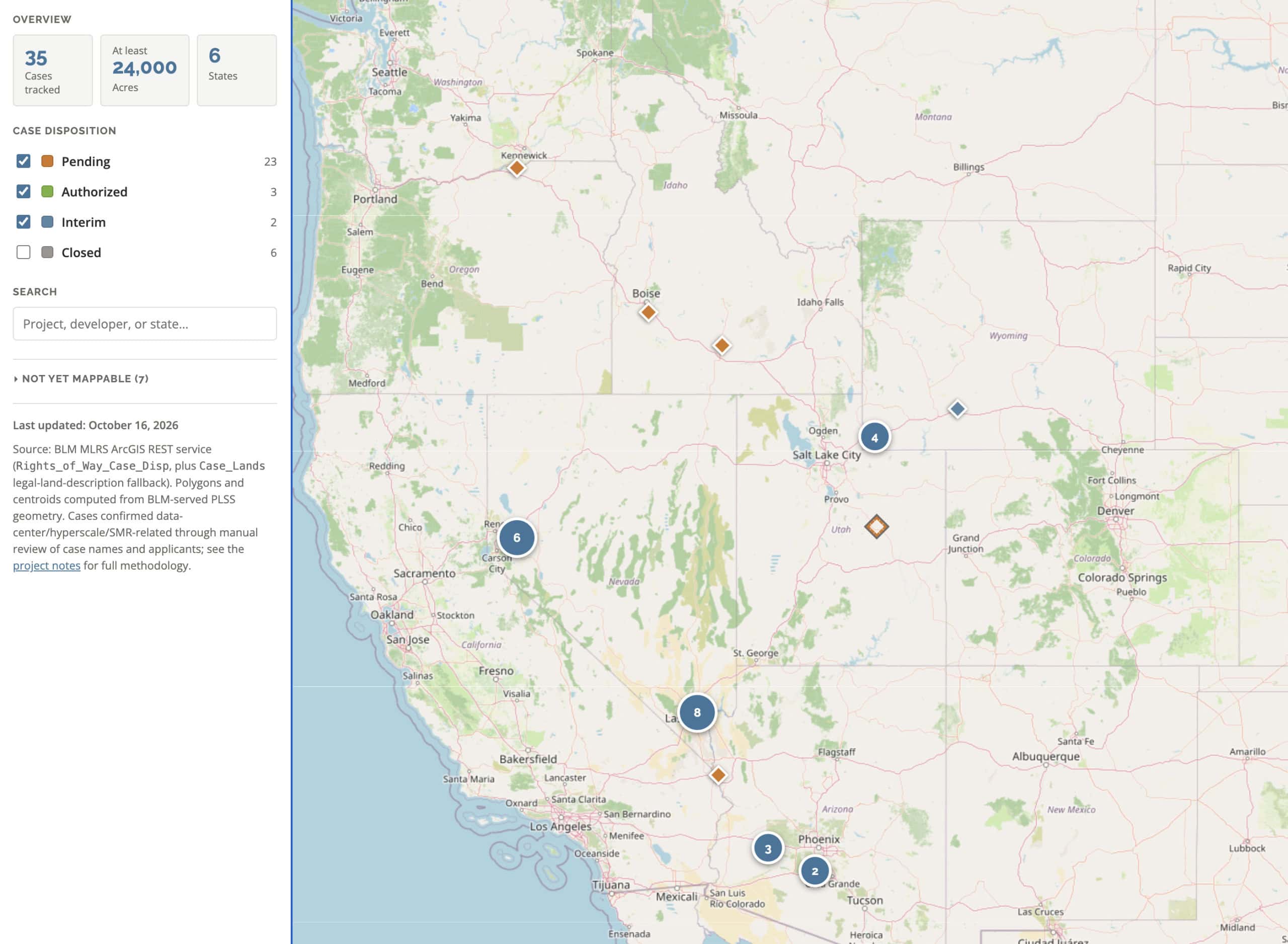
The Center for Western Priorities' BLM Data Center Tracker map, with data current to October 16, as published with its October 20 release. It is a screenshot of the map, not a photo of a site.
Image: Center for Western Priorities
Source · Press image from the Center for Western Priorities newsroom, used for news reporting.
On October 20, 2026, the Center for Western Priorities (CWP) counted at least 35 data center-related applications covering more than 24,000 acres of public land under review at the Bureau of Land Management (BLM).
Reuters reported the count the same day. CWP, a conservation group, found the applications in Arizona, Idaho, Nevada, Oregon, Utah and Wyoming by searching BLM's own land records, current to October 16; BLM's records service was down on October 20, CWP said. It says 17 of the 35 look like data center campuses, 13 look like supporting infrastructure such as access roads, water pipelines, telecom lines and transmission lines, and five could not be classified. Reuters said BLM officials were not immediately available for comment.
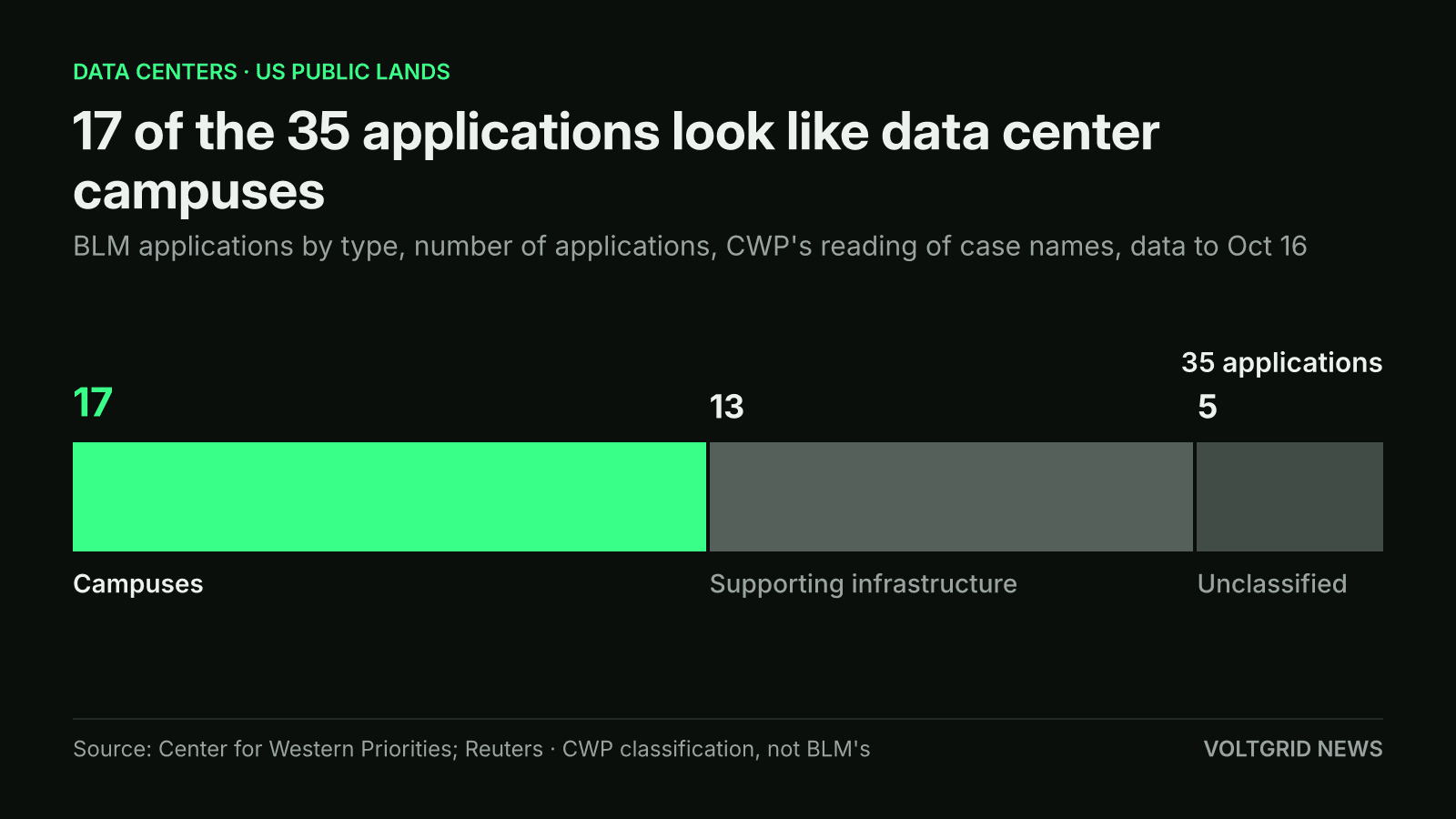
Of the 35 applications, 17 appear to be data center campuses, according to the Center for Western Priorities, whose split is its own reading of case names, not a BLM classification.
Illustration (AI-generated)
In September, press reports and a congressional letter put the count at roughly 12 proposals over 17,600 acres, CWP said. The new total is a floor, since BLM often records zero acres for early-stage filings and unnamed filings by unidentified applicants are missed. It also mixes two kinds of number. The acreage in CWP's published case data adds up to about 15,400 acres on BLM's books for the 35 active cases, and the map adds 9,000 acres for Valar Atomics' Project Beehive in Utah, the figure NPR reported, because BLM lists no acreage for it.
Who is filing
According to Reuters, the map lists several filings for infrastructure serving a Prometheus Hyperscale facility in Wyoming, plus projects by developer Copia Power in Arizona, Nevada and Idaho. CWP counts 16 site and infrastructure proposals from Copia in five states, one of them tied to a 2,520-acre parcel near Las Vegas.
CWP singles out Beehive for scale. NPR reported on September 30, citing documents it reviewed, that it would cover more than 9,000 acres of BLM land near Price, Utah, with 456 small modular reactors (SMRs) producing about 9.6 GW for the data centers. NPR put Utah's entire average electricity output at around 4 GW. The documents put the first reactors in 2028, and BLM's Utah office told NPR it was reviewing the application for completeness.
Why it matters for power and siting
The records say little yet about power. They give acreage and case names, not megawatts, tenants or interconnection dates, so Beehive's 9.6 GW is a company plan, not a BLM figure. At least two pending filings are power lines: Copia's Harquahala to Hyder Transmission Line in Arizona and PacifiCorp's Powerline to Prometheus facility in Wyoming. Patrick Donnelly of the Center for Biological Diversity told Nevada Current that local pushback makes public land more attractive to developers, and as Voltgrid reported, a SemiAnalysis review counted more than 300 local moratoriums on new data centers.
CWP argues there is no established permitting process for data centers on public land, unlike for solar, wind, drilling or mining, and one project has tested the gap. BLM approved the Townsite Data Center near Boulder City, Nevada, on June 26 without a new environmental review, treating it as essentially like a solar plant approved there in 2023. Townsite has called it a 167 MW project, and its plan includes a 70 MW battery system, according to the Interior Board of Land Appeals, which stayed the approval on September 1 after Boulder City and two conservation groups appealed. In September BLM itself asked the board to set the approval aside, and on October 15 the board revoked it and sent it back for a separate environmental review that BLM must complete and approve before work can proceed, Nevada Current reported.
What is not confirmed yet
These are applications, not approvals. CWP notes a right-of-way application is a request that BLM can deny or the developer can withdraw, and the 17 / 13 / 5 split is its reading of case names, not a BLM classification. Of the 35 active cases, 29 are pending, three are interim and three show as authorized: Townsite, which BLM's land records still list that way despite the board's order, and two Nevada geotech cases.
On September 24, Representatives Jared Huffman, Dina Titus and 13 other members of Congress sent Interior Secretary Doug Burgum 18 questions, including whether the public can weigh in, and asked for answers by October 8. CWP's release does not say Interior replied, and Voltgrid found no public reply as of October 25. CWP's tracker, updated October 22, still shows 35 active cases.