Bloom Energy 10-Q Puts Two Customers at About 43% and 26% of Q3 Revenue
Bloom Energy's customer concentration is high: two buyers took about 43% and 26% of Q3 revenue, one a Brookfield-linked related party, while operations used $27.1 million in cash.
5 min readAI-assisted
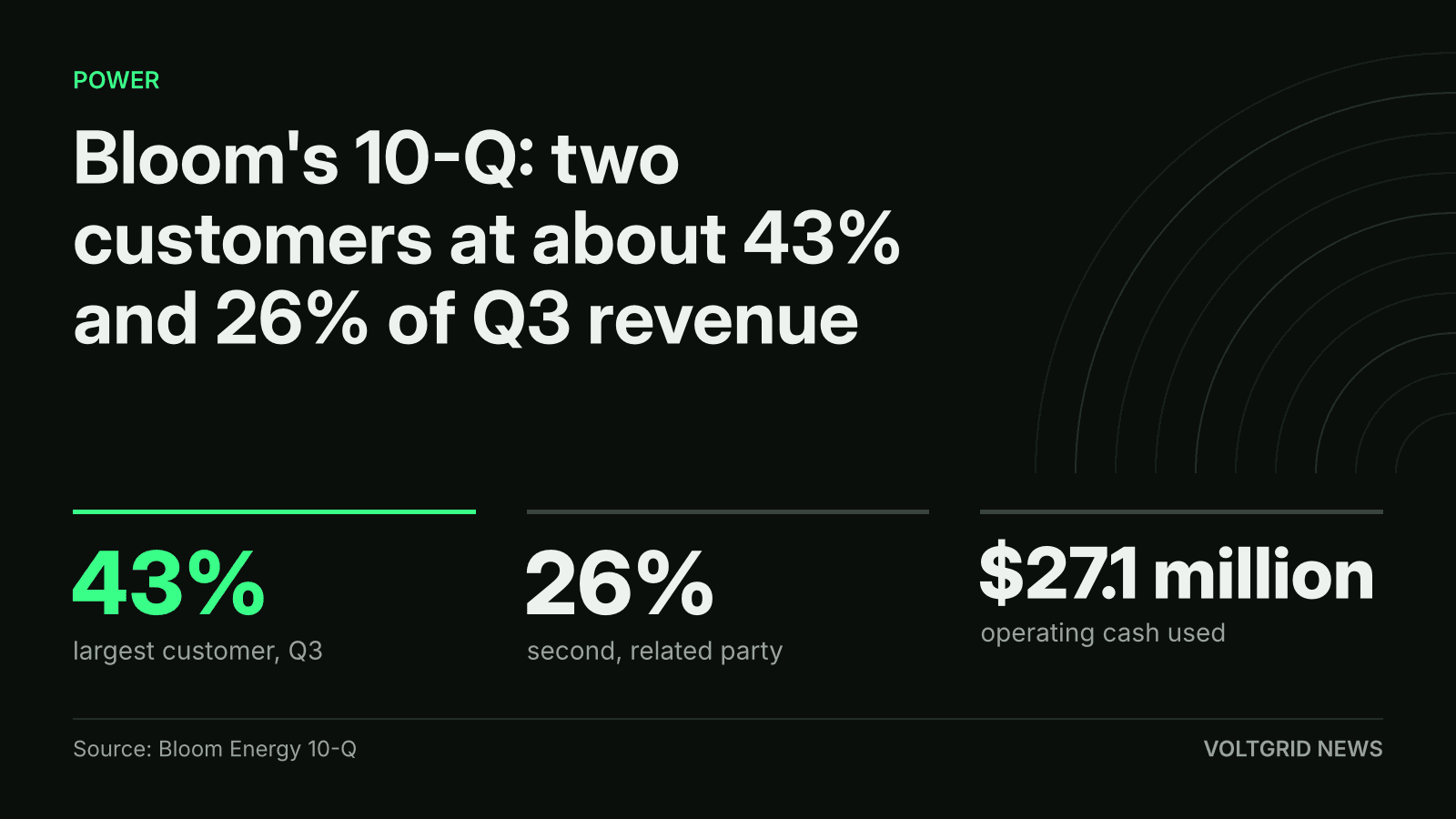
Bloom's 10-Q does not name either customer; the second is a related party. Operating activities used $27.1 million of cash in the quarter.
Illustration (AI-generated)
Bloom Energy's customer concentration is the story in its 10-Q filed on Oct. 22: two customers accounted for about 43% and 26% of record third-quarter revenue, and operating cash flow turned negative as money went into inventory and unbilled work. The argument here is that fuel cells have become a real source of fast power for AI data centers, but the demand behind Bloom still rests on a very small group of buyers and one Brookfield-linked financing channel.
What happened
Bloom reported Q3 2026 revenue of $1,235.8 million, up 138.1% from a year earlier, and raised its full-year revenue guidance to $4.4 billion to $4.6 billion. Voltgrid covered the headline results and Oracle's fuel-cell plans on Oct. 23. This piece is about what the quarterly filing adds.
The 10-Q says two customers made up about 43% and 26% of Q3 revenue, and that the second is a related party. Over nine months the two shares were 43% and 23%. Bloom does not name either one. It also explains that for this disclosure a "customer" is the contractual counterparty, which in some deals is a project-finance affiliate rather than the end user.
The related parties are joint ventures with Brookfield Asset Management: two held in Brookfield's AI Infrastructure Fund and one outside it. Related-party revenue was $321.6 million in Q3, against $288.0 million a year earlier, and $697.7 million over nine months, against $317.8 million. Bloom owns 6.2% of each AI Fund venture, down from 9.9% at the end of 2025, and does not consolidate them. It puts its maximum loss exposure to the ventures at $63.4 million.
Cash moved the opposite way from revenue. According to the release, operating activities used $27.1 million in Q3, after providing $226.4 million in Q2, and capital spending was $153.5 million. Between Dec. 31 and Sept. 30, inventories rose from $643.3 million to $927.7 million and current contract assets went from $178.9 million to $792.8 million. On the call, Chief Financial Officer Simon Edwards called the outflow a working-capital effect and "not the beginning of a trend," according to a transcript published by Investing.com. He put Q3 free cash flow at a $181 million use and year-to-date free cash flow at $42 million positive.
How Bloom's Capacity Agreements Work
Bloom does not only sell a fuel cell outright. In Nebius's SEC filing, Nebius buys the capacity and the electricity while Bloom installs, operates and maintains the systems, in three phases that each carry a 10-year supply term and fees of up to $2.6 billion in total. The 10-Q counts the contractual counterparty as the customer, which in some deals is a project-finance affiliate rather than the end user.
The headline figure needs a label too. Nebius's first project is 328 MW of installed capacity, while the filing puts guaranteed capacity at about 250 MW. For buyers the consequence is time to power and credit: the fees start only after certain conditions are met, and Bloom says it generally cannot sell to a financier until permits are in hand.
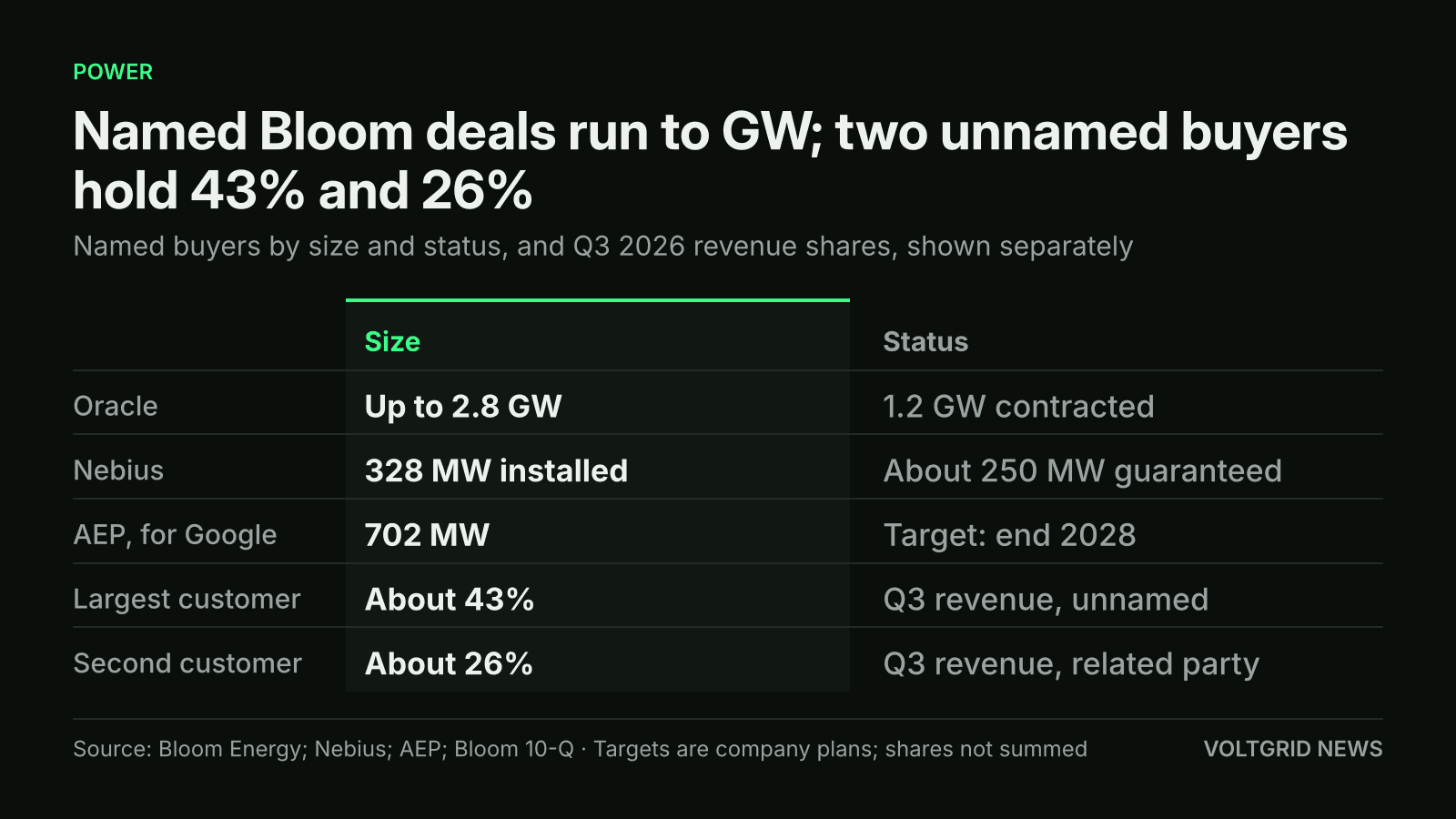
Bloom's named deals and its two unnamed revenue concentrations are separate measures, so the 43% and 26% shares are not added to any deal size.
Illustration (AI-generated)
Why it matters
The first step of the argument is that this supply is real and large. Oracle has contracted 1.2 GW of Bloom fuel cells under a master services agreement and intends to buy up to 2.8 GW in total. Nebius expects its first US project, with 328 MW of installed behind-the-meter capacity (about 250 MW guaranteed, according to its SEC filing), to be operational in 2026. AEP plans a 702 MW Bloom plant near Cheyenne, Wyoming, under a 20-year power purchase agreement (PPA) with Google. For campuses that cannot get a grid connection quickly, fuel cells are now one of the main bridges.
The second step is that the revenue base is narrow. When two counterparties account for about 43% and 26% of a quarter's sales, one delayed project or one financing that slips can move a whole quarter. A year earlier one related party was about 55% of revenue, so heavy concentration is not new. What changed is the size of the quarter.
The third step is that a large share of the business now depends on financing. Bloom says it arranges financing for customers through PPAs, capacity or lease arrangements, and that some of its sales go to project-finance affiliates rather than end users. That suggests revenue depends on that capital continuing to flow. The 10-Q warns that Bloom generally cannot sell a system to a financier until permits are issued, and that the financing economics depend on investment tax credits under the OBBBA tax law.
The 10-Q's risk factors make the same point in Bloom's own words. They cite New York's July 2026 executive order creating a moratorium on new hyperscale data centers and similar measures in other states. They report delays to air, gas and land-use permits, including for fuel-cell projects. They also say that hyperscaler, neocloud and co-location customers are increasingly viewed as high credit risks. If those trends continue, the most exposed part of the business is permit-dependent revenue from a few counterparties.
The case against
The bull case is a strong one. Concentration measured by contractual counterparty overstates the risk if one financing vehicle sits in front of several end users, and the filing allows for that. Related-party revenue rose to $321.6 million from $288.0 million a year earlier while its share of revenue fell from about 55% to 26%, which suggests other buyers grew faster. Chief Executive KR Sridhar said on the call that backlog is growing faster than revenue and is becoming more diverse across customers and sectors.
The balance sheet also leaves plenty of room. Bloom held $2,486.7 million in cash at Sept. 30 and has positive free cash flow for the year so far. The 10-Q links the jump in receivables and contract assets to milestone billing and customer acceptance, and the inventory build to raw-material purchases ahead of higher output. If those assets turn into cash in Q4, the Q3 outflow will look like timing, as Edwards says. Fuel cells are not automatically free of delay, either: Bloom says air permits for larger installations are taking longer than expected, though Nebius chose fuel cells in place of the reciprocating engines it had planned. Bloom argues in the 10-Q that its systems emit fewer criteria pollutants than combustion alternatives.
What it means for buyers and developers
For data-center developers, the filing argues for treating fuel-cell supply as firm in hardware and less firm in timing. Bloom says it is approaching 5 GW a year of production capacity, which suggests manufacturing is not the constraint. If the 10-Q's risk factors are right, permits, project finance and the buyer's own credit are. Oracle, Nebius and Google, through AEP, are the named buyers whose schedules matter most. Bloom also says it has not had material credit losses from its largest receivable holders so far.
What to watch
Bloom's next update at the start of 2027, when Sridhar said Bloom will give exact backlog guidance, will show whether the base is widening. Nebius's 328 MW site is due to operate in 2026. AEP plans to start construction of its Cheyenne plant in 2026 and expects it to be fully operational by the end of 2028. Bloom said in April that deployment of Oracle's initial 1.2 GW is underway and continuing into next year. The New York permit pause, which can last up to one year, is a test of whether the moratoriums Bloom flags spread to its projects.
Sources
- 01Bloom Energy and Oracle Expand Strategic Partnership to Deploy up to 2.8 GW to Accelerate AI Infrastructure Build-OutBloom Energy · bloomenergy.com
- 02Bloom Energy Corporation Form 10-Q for the quarter ended September 30, 2026Bloom Energy (SEC filing) · sec.gov
- 03Nebius and Bloom Energy partner to power AI infrastructure build-outNebius · nebius.com
- 04Bloom Energy Reports Record Third Quarter 2026 Financial Results and Raises Full Year 2026 GuidanceBloom Energy · bloomenergy.com
- 05Earnings call transcript: Bloom Energy beats Q3 2026 estimates, stock fallsInvesting.com · investing.com
- 06AEP Advances Innovative Energy Solution for Google with 702MW of Bloom Fuel CellsAEP · aep.com