Batteries · Oct 18, 2026, 16:52
Global grid battery installs hit 20.4GWh in September, up 61%
About 20.4GWh of big grid batteries came online worldwide in September, 61% more than a year earlier. China led, and Europe is growing fastest.
Illustration (AI-generated)
A grid-scale battery storage yard.
Key takeaways
- 20.4GWh of grid batteries were switched on globally in September, up 61% on last year.
- The 2026 total so far is 208GWh, up 43%.
- China added more than 12GWh, about two-thirds of the month.
- Europe's nine-month total is 22GWh, up 182%.
- Almost all new storage is still lithium-ion; other chemistries made up just over 600MWh.
What happened
Around 20.4GWh of grid-scale batteries came online around the world in September. The figures come from Benchmark Mineral Intelligence, a market research firm, and were published by Energy-Storage.news.
What a GWh means
A gigawatt-hour (GWh) measures stored energy. One GWh is 1,000 megawatt-hours, enough to run a 1GW power plant for an hour. Grid-scale batteries, often called BESS (battery energy storage systems), are large battery banks that soak up power and release it later.
September's total was 61% higher than a year earlier. That brings 2026 to 208GWh so far, up 43% on the same nine months of 2025.
Where the batteries went
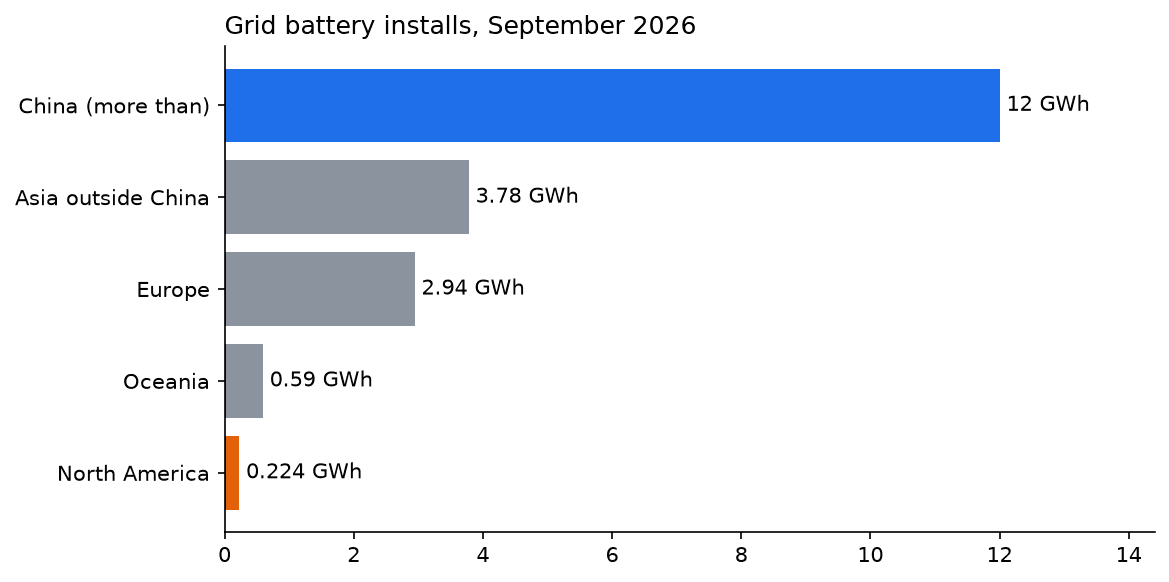
China switched on more than 12GWh, nearly two-thirds of the total. China usually takes 50% to 90% of the world's new storage. July was an exception, when Saudi Arabia was the top market with 37% of 33.5GWh.
Europe added over 2GWh for the fifth month in a row. September projects included a 600MWh EDF site in Belgium, a 773MWh Renalfa site in Bulgaria and Switzerland's largest storage plant. Asia outside China added 3,778MWh, Oceania 590MWh and North America only 224MWh.
VoltGridNews · Source · Original VoltGridNews diagram; data from cited source
September installs by region. China is shown at its stated minimum of 12 GWh.
Why it matters
Europe is now the fastest-growing region. It has added 22GWh in the first nine months, up 182%. The biggest single projects in September were in India and China. The average new battery could run for 2.9 hours at full output.
Beyond lithium
Lithium-ion batteries still dominate. Only a little over 600MWh came from other types, mostly in China. These included a 380MWh flow battery, which stores energy in liquid tanks, and two sodium-ion sites of 1MWh and 40MWh. Sodium-ion batteries use common salt-based materials instead of lithium.
What's next
The data do not say whether Europe can keep this pace through the last quarter. They also do not explain why North America added so little in September.
Sources
- 20.4GWh grid-scale BESS deployed globally in September, up 61%; YTD installs up 43% · Energy-Storage.news