Nigeria Ministry Says 640 MW Transmission Capacity Added in Kano, Katsina
Nigeria's Power Ministry says six Kano and Katsina substations add 640 MW of transmission capacity, but TCN's own statement counts five projects and about 616 MW.
2 min readAI-assisted
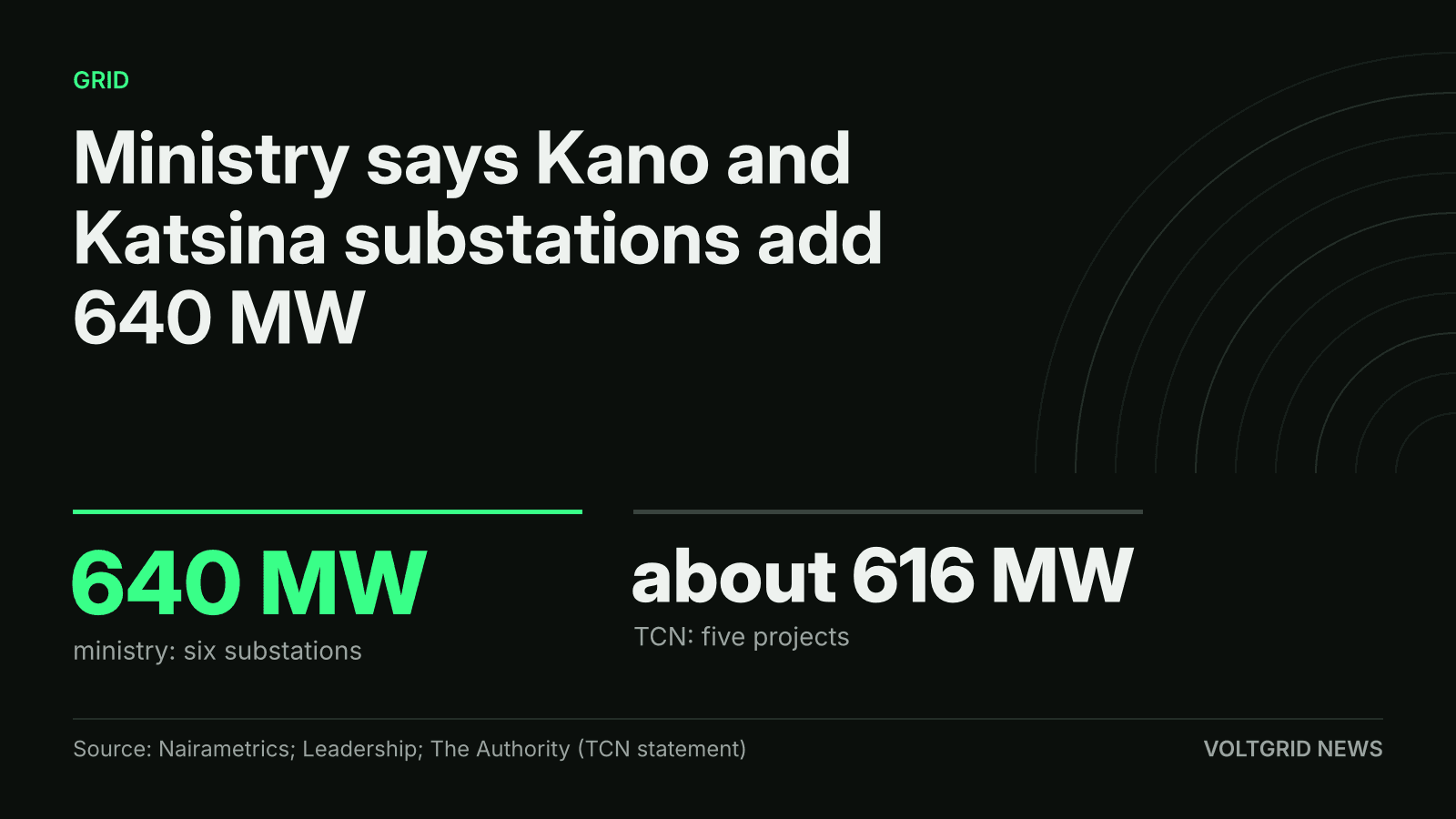
The ministry's 640 MW and TCN's about 616 MW are reported separately and have not been reconciled.
Illustration (AI-generated)
Nigeria's Ministry of Power said on Saturday, October 24, 2026, that the Transmission Company of Nigeria (TCN) added 640 megawatts (MW) of transmission capacity by commissioning six substations in Kano and Katsina states, according to Nairametrics and Leadership.
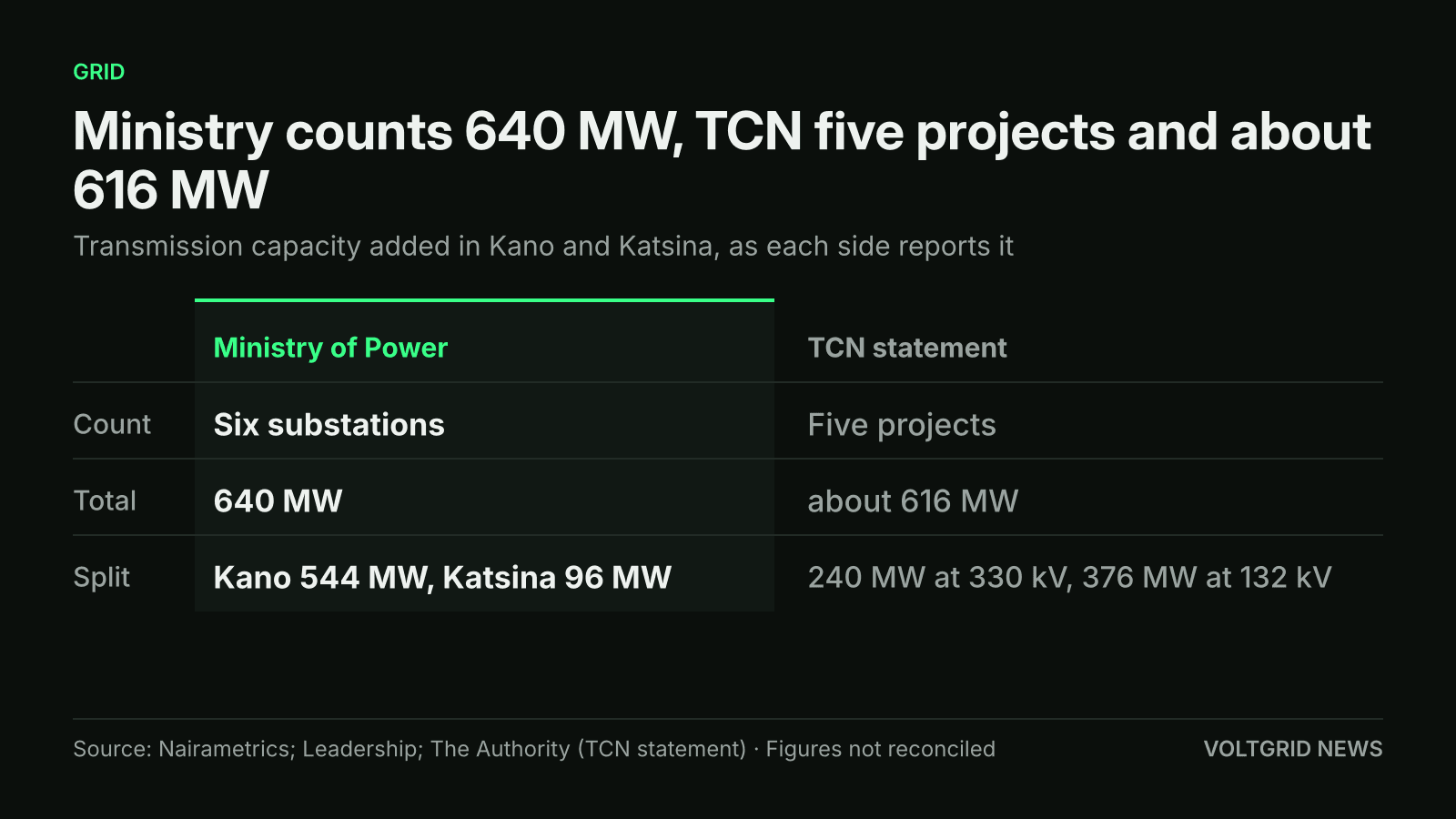
The ministry and TCN give different counts and totals for the Kano and Katsina additions, and neither set of figures has been reconciled.
Illustration (AI-generated)
Four of the substations are in Kano: Walalambe, Kumbotso, Dakata and Dan-Agundi, which the ministry says together add 544 MW. The other two are 60 MVA, 132/33 kV units at Kankia in Katsina, credited with 96 MW. Minister of Power Joseph Tegbe commissioned the Kankia units on Friday, October 23, and the Kano sites earlier in the week.
This is wheeling capacity, the ability to carry power to distribution companies, and not new generation. Nairametrics noted that the effect on supply depends on how much generating plants can deliver and on the capacity of downstream distribution networks. For large industrial and commercial loads, the practical gain is another supply point and less pressure on existing Kano facilities, as Tegbe put it. The ministry also cited a dedicated 33 kV feeder that connects the Lee Group of Companies, which had run off-grid for more than 30 years.
Transformer Capacity Added, per TCN
A TCN statement, carried by The Authority, gives the hardware. Walalambe has two 40 MVA transformers. Kumbotso received 300 MVA and 100 MVA power transformers, and Dakata and Dan-Agundi each received one 100 MVA unit. In Katsina, two 60 MVA transformers lifted Kankia's installed capacity from 60 MVA to 150 MVA, TCN said, which it equates to 120 MW. TCN managing director Sule Abdulaziz said the works also moved the Kankia control room to digital control and protection panels and expanded the 33 kV busbar.
Why the 640 MW and 616 MW Figures Differ
The tally differs by outlet. The Authority, citing the TCN statement, describes five projects that added 240 MW at the 330 kV level and 376 MW at the 132 kV level, about 616 MW in total, rather than six substations and 640 MW. The same statement says a 120 MVA substation at Mashi in Katsina, equal to 96 MW, had its groundbreaking on the same trip, and that project is not yet built. The 96 MW figure in the six-substation headline matches the Mashi number, so the Katsina share of the 640 MW may be a different count than the Kankia transformers alone.
Voltgrid has not seen a TCN or ministry document that reconciles these figures.
What Remains Unconfirmed
No outlet reports voltage, line or load-flow data showing how much more power can actually be delivered in Kano and Katsina. The 640 MW is a capacity rating, and the ministry has not said when the Mashi substation is due. Nairametrics also reported that the government has cited 672 MW of added capacity from transformers at Apapa, Ijora, Alausa and Lekki in Lagos, so the Kano and Katsina additions continue an existing programme of transformer upgrades. Whether supply to Kano's industrial corridors rises will depend on generation and distribution, which these projects do not change.