Xcel Energy Blue Lake Battery Units Arrive at 135.5 MW Site
Xcel Energy says battery units have reached its 135.5 MW Blue Lake site in Minnesota, due to serve customers in 2027 as part of more than 735 MW of storage in the state.
2 min readAI-assisted
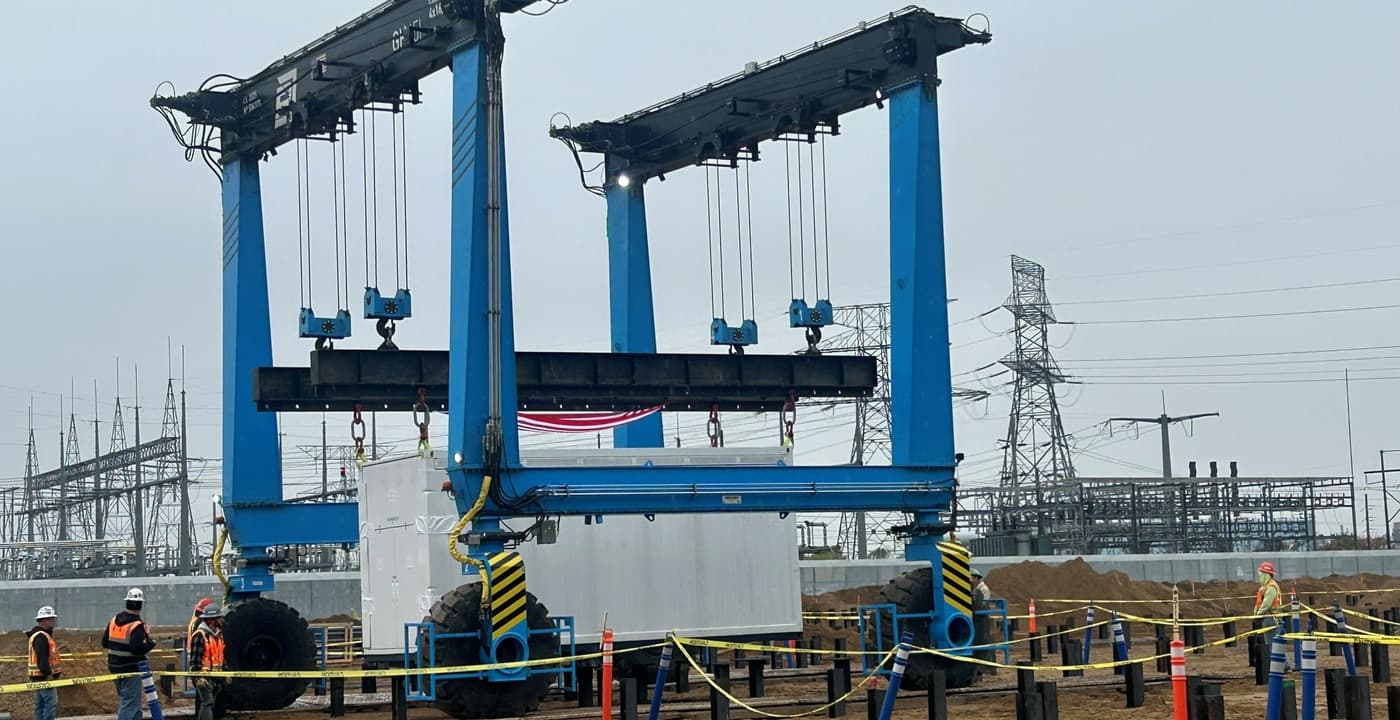
Battery equipment being moved at a substation site, from Xcel Energy's release on battery units arriving at Blue Lake. The release does not caption the image.
Image: Xcel Energy
Source · Press image from the Xcel Energy newsroom, used for news reporting.
Xcel Energy said on Oct. 28 that battery units have arrived at its Blue Lake battery storage site in Minnesota, a 135.5 MW facility that the utility expects to begin serving customers in 2027, according to Power Engineering.
The Blue Lake system will include 132 battery units able to store energy and deliver electricity for up to four hours, Power Engineering reported. It will hold energy generated across Xcel's Upper Midwest system, including wind, solar, nuclear and natural gas output.
Blue Lake is one piece of a larger build-out. Together with two planned projects in Becker, Minnesota, Xcel expects to operate more than 735 MW of battery energy storage in the state by the end of 2027. The utility says that would make it the largest battery portfolio in the Upper Midwest. That ranking is Xcel's own claim, not an independent count.
What four hours of storage means for the grid
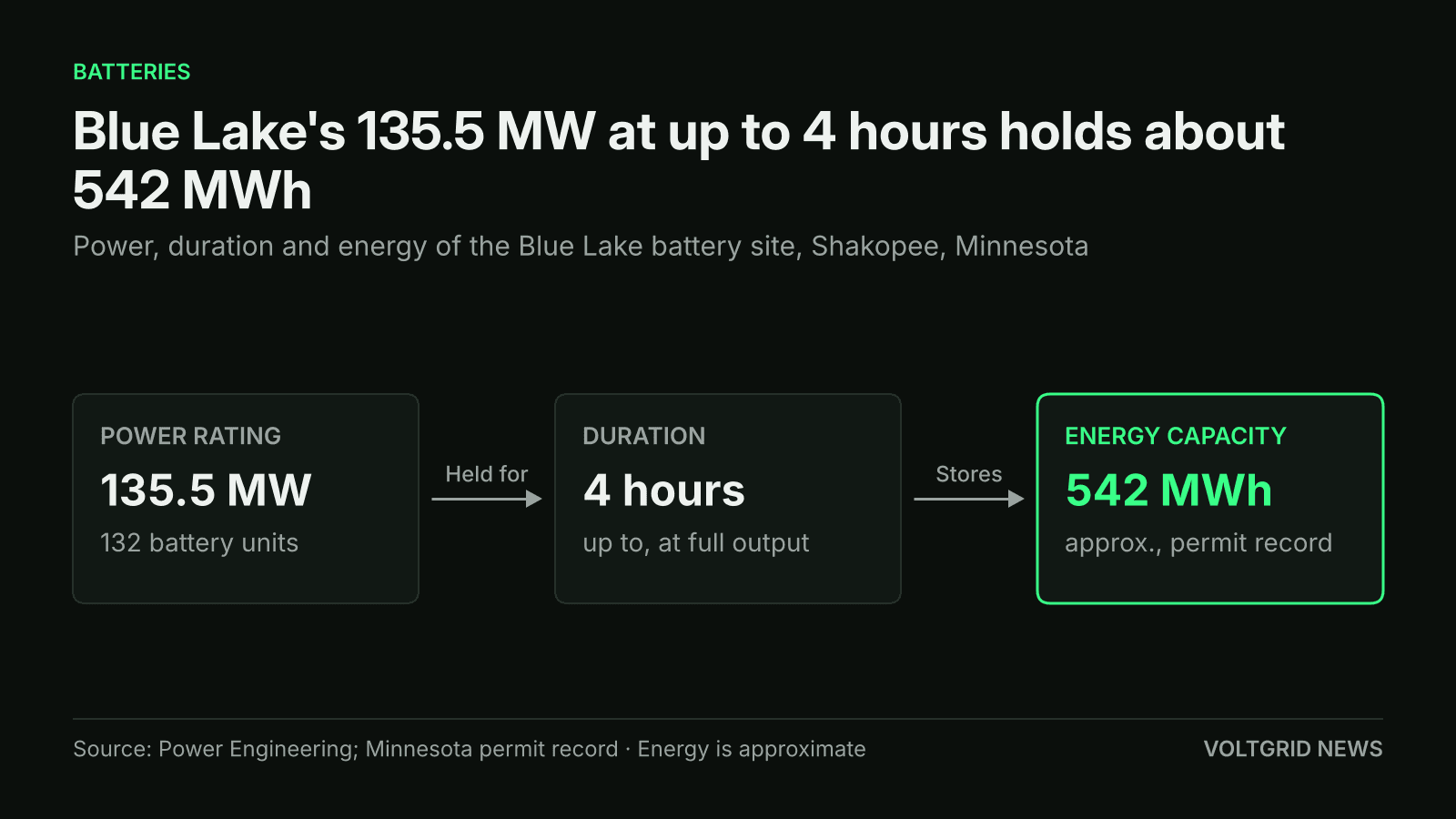
Blue Lake's roughly 542 MWh comes from the Minnesota permit record, while the 135.5 MW and four-hour figures come from Power Engineering.
Illustration (AI-generated)
A 135.5 MW system with up to four hours of duration can discharge for four hours at full output, which puts its energy capacity at roughly 542 MWh. That figure comes from a Minnesota administrative law record on the site permit for the Blue Lake project, which describes an up to 135.5 MW system with approximately 542 MWh of capacity near the existing Blue Lake substation in Shakopee, Scott County. Power Engineering's report gives power and duration but not the MWh figure.
Batteries at an existing generating site can reuse grid connections and other infrastructure, which Xcel cited as a reason such systems can now be placed more widely. Bria Shea, president of Xcel Energy for Minnesota, North Dakota and South Dakota, said storage lets the utility dispatch energy when it is needed most. For a utility serving growing load, a four-hour block moves midday solar and overnight wind into the evening peak without new generation.
The project sits inside a fast-growing market. Voltgrid News reported that BloombergNEF forecasts 188 GW of global energy storage additions in 2026, with the United States, China and Australia accounting for most installs. Xcel's Minnesota plan is small against those totals but typical of how utilities are adding multi-hour batteries beside existing plants.
What is not confirmed yet
Power Engineering did not say how many units have arrived, who supplied them, what cell chemistry they use or when commissioning tests begin. It also did not give the cost of Blue Lake or of the Becker projects. Xcel's 2027 date is an expectation, and the two Becker projects are still described as planned.
The next checkpoints are the installation and energizing of the full set of 132 units and the start of customer service in 2027. Whether Xcel reaches more than 735 MW in Minnesota by the end of 2027 depends on the Becker projects keeping to schedule.