EIA: 16% of New US Utility-Scale Solar in 2026 Has Co-Located Batteries
Over 16% of solar capacity added in 2026 through September pairs with battery storage, up from 2% in 2017, EIA said, and plans point to more than 30% for 2027 and 2028.
Energy & Cooling DeskEdited by Ege Erten
2 min readAI-assisted
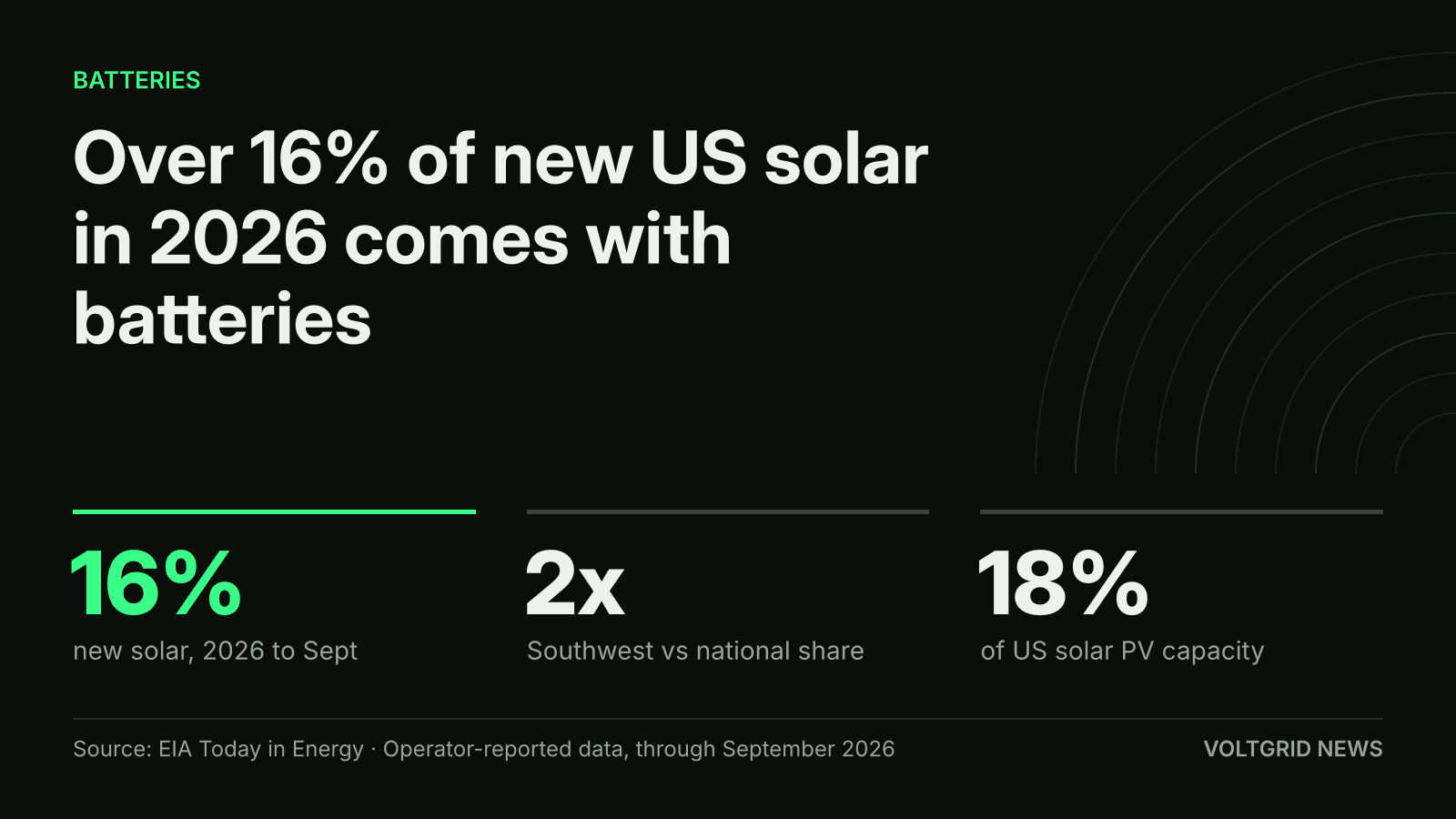
EIA data through September 2026: over 16% of new utility-scale solar capacity is co-located with operable battery storage.
Illustration (AI-generated)
The U.S. Energy Information Administration (EIA) said on Oct. 30 that over 16% of the new utility-scale solar capacity added in 2026 through September is co-located with operable battery storage, up from 2% in 2017. The figures come from data that operators report to the agency.
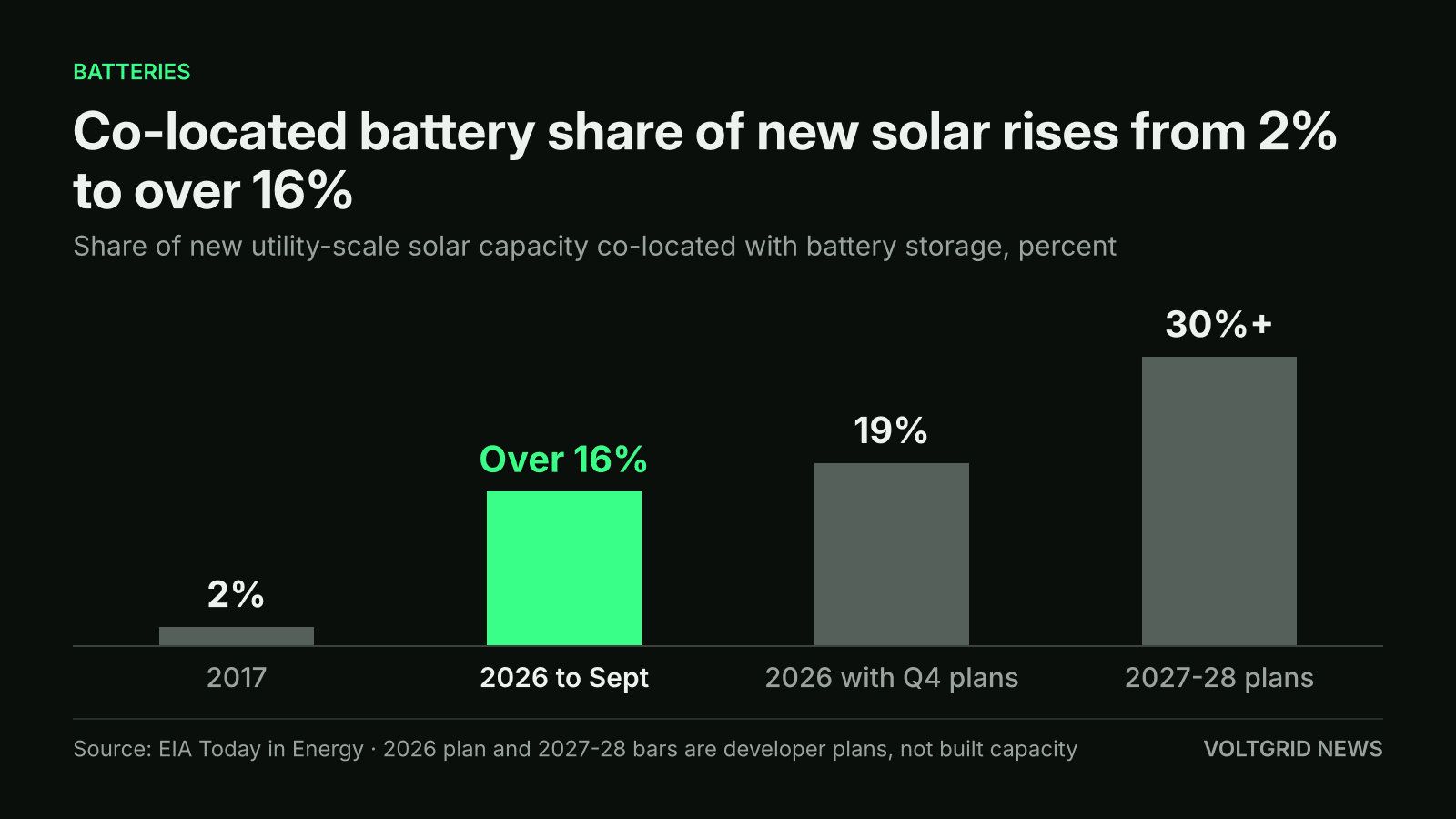
EIA: the 2026 Q4 and 2027-28 figures are developer plans, not built capacity.
Illustration (AI-generated)
EIA's Today in Energy note adds that plans for solar projects due online in the last three months of 2026 could lift the 2026 share to 19%. Plans submitted for 2027 and 2028 put the share at more than 30%. Those later numbers are developer plans, not built capacity, and EIA does not say how many of the planned projects will be completed on schedule.
Why developers pair solar with batteries
EIA explains the logic in terms of price. A plant with a battery can send solar output to the grid or to the battery, depending on wholesale prices. In regions with a lot of solar, prices tend to fall when solar output is high and rise as it fades, so a co-located plant can shift energy toward the hours when it is worth more and manage the combined output of its resources.
For grid operators and large-load planners, that shift matters in the evening, when solar output drops while demand stays high. Batteries are already visible in that window elsewhere: Voltgrid reported that batteries beat gas in Australia's evening peak in the third quarter, with 8% of supply against 5.1%. A rising share of co-located storage in the U.S. points the same way, although EIA's note gives capacity shares, not hours of discharge or MWh of storage.
Where the share is highest
EIA says the Southwest leads. As of September, 13% of total U.S. utility-scale generating capacity is solar photovoltaic, and 18% of that solar is co-located with battery storage. In California, Arizona, New Mexico and Nevada, the share of solar co-located with batteries is more than double the national average.
Storage is growing outside the Southwest too. Voltgrid reported earlier that ERCOT storage reached 33.1 GWh as summer prices fell 42%, though EIA's note does not break out Texas.
What is not confirmed yet
EIA's tracking relies on its EIA-860 and EIA-860M surveys, and the agency notes that solar and battery units at the same plant often enter commercial service at different times. The 16% figure is a share of capacity at plants where operable battery storage is reported alongside solar, so it says nothing about how large the batteries are.
The note does not give battery power in MW, energy in MWh, or the number of projects, so the scale of the storage behind the share is not stated. Readers who need that for a specific interconnection or data-center supply plan will have to go to EIA's unit-level inventory data, which the agency publishes.