Samsung SDI Q3 Profit Hits 407.8B Won as AI Data Centers Lift ESS
Samsung SDI's Q3 operating profit swung from a 591.3 billion won loss a year earlier, as ESS and backup batteries for AI data centers sold. It reports over 60 GWh of ESS orders, mainly US.
3 min readAI-assisted
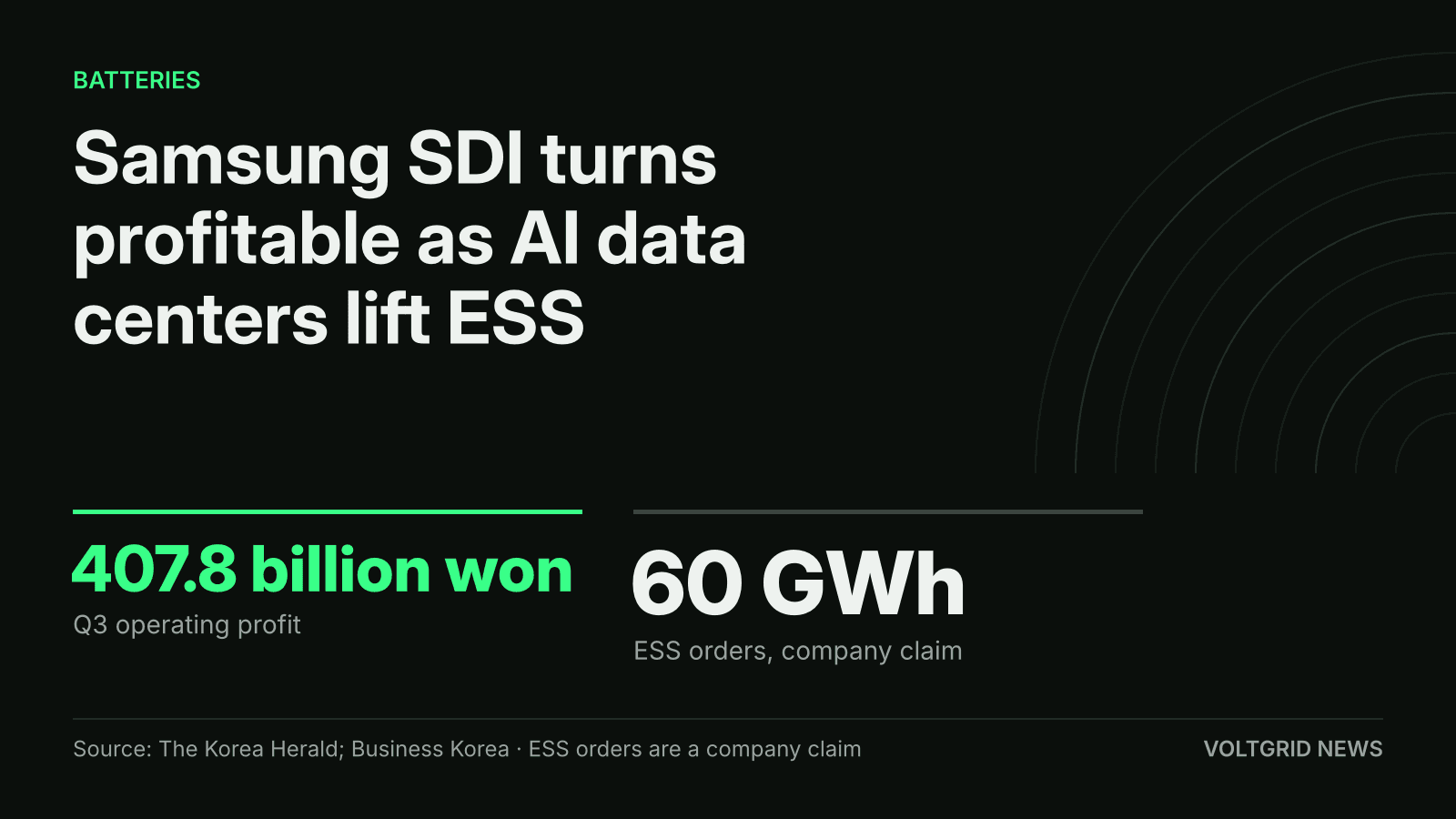
Samsung SDI's Q3 operating profit was 407.8 billion won; the 60 GWh of ESS orders is the company's own figure.
Illustration (AI-generated)
Samsung SDI reported a third-quarter (Q3) 2026 operating profit of 407.8 billion won (about $305 million, per The Korea Herald) on Oct. 29, as energy storage systems (ESS) and battery backup units for AI data centers lifted sales, against a loss of 591.3 billion won a year earlier.
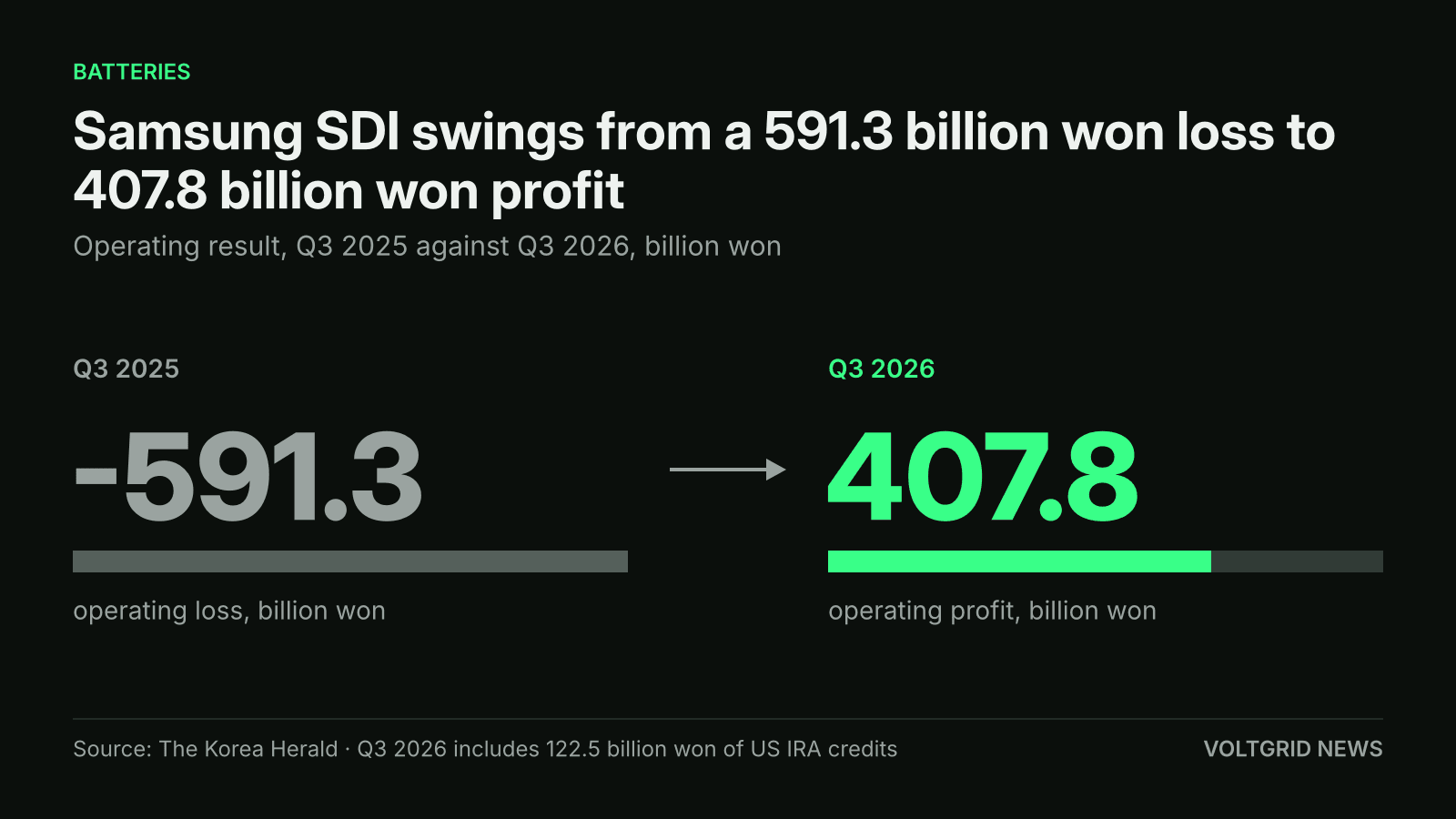
Samsung SDI moved from a 591.3 billion won operating loss to a 407.8 billion won profit; the latest quarter includes 122.5 billion won of US IRA credits.
Illustration (AI-generated)
Revenue rose 52.6% from a year earlier to 4.69 trillion won, according to the company's filing as reported by The Korea Herald and Business Korea. Operating profit nearly doubled from 203.8 billion won in the second quarter and was the highest since the third quarter of 2023, when it reached 496 billion won. Net income was 342.2 billion won. The battery unit carried the result: revenue of 4.41 trillion won, up 55.3%, and an operating profit of 361.9 billion won.
Samsung SDI said the gain came from ESS and backup battery sales as technology companies build AI data centers, plus higher sales of cylindrical cells for power tools and electric vehicles. Business Korea reported that the quarter included 122.5 billion won in US Inflation Reduction Act advanced manufacturing production credits, which the company now books in sales and other income. Part of the profit is therefore policy support, not only demand.
Orders that fill the lines through 2028
The order book is the number data-center and grid buyers should read. Cho Yong-hwi, head of Samsung SDI's ESS business team, said on the earnings call that the company has secured more than 60 gigawatt-hours (GWh) of ESS orders through October, mainly in the US, according to Business Korea. On that basis, the StarPlus Energy plant in the US and the Ulsan lines in Korea have enough volume to run at full capacity through 2028, he said. The company aims to sign contracts for production from 2029 onward by the end of the year.
For buyers, that means US-made ESS cells are largely allocated for the next two years. The company plans to turn the Synergy Cells plant in Indiana into an ESS production base in stages, but Business Korea reported the target for mass production there is the second half of 2028 or early 2029, so it adds little near-term supply.
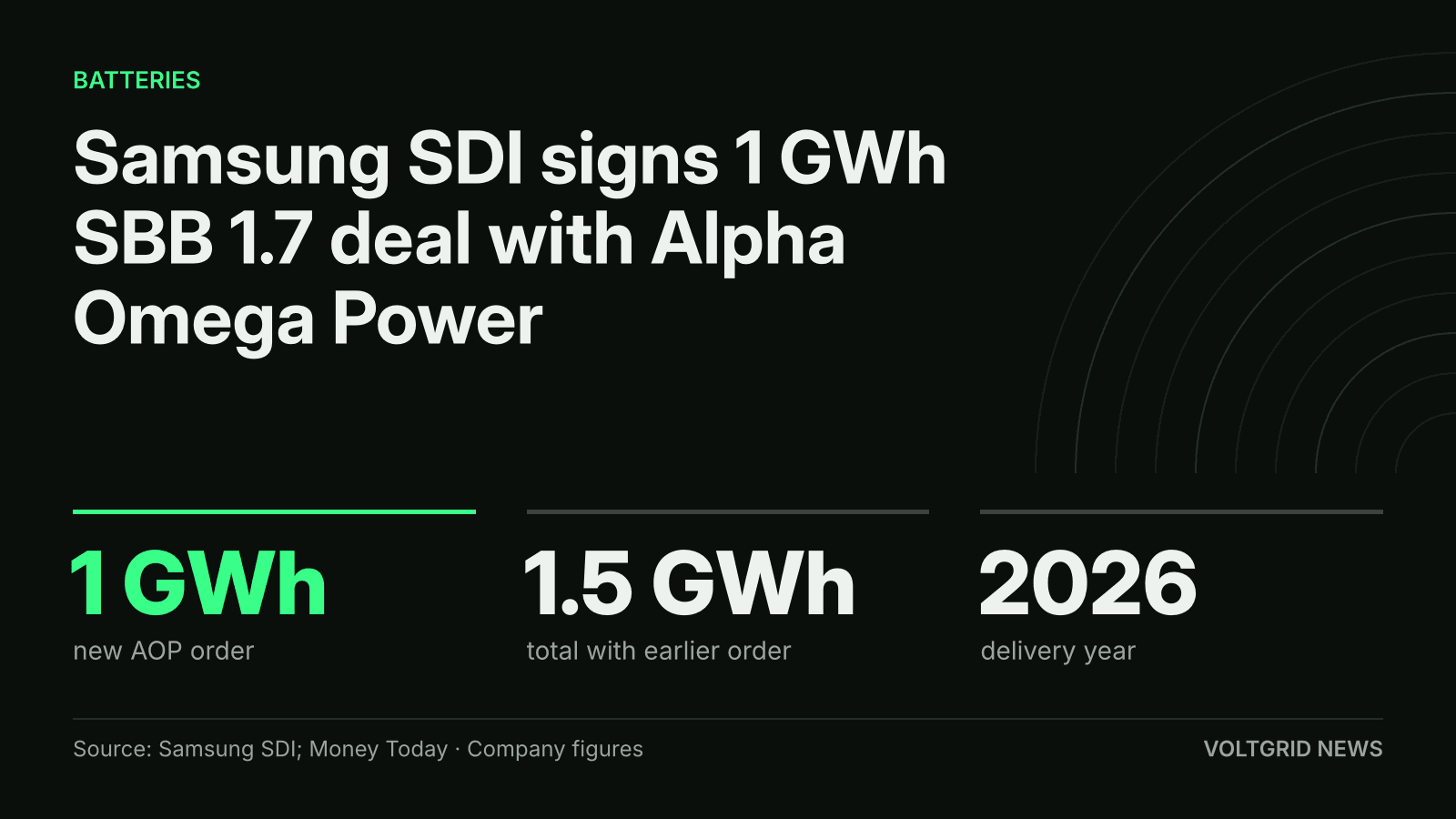
The nearer-term capacity is lithium iron phosphate (LFP). Samsung SDI began mass production of high-capacity prismatic LFP cells at StarPlus in early October, with shipments from mid-October, according to Business Korea. It plans to deliver finished Samsung Battery Box (SBB) ESS products from December and to convert two more US lines, bringing them online from the first half of next year. Voltgrid covered the third US LFP line at StarPlus and the 1 GWh Alpha Omega Power deal earlier this month; the order figure above is the company-wide backlog those deals sit inside.
Backup batteries and solid-state
The AI data-center link runs through two products. Besides large ESS, the company unveiled cylindrical LFP cells for battery backup units, which keep servers running through a power loss, and said it will expand supply to existing global cloud service provider customers, per the Seoul Economic Daily and The Korea Times.
On next-generation cells, Cho Han-jae, who heads battery strategic marketing, told the call that Samsung SDI has supplied all-solid-state cell and pack samples for humanoid robots since September and is targeting commercialization in the second half of next year, The Korea Herald reported. Customers are still evaluating those samples, so they are not production cells.
What is not confirmed yet
Samsung SDI said it expects to stay profitable in the fourth quarter. It has not published customer names for the 60 GWh, and the long-term supply contracts for utility-scale ESS and uninterruptible power supply (UPS) systems are still under negotiation, with the company aiming to finalize them this year, according to the Seoul Economic Daily. It also said US EV demand will stay weak for some time, so the ESS mix, not cars, is what the profit depends on. Dollar conversions of the won figures differ between outlets, from about $285 million to $305 million.