Hemispherical Perovskite Solar Cell Hits 95% Absorption in Simulation
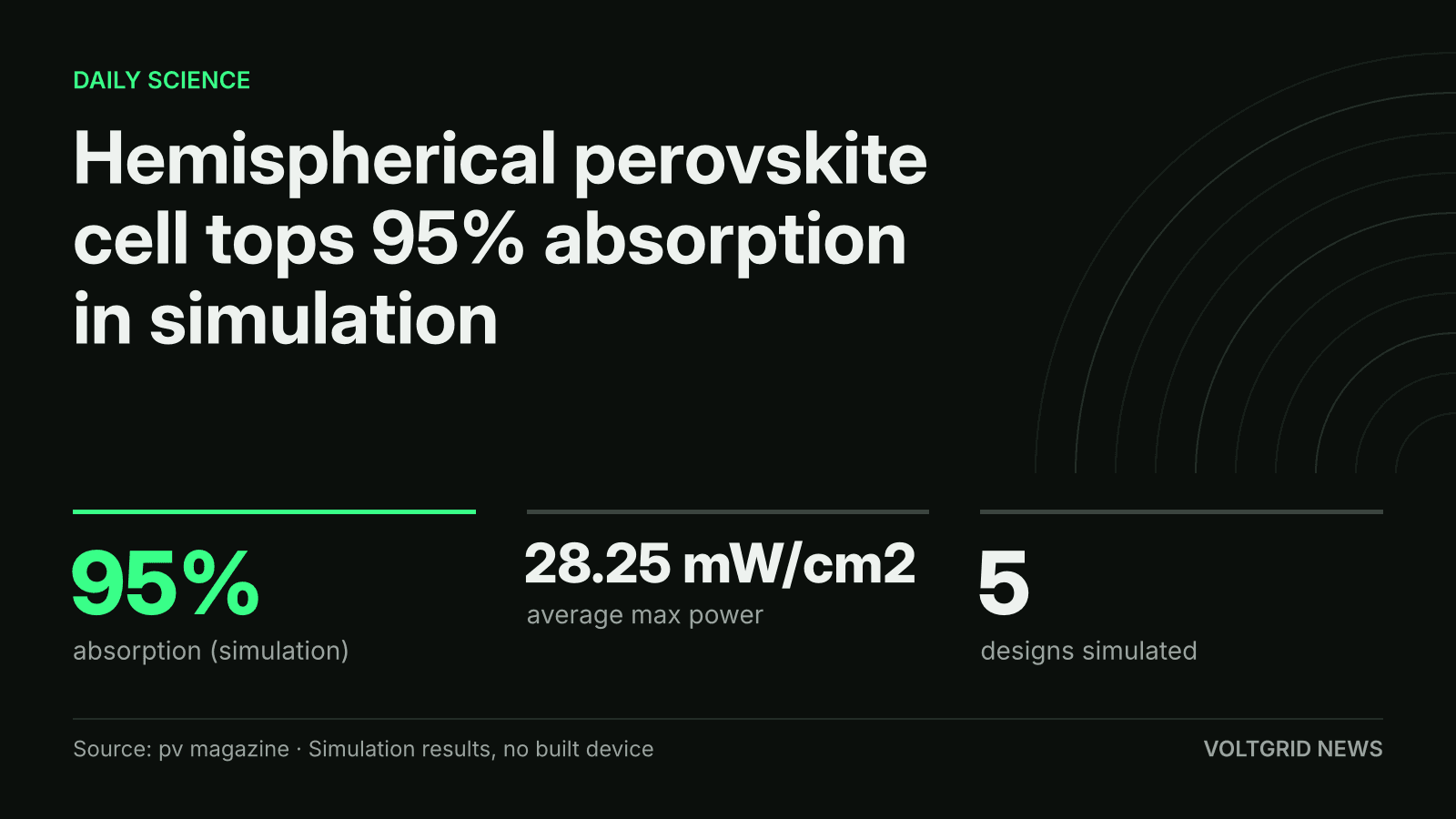
A hemispherical perovskite solar cell modeled by Chinese researchers averaged 28.25 mW/cm² across sun angles of 0° to 50°, pv magazine reported on October 23. No built device is reported.
2 min readAI-assisted
Simulated results for a hemispherical perovskite solar cell design, as reported by pv magazine. No built device has been reported.
Illustration (AI-generated)
A research team in China has proposed a hemispherical perovskite solar cell designed to hold its simulated output steady as sunlight moves from straight-on to a 50-degree angle, pv magazine reported on October 23.
In the simulations, the best design absorbed more than 95% of incoming light and averaged a maximum power output of 28.25 mW/cm² across incidence angles from 0° to 50°. No physical device has been reported. These are modeled results.
Why the angle matters
The researchers say conventional flat perovskite cells lose light when the sun is off-axis, so their energy yield varies with the angle of incidence, which undermines their value for renewable power. Perovskites are a family of crystal materials that absorb light well and can be made cheaply.
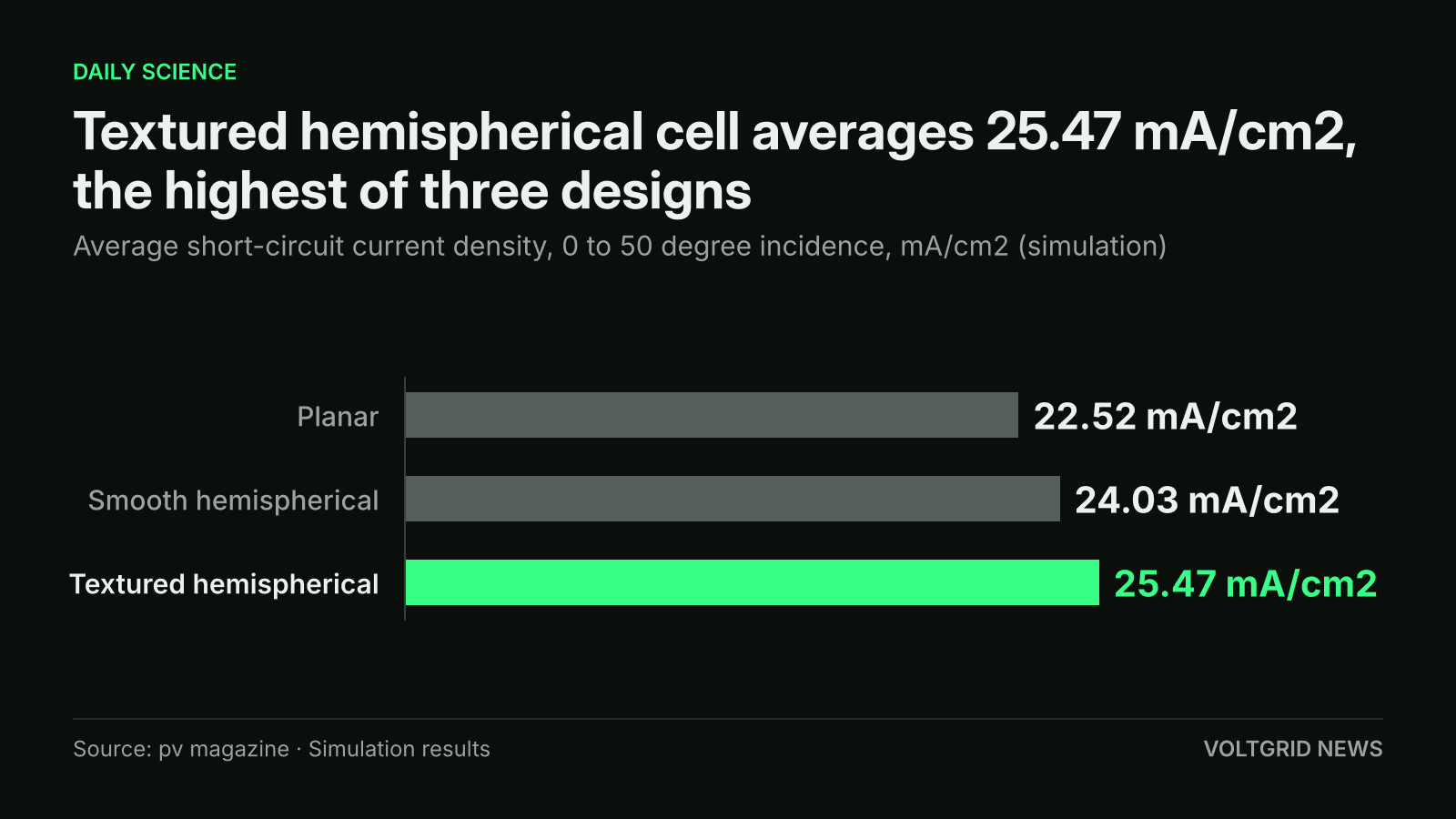
The proposed fix is shape. A hemispherical cell is symmetric in three dimensions, which the authors say balances how charge is collected. A textured outer surface scatters light in many directions to raise absorption. The authors also credit Mie resonances, a light-trapping effect in small structures, inside the perovskite shell.