INRS Light Pulse Suggests Pseudogap Competes With Superconductivity
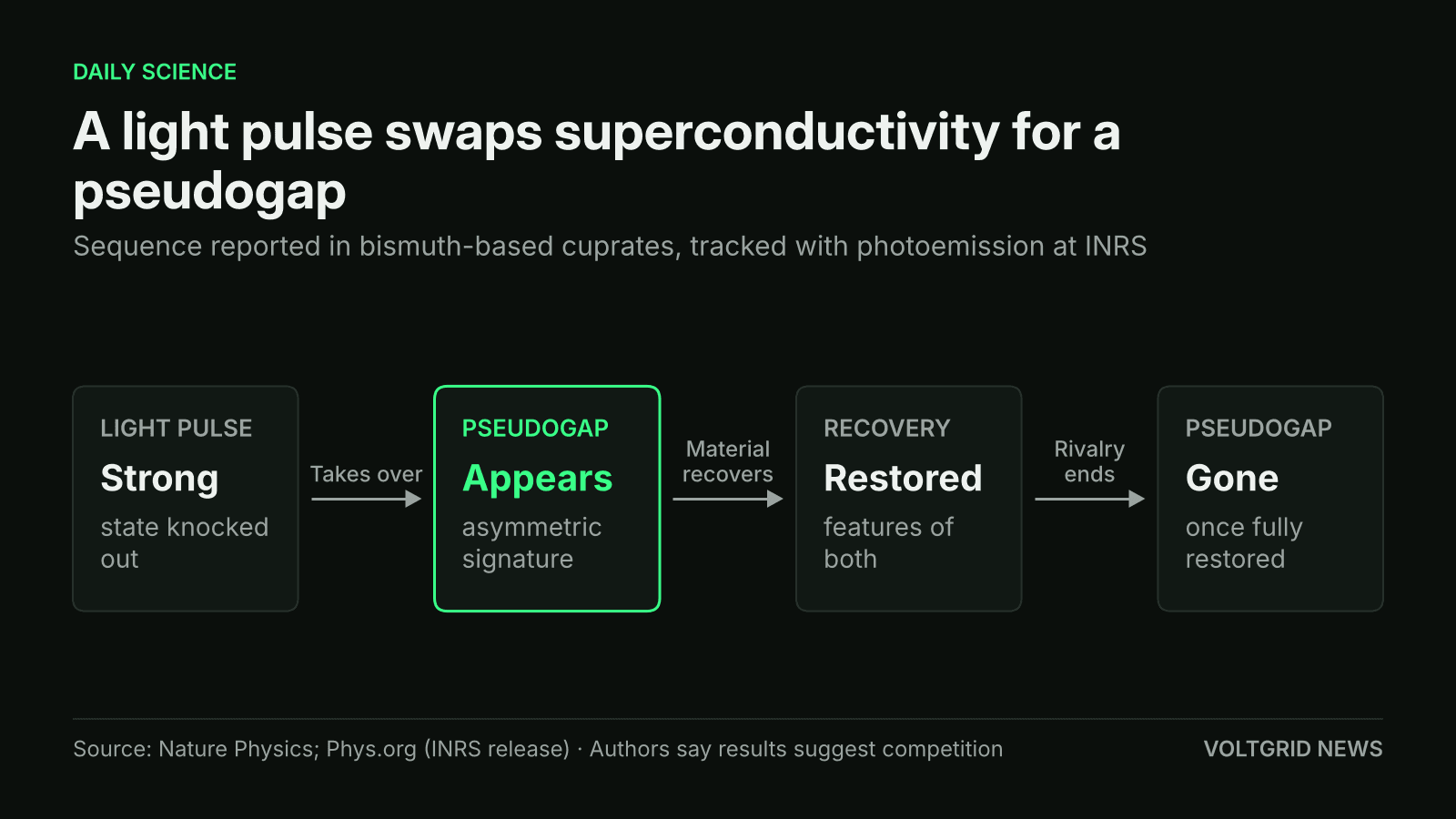
INRS physicists briefly suppressed superconductivity in a copper-oxide material with laser light and saw a pseudogap appear, then fade as it returned. The work is fundamental research and names no timeline.
1 min readAI-assisted

The INRS team's Nature Physics paper builds on cuprates, the copper-oxide superconductors discovered in 1986.
Illustration (AI-generated)
Physicists at Canada's INRS research institute have used a pulse of light to suppress superconductivity in a copper-oxide material and watched a competing quantum state, the pseudogap, take its place, according to a Nature Physics paper published Oct. 20.
The group, led by Fabio Boschini with first author Dario Armanno, worked with Olivier Gingras of the Flatiron Institute's Center for Computational Quantum Physics in New York. They used time- and angle-resolved photoemission spectroscopy at INRS's Advanced Laser Light Source. The technique tracks the material's electronic response in real time after a light pulse.
What the Experiment Saw in Cuprates
In optimally doped bismuth-based cuprates, a laser pulse of high enough strength disrupted superconductivity. The material's electron signature changed from a symmetric, superconducting-like shape to an asymmetric, pseudogap-like one, the paper reports. This happened at electronic temperatures well below the temperature at which the material normally stops superconducting.