Hyundai Engineering Signs Reactor MoUs With NANO Nuclear (15 MWe), ARC (100 MWe)
Hyundai Engineering signed MoUs with NANO Nuclear on its 15 MWe-rated KRONOS in Illinois and with ARC on the 100 MWe ARC-100, World Nuclear News reports; no contract value, work package or date is given.
3 min readAI-assisted
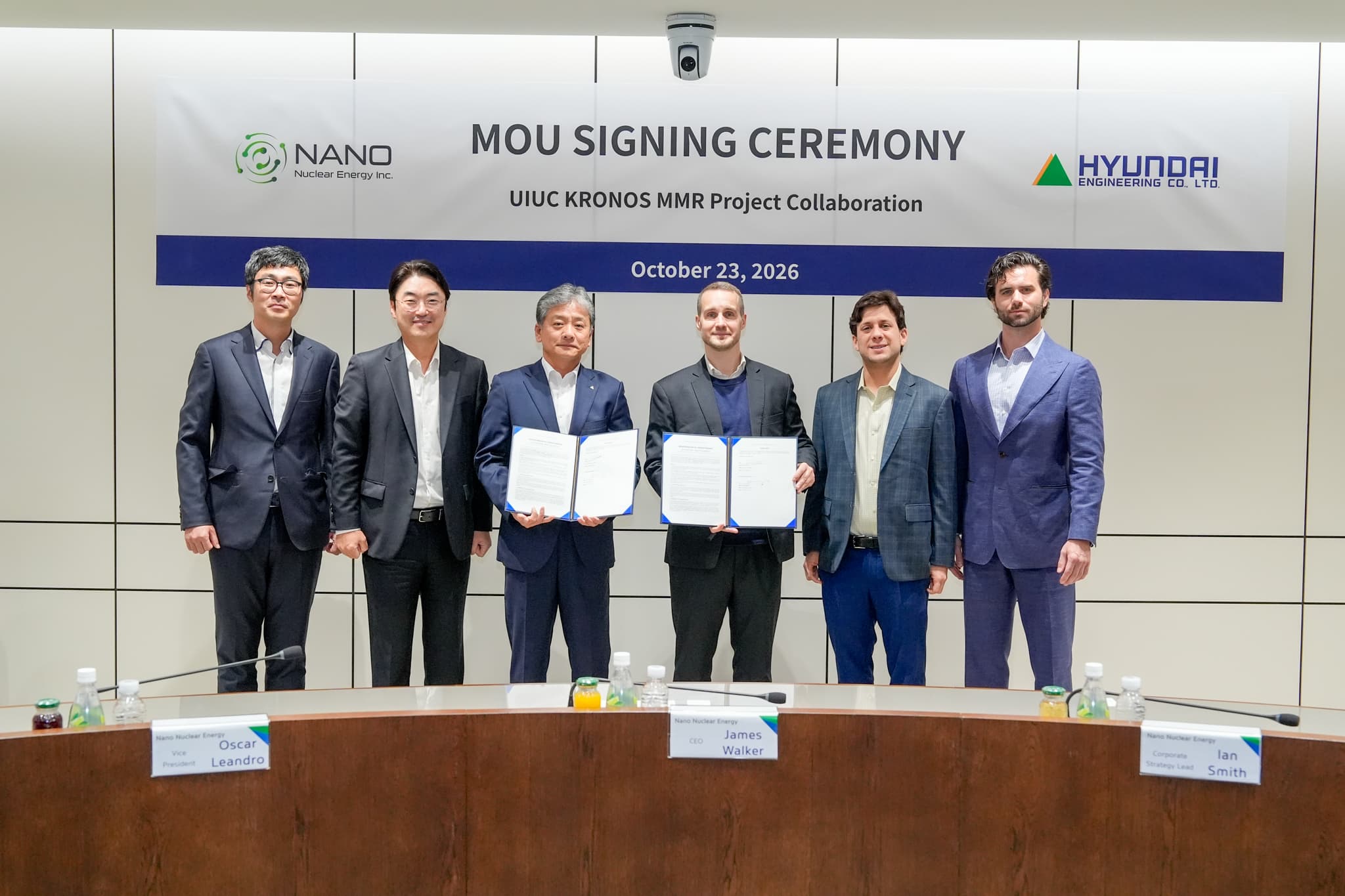
NANO Nuclear Energy and Hyundai Engineering mark their MoU on the KRONOS micro modular reactor project at the University of Illinois Urbana-Champaign.
Image: NANO Nuclear Energy
Source · Press image from the NANO Nuclear Energy website, used for news reporting.
Hyundai Engineering, the South Korean engineering and construction firm, has signed memorandums of understanding with US advanced-reactor developers NANO Nuclear Energy and ARC Clean Technology, according to World Nuclear News, which reported the deals on Oct. 28 after the companies announced them on Oct. 27.
The NANO Nuclear agreement is a framework for possible collaboration on the KRONOS micro modular reactor planned at the University of Illinois Urbana-Champaign. KRONOS is a high-temperature gas-cooled reactor rated at 45 MW thermal and 15 MW electrical, using TRISO fuel in prismatic graphite blocks. The University of Illinois Urbana-Champaign, with NANO Nuclear as partner, submitted the construction permit application for the Illinois unit on 31 March 2026, and the NRC accepted and docketed it in May.
Neither MoU is an order. The parties said any larger role for Hyundai Engineering depends on technical and commercial evaluation, the university's and regulators' requirements, and separate definitive agreements. World Nuclear News reports no work package, funding commitment or contract value.
What Hyundai Engineering could do on KRONOS
The first phase is planning work: project-execution planning, site-related and conventional construction, procurement readiness, constructability, modularisation, logistics and US supply-chain planning for the Illinois project. NANO Nuclear said it wants to keep clear interfaces with the university, existing expected contractors and public-procurement rules.
If the evaluation goes well, the role could grow to architecture and engineering, procurement, full engineering-procurement-construction (EPC), construction management and component fabrication, and could extend to a future KRONOS fleet. The MoU also covers evaluating other NANO Nuclear projects in the US, plus balance-of-plant support for industrial heat, hydrogen, desalination and maritime uses, according to World Nuclear News.
The ARC-100 MoU
Hyundai Engineering also signed an MoU with ARC Clean Technology, developer of the 100 MWe ARC-100, a sodium-cooled fast reactor. In August, ARC signed a framework agreement with Battelle Energy Alliance, which runs Idaho National Laboratory (INL), aimed at a first-of-a-kind ARC-100 at the site. That project is a planned commercial demonstration plant of about 200 MWe, and ARC is considering growing it to around 600 MWe, according to World Nuclear News.
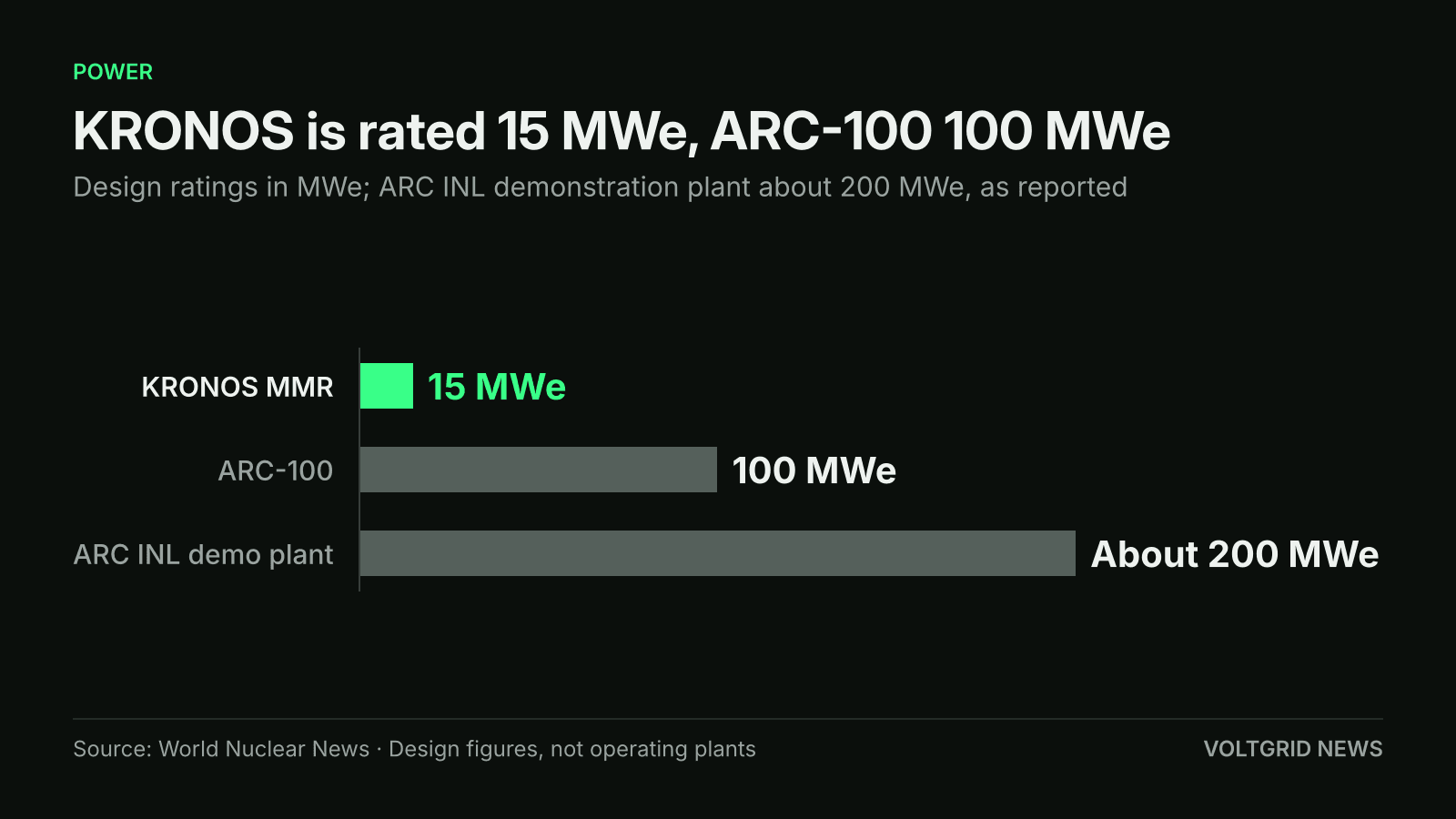
KRONOS is rated 15 MWe and the ARC-100 100 MWe; these are design figures, and the ARC INL demonstration plant is reported at about 200 MWe.
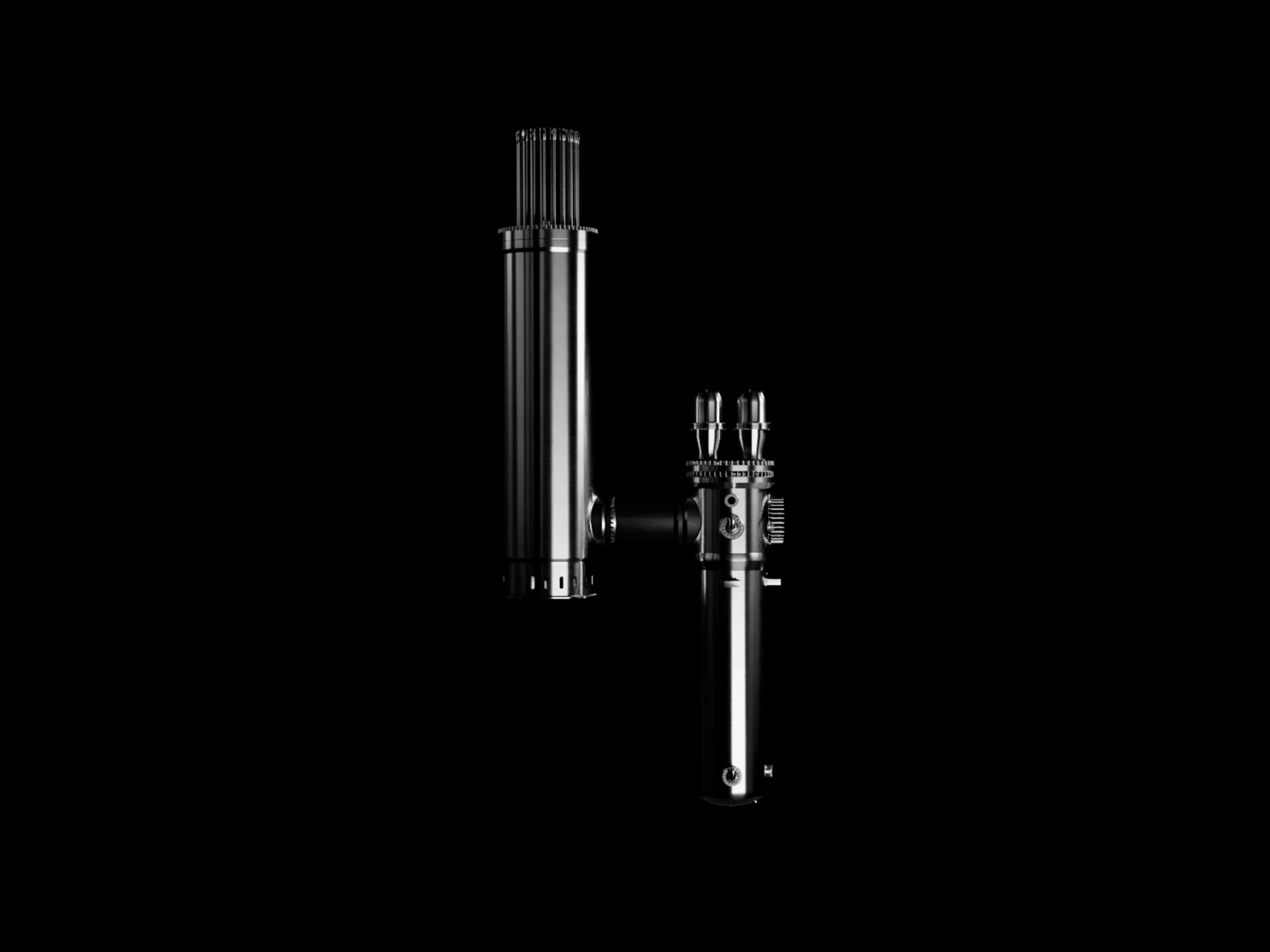
Illustration (AI-generated)
Why it matters for power supply
Both designs are small reactors aimed at sites with a defined load, the class of supply that microreactors and small modular reactors (SMRs) represent in data-center power planning. But the Illinois KRONOS unit is a research reactor on a campus, and the ARC-100 plant is a demonstration. Neither MoU names a data-center customer or a delivery date, so none of this adds supply yet.
What the deals add is execution capacity. Hyundai Engineering says it has carried out 254 nuclear projects since 1985, including 145 designs for operating plants and six SMR technology development projects. For developers, an EPC partner with that record is a supply-chain step, and as Voltgrid reported, NANO Nuclear is also lining up manufacturers to vet 15-MWe KRONOS parts.
How a high-temperature gas reactor works
In a high-temperature gas-cooled reactor such as KRONOS, gas rather than water carries the heat out of the core, World Nuclear News reports. The design's two ratings measure different things: 45 MW thermal is the heat the core produces, and 15 MW electrical is what can reach the grid or a customer.
That gap is why the 15 MWe design figure matters more for power supply than the 45 MWt. The Illinois unit is docketed with the NRC as a research reactor, so it is a test of the design rather than a commercial supply source.
What is not confirmed yet
No definitive agreement, price, schedule or work scope has been published for either MoU. The US Nuclear Regulatory Commission has not issued a construction permit for the Illinois reactor; NANO Nuclear estimates the review will finish in 2027, a company estimate rather than an NRC commitment.