Nano Nuclear Signs 3-Year IMPSA Deal to Vet 15-MWe Kronos Parts
NANO Nuclear's Oct. 21, 2026 engineering agreement with IMPSA's US arm starts with an estimated six-month review of Kronos parts, led by the pressure vessel. No order, value or delivery date is disclosed.
3 min readAI-assisted
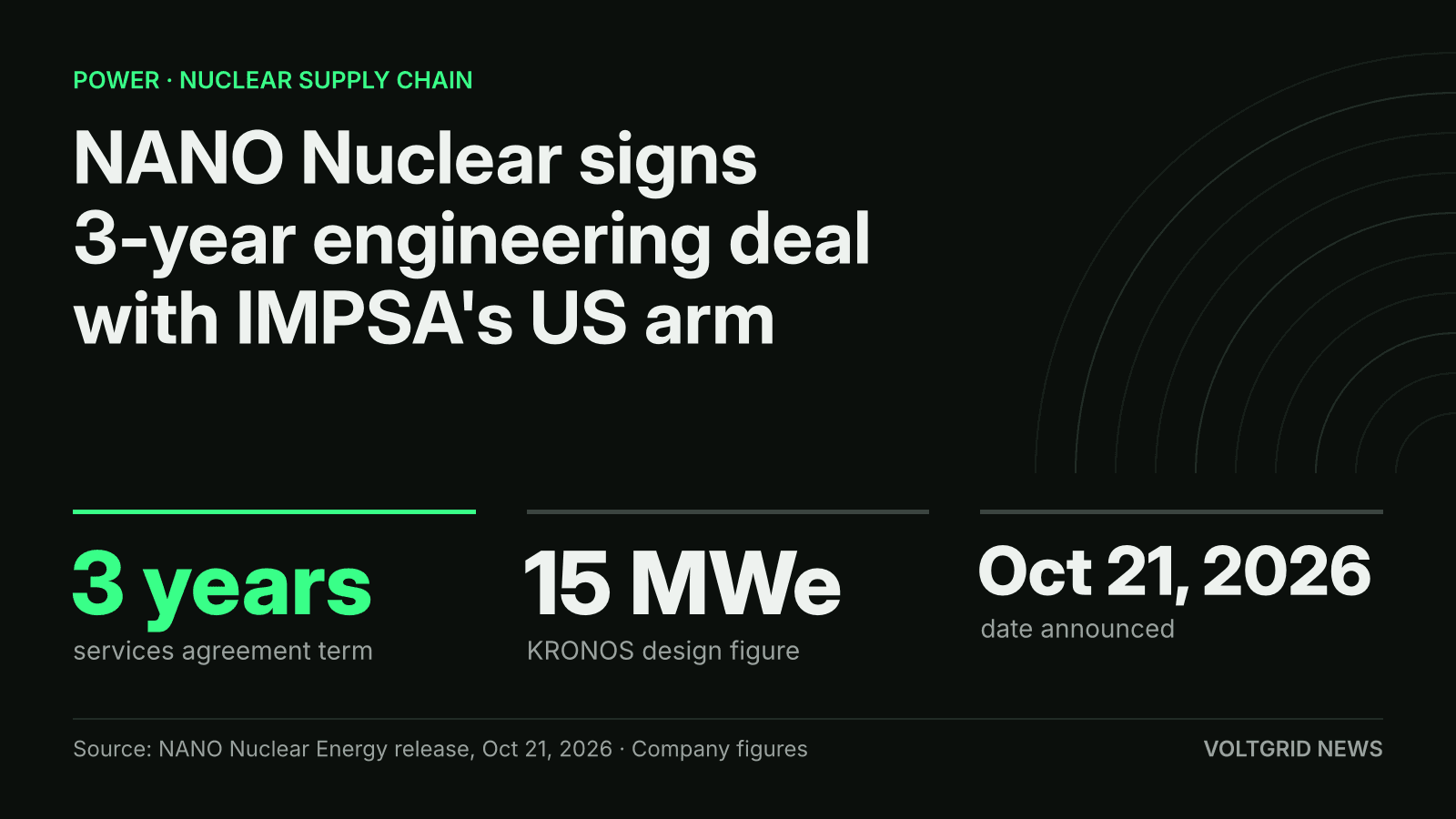
The agreement is an engineering services framework, not a supply contract, NANO Nuclear said in its Oct. 21, 2026 release.
Illustration (AI-generated)
NANO Nuclear Energy said on Oct. 21, 2026 it signed a three-year engineering services agreement with the US arm of Argentina's IMPSA for design-for-manufacture work on its KRONOS microreactor, a 15-MWe design.
The first task is a design review and manufacturability feasibility study that NANO estimates at six months, supported by a retainer. IMPSA will check KRONOS components against Section III of the American Society of Mechanical Engineers (ASME) Boiler and Pressure Vessel Code, which covers nuclear components, with the reactor pressure vessel as the principal component under evaluation, according to the company's press release. NucNet carried the news on Oct. 23.
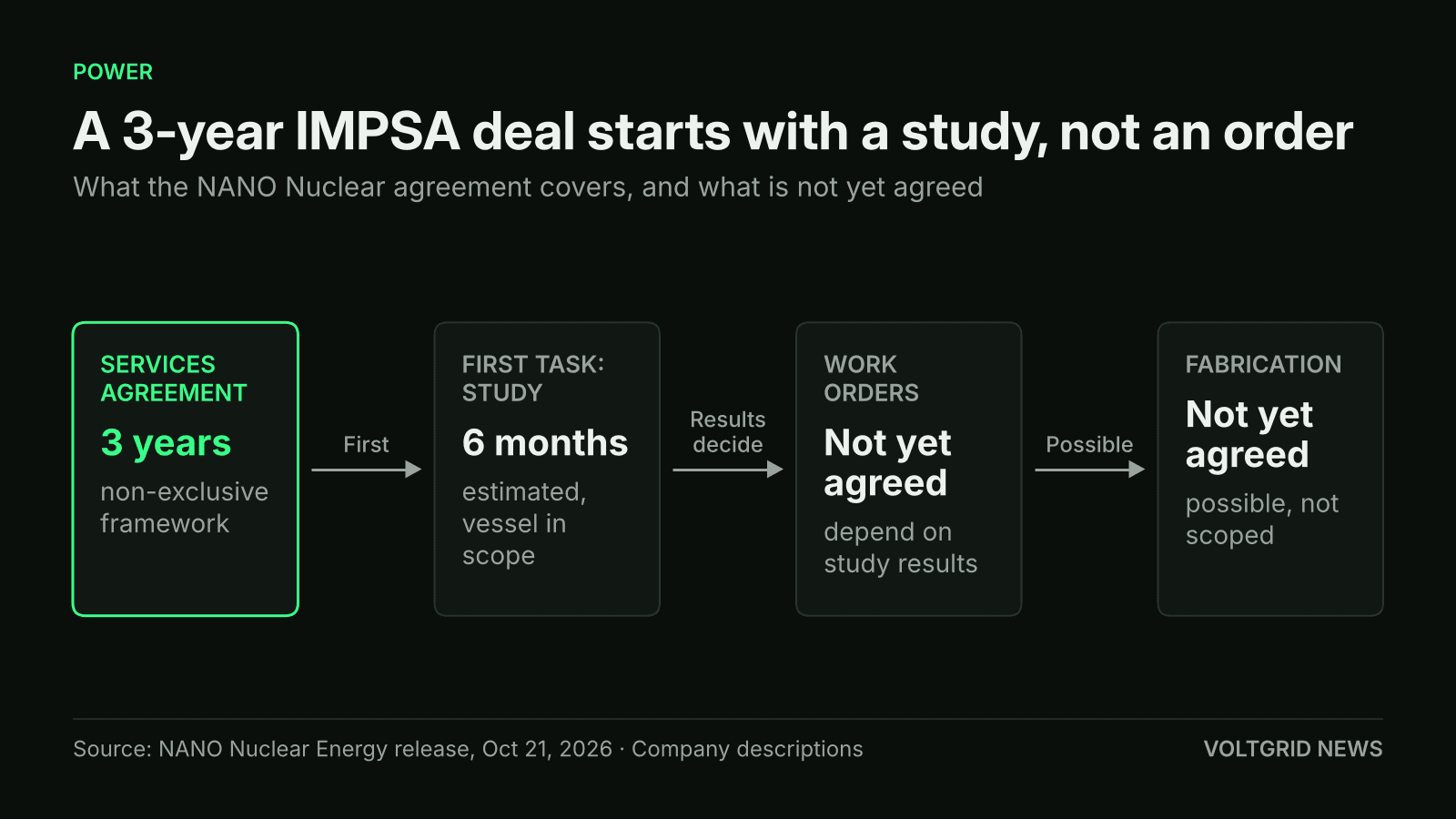
The 3-year framework starts with an estimated 6-month study; work orders and fabrication depend on its results, NANO Nuclear said.
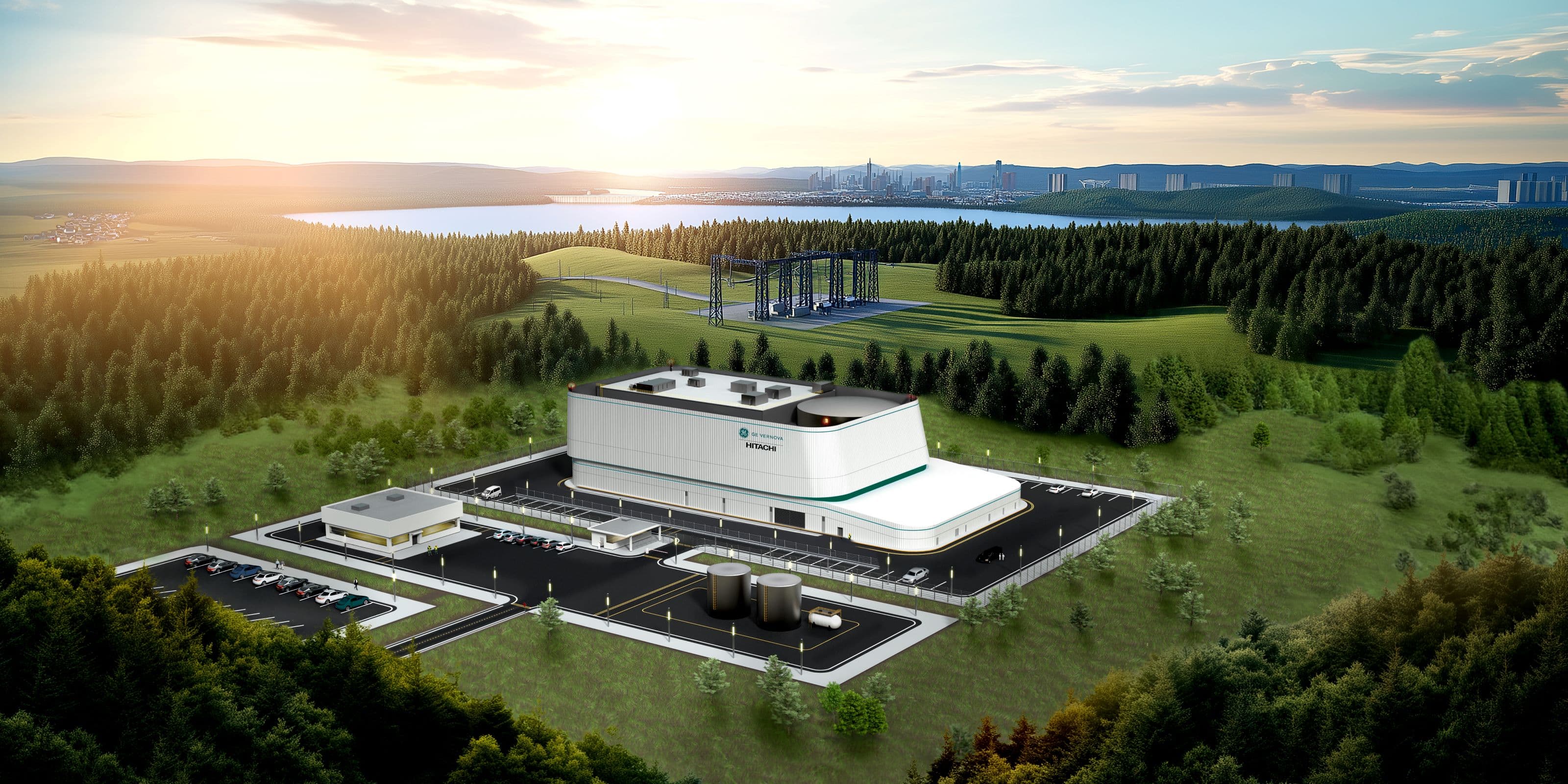
Illustration (AI-generated)
A microreactor can serve a data-center campus only if its heavy parts can be built repeatedly to nuclear code, and this study tests that before any order exists. NANO chief executive James Walker said the aim is to turn drawings and calculations into modular components that can be manufactured, inspected and qualified. The release adds no capacity: it gives no contract value, retainer size, component count or delivery schedule, and names no data-center customer.
What the agreement is, and what it is not
This is an engineering services agreement, not a supply contract or a purchase order. NANO said it is non-exclusive, and that fabrication, regional projects or other commercial work beyond the initial engineering depend on the study results, regulatory requirements and, where required, further work orders or definitive agreements. Reactor cavity cooling, spent-fuel storage and other reactor and transport components were named only as possible areas of collaboration.
KRONOS: design figures, licensing and the Tillman framework
KRONOS is a high-temperature gas-cooled reactor that uses helium coolant and TRISO (tristructural isotropic) fuel and would pass heat to a molten-salt thermal energy storage system. NANO's 15 MWe is a design figure that the sources do not label net or gross; the NRC's project page lists 45 MWth of thermal power. X-energy rates each Xe-100 module at 80 MWe, as Voltgrid reported, so a KRONOS site needs more modules for the same electric output.
The licensing record is separate from the IMPSA deal. The University of Illinois Urbana-Champaign, not NANO, applied for a construction permit for a KRONOS research reactor in Champaign County on Mar. 31, 2026, and the NRC docketed the application on May 18, 2026. Docketing means accepted for review, not approved, and the university would still need an operating licence. The NRC targets a final environmental assessment in May 2027 and a final safety evaluation in September 2027, and NANO expects to begin construction in the second half of 2027.
On Aug. 24, 2026, NANO announced a non-binding Strategic Commercial Framework with Tillman Global Holdings and its data-center platform, Tillman Digital Gateway. It names NANO as Tillman's anticipated preferred nuclear technology provider. The parties aim for 2 GW or more of advanced nuclear by the mid-2030s, rising to 6 GW or more by 2040, but only through definitive agreements, customer commitments, financing and regulatory approvals. Most of the contemplated warrants, for up to $100 million of NANO stock, would vest only on future binding reactor purchase commitments.
What is not confirmed yet
The release does not give the agreement's value or the study's start date, and it treats fabrication as a possible later step. The Tillman release does not say whether its 2 GW and 6 GW targets are electric or thermal. The NRC dates are targets, and the application covers a university research reactor, not a data-center plant. The next dated checkpoint is the NRC's February 2027 target for the draft safety evaluation and draft environmental assessment.