India Cabinet Approves Rs 14,500 Crore VGF for 92 GWh Grid Storage
India's Union Cabinet approved Rs 14,500 crore of viability gap funding on Nov. 4 for 92 GWh of grid storage, adding 60 GWh of pumped hydro to earlier battery-only rounds.
Policy & Economics DeskEdited by Ege Erten
2 min readAI-assisted
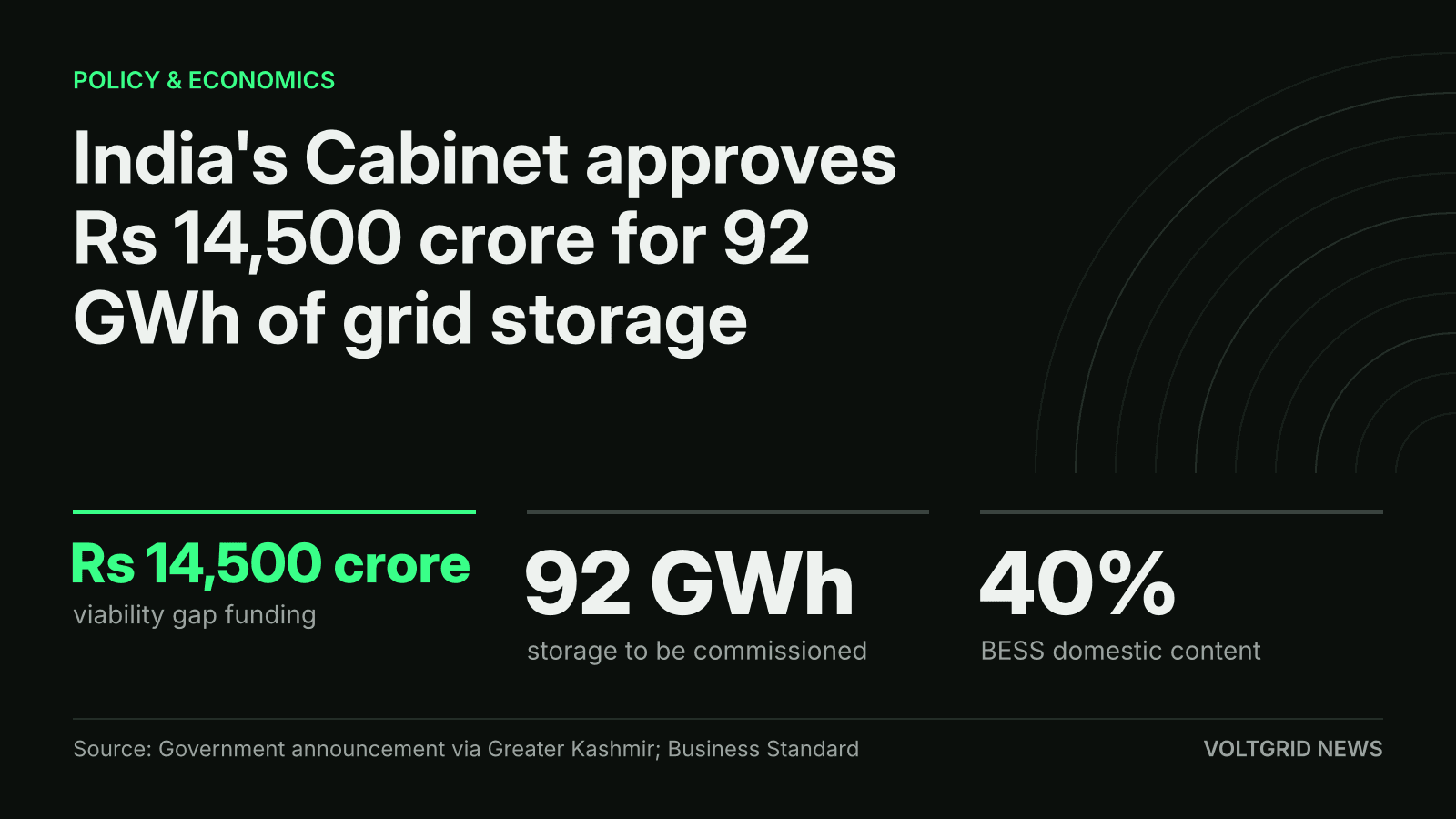
India's Union Cabinet approved Rs 14,500 crore of viability gap funding for 92 GWh of grid-scale storage on Nov. 4.
Illustration (AI-generated)
India's Union Cabinet approved a Rs 14,500 crore Viability Gap Funding (VGF) scheme on Nov. 4 to support 92 GWh of grid-scale energy storage that is yet to be commissioned, with money flowing over FY2026-27 to FY2030-31.
The government's announcement, as published by Greater Kashmir, splits the 92 GWh into 60 GWh of hydro pumped storage plant (PSP) capacity, 30 GWh of battery energy storage systems (BESS) and 2 GWh of alternative storage technologies. It puts the total estimated investment at Rs 97,600 crore. Information and Broadcasting Minister Ashwini Vaishnaw briefed the decision, Business Standard reported. Voltgrid arithmetic: the VGF covers about 14.9% of that estimated investment, so developers and distribution companies carry the rest.
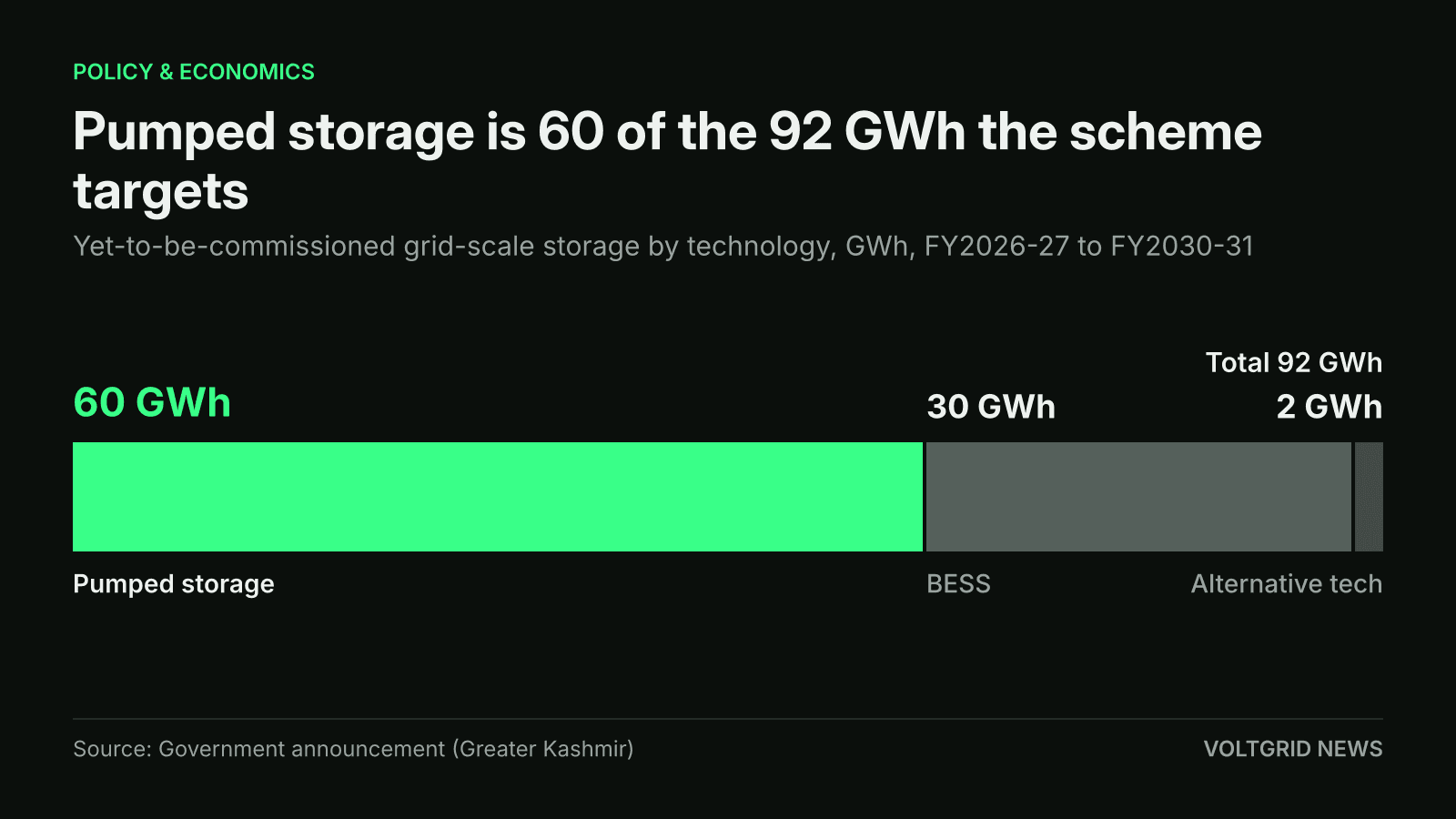
Pumped storage accounts for 60 GWh of the 92 GWh target, per the government announcement; the split of the Rs 14,500 crore by technology is not stated.
Illustration (AI-generated)
The announcement says the new capacity equals 170% of India's present grid-scale storage and would help meet a required 411 GWh by 2031-32. Capacity will be allocated through tariff-based competitive bidding. Public and private distribution companies (discoms) can claim VGF for BESS and PSP projects, while alternative-technology projects will be run by public and private entities.
Domestic content rule for batteries
BESS projects must meet a minimum Domestic Content Requirement (DCR) of 40%, which the announcement says is meant to complement existing supply-side incentives for battery manufacturing. Mercom India's manufacturing report found a 20% local-content requirement on VGF-backed projects, and noted that eligible downstream components can meet it without domestic cells, as Voltgrid reported. The 40% figure is double that earlier threshold, though the announcement does not say which components count.
How it compares with earlier VGF schemes
The 2023 battery scheme had an initial outlay of about Rs 9,400 crore, including Rs 3,760 crore of budgetary support, for 4,000 MWh of BESS by 2030-31, with support of up to 40% of capital cost and at least 85% of capacity reserved for discoms, according to All India Radio's report of the Cabinet briefing. The second tranche, announced by the Ministry of Power in 2025, was Rs 5,400 crore for 30 GWh at Rs 18 lakh per MWh, funded from the Power System Development Fund, pv magazine India reported.
The battery target of 30 GWh matches that 2025 tranche. What is new is 60 GWh of pumped storage, plus the 2 GWh for emerging technologies, under one scheme that covers three technologies; both earlier rounds, as reported, covered batteries only.
What is not confirmed yet
None of the reports gives the VGF rate per MWh or GWh for BESS or PSP, or how the Rs 14,500 crore divides between technologies. The first bidding dates are also unstated. The figures here come from Business Standard and the government announcement text published by Greater Kashmir. One headline in the Indian press cited Rs 17,500 crore, but both of those reports give Rs 14,500 crore.
Sources
- 01Cabinet clears Rs 14,500 cr funding scheme for battery energy storage systemsBusiness Standard · business-standard.com
- 02Cabinet approves Rs 17,500 crore scheme to promote grid-scale energy storage systemGoogle News · storage · news.google.com
- 03Centre clears Rs 14,500-crore scheme to develop 92 GWh grid-scale energy storage capacityGreater Kashmir · greaterkashmir.com