Chips · Oct 18, 2026, 16:54
Intel's new AI card trades top speed for lower power
Intel's GPU D270, the first card from its Crescent Island project, is slower on paper than AMD's rival but uses far less power and needs no liquid cooling. There is still no launch date or price.
Illustration (AI-generated)
An air-cooled accelerator card in a server.
Key takeaways
- Intel has named and specified its first Crescent Island card: the Intel GPU D270.
- It reaches 1.3 PFLOPS of AI math at 350 W and is cooled by air, with no liquid cooling needed.
- AMD's MI350P is about 40% faster on paper, but its top version draws 600 W.
- Cards are with test customers now. With no date or price, buyers should plan around 2027.
What Intel announced
Intel has given its Crescent Island chip a product name and a spec sheet. The first card built on it is called the Intel GPU D270. Intel shared the details at the OCP Global Summit, according to ServeTheHome.
The D270 is an inference card. Inference means running an AI model that has already been trained, for example to answer a user's question. The card plugs into a standard PCIe slot, the common expansion slot found in most servers. It takes up two slot widths and is cooled by air.
The key numbers
The card delivers 1.3 PFLOPS of FP8 compute. FP8 is a compact number format that AI chips use to do math quickly. One PFLOPS means a million billion calculations per second. The card can also move 1.5 TB/s of data to and from its memory. It draws up to 350 W, about the same as a high-end gaming graphics card.
Inside, the chip uses Intel's Xe3P design. It has 32 Xe cores and 256 XMX engines, which are units built for the matrix math at the heart of AI. They run at close to 2.5 GHz. The chip also has 32 MB of L2 cache, a small, fast memory store on the chip, and connects to the server through a PCIe Gen5 x16 link.
A different kind of memory
Most AI accelerators use HBM, a costly type of memory stacked right beside the chip. The D270 instead uses LPDDR5X, the kind of memory common in laptops and phones. Intel's own card carries 160 GB spread across 20 memory chips. Partner manufacturers, known as ODMs, may build versions with up to 480 GB by using larger 24 GB chips.
The 1.5 TB/s figure comes from a very wide connection to that memory. It is 1,280 bits wide and runs at about 9,375 MT/s, or million transfers per second.
Slower than AMD, but cooler
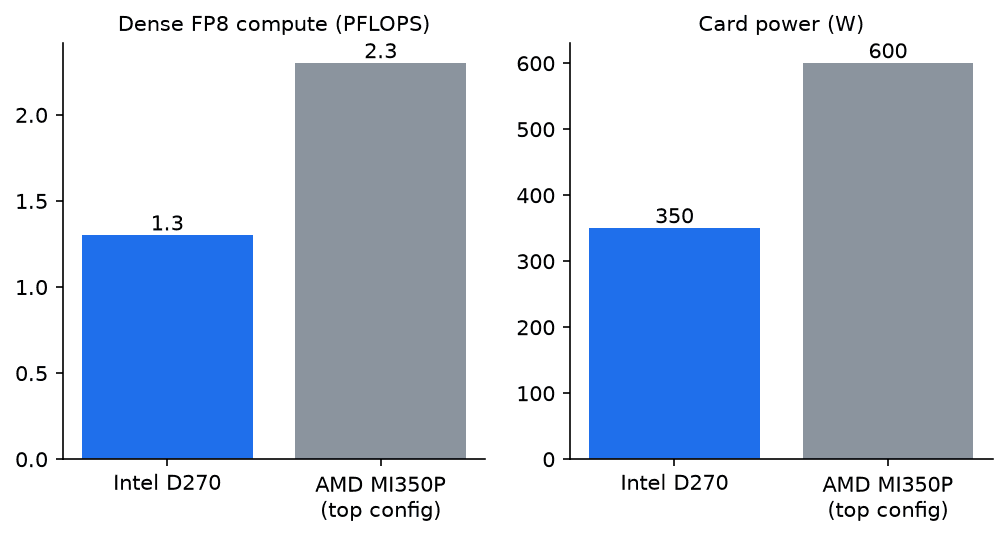
On paper, the D270 is not the fastest option. AMD's MI350P is a similar card that plugs into the same kind of slot. It is rated at 2.3 PFLOPS of dense FP8, roughly 40% more than Intel's card.
The trade-off is power. AMD's top MI350P setup draws 600 W. The D270 stays at 350 W and does not need a liquid cooling loop, so it fits into ordinary servers. Intel is selling efficiency, meaning more work per watt, rather than the highest raw speed.
VoltGridNews · Source · Original VoltGridNews diagram; data from cited source
Dense FP8 compute and card power, as reported.
Intel's return to AI data center chips
This is Intel's first commercial AI data center GPU since Ponte Vecchio in 2021. Two planned follow-ups, Rialto Bridge and Falcon Shores, were cancelled. The new D-Series name also drops the Data Center GPU Max and Flex brands Intel used on earlier cards.
What to watch next
Intel is already sending sample cards to customers. But it has not given a launch date or a price, and it has not promised to ship this year. Buyers who want a lower-power inference card should plan around 2027. Real-world efficiency, not the numbers on the spec sheet, will decide whether the 350 W design pays off.