Chips · Oct 18, 2026, 16:55
NVIDIA RTX Spark N1X brings the GB10 Arm chip to Windows laptops
The chip NVIDIA has sold in small Linux computers for a year is now inside Windows laptops, led by Microsoft's Surface Laptop Ultra. Its graphics are strong, but its main processor cores are older.
Illustration (AI-generated)
A laptop with a system-on-chip, shown as an illustration.
Key takeaways
- NVIDIA's RTX Spark N1X is the Windows version of its GB10 chip, sold in Linux machines for about a year.
- Microsoft's Surface Laptop Ultra leads the launch, with around six other laptops and a Surface mini-PC.
- Its graphics match a GeForce RTX 5070 in core count, and it can use up to 128 GB of memory.
- Its processor cores date from Arm's 2024 lineup, so single-task speed is a weak spot.
- Watch whether a chip built for AI developers works as an everyday Windows laptop chip.
What NVIDIA launched
NVIDIA has launched the RTX Spark N1X for Windows PCs. It is a system-on-chip, meaning one package that holds the main processor, the graphics and the memory controls. Under the hood, it is the same GB10 chip that NVIDIA has shipped in Linux computers for about a year.
Microsoft's Surface Laptop Ultra leads the rollout, ServeTheHome reports. Around six other laptops arrived this week too, along with a small desktop called the Surface RTX Spark Dev Box.
How the chip is built
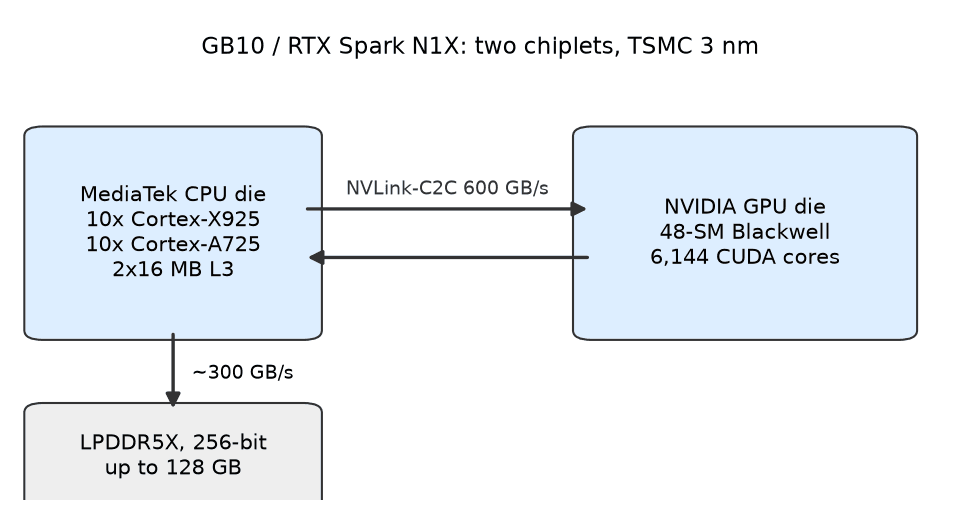
GB10 is made of two chiplets, smaller pieces of silicon joined together in one package. NVIDIA built it with MediaTek, and TSMC makes both pieces on its 3 nm process.
MediaTek's piece holds the CPU, the main processor that runs Windows and apps. It has 10 fast Cortex-X925 cores and 10 power-saving Cortex-A725 cores, split into two groups. Each group has 16 MB of L3 cache, a fast memory store on the chip. This piece also handles the memory, the display outputs and PCIe, the link used for storage and other add-ons.
VoltGridNews · Source · Original VoltGridNews explanatory diagram based on the cited source
GB10's two chiplets and their links.
Lots of memory
The chip uses LPDDR5X, the kind of memory found in many laptops. Its memory connection is unusually wide, at 256 bits across 16 channels. That lets it use up to 128 GB of memory and move about 300 GB/s of data. Large memory matters for running AI models on the machine itself.
Desktop-class graphics
NVIDIA's piece holds the GPU, the graphics processor that also speeds up AI work. It uses NVIDIA's Blackwell design with 48 SMs, the GPU's main building blocks, for a total of 6,144 CUDA cores. A 600 GB/s NVLink-C2C link, NVIDIA's fast chip-to-chip connection, joins it to the CPU piece.
This is a complete graphics chip, not a cut-down AI part. It has ray tracing hardware for realistic lighting, plus texture units and ROPs, the parts that draw the final image. In core count it matches the GeForce RTX 5070 desktop card. That card has more than twice the memory speed, though, because it uses faster GDDR7 graphics memory.
The weak spot
The CPU is the weaker side. Its cores come from Arm's 2024 lineup, yet the chip arrives in 2026. As a result, it is better at running many tasks at once than at doing one task quickly.
Who it is for
Most laptop makers are aiming at developers and content creators. Those are the same buyers the Linux-based DGX Spark served. Some makers are also selling it in broader consumer laptops. That puts NVIDIA's chip in the same high-end group as AMD's Ryzen AI Max for Windows.
What to watch next
The big question is whether a chip tuned for local AI work also makes a good everyday Windows laptop chip. There, quick response on single tasks and app compatibility with Arm processors matter. ServeTheHome also says it is unclear whether NVIDIA and MediaTek will build another chip together after GB10.
Sources
- NVIDIA RTX Spark N1X Launch Overview: NVIDIA Arms Windows · ServeTheHome