Kori 3 and 4 Cleared for 10 More Years; KHNP Targets H1 2027 Restart
Kori 3 may run to Sept. 28, 2034 and Kori 4 to Aug. 6, 2035, but KHNP's phased restart of the two Busan reactors follows inspections and has no firm date.
3 min readAI-assisted
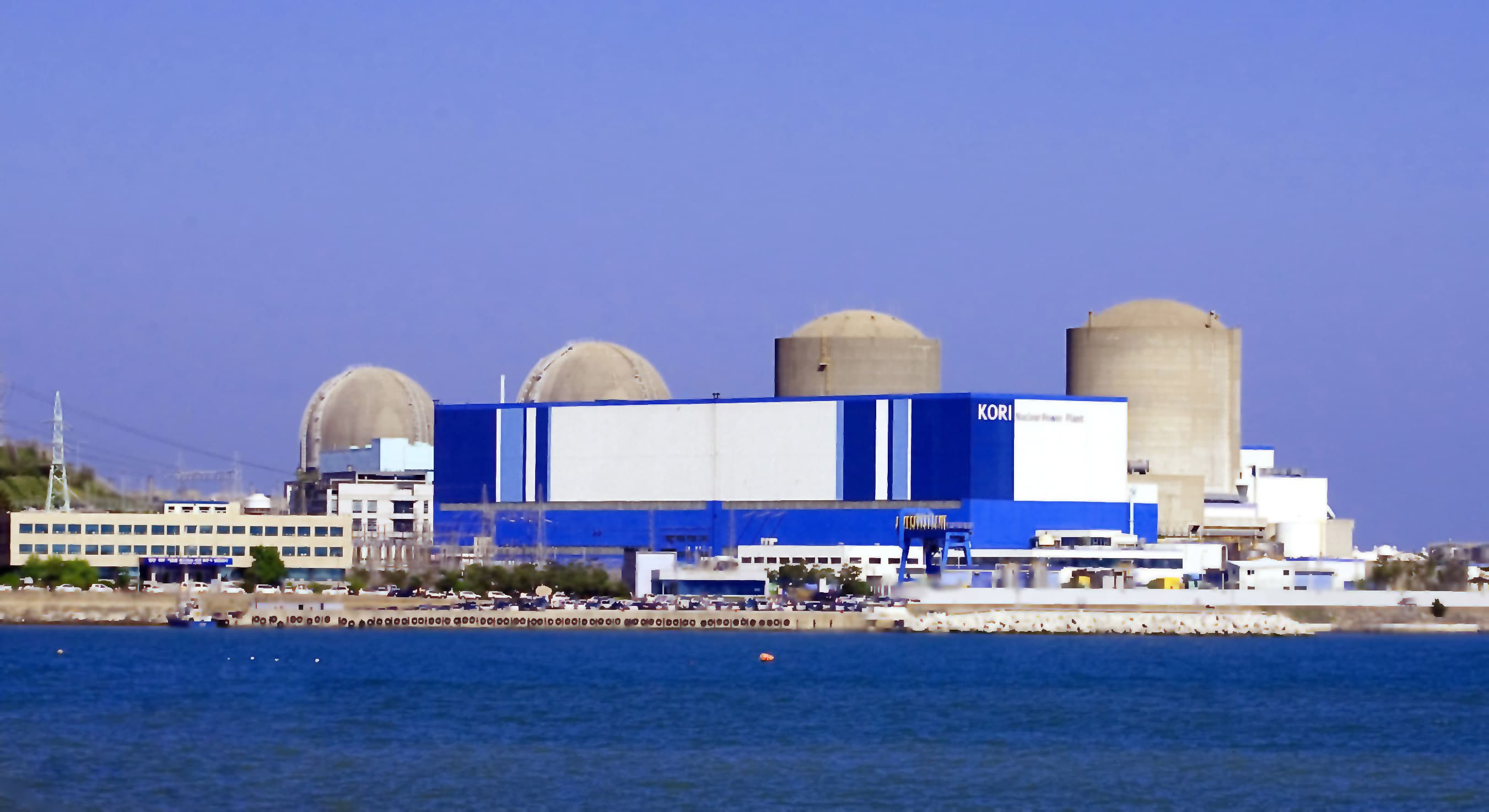
KHNP's Kori Nuclear Power Plant site near Busan, where units 3 and 4 sit. KHNP's photo gallery does not label the image by unit.
Image: KHNP
Source · Press image from the KHNP photo gallery, used for news reporting.
South Korea's Nuclear Safety and Security Commission (NSSC) on Oct. 27 approved continued operation of the idled Kori 3 and 4 reactors for 10 years beyond their original design lives, to 2034 and 2035, and Korea Hydro & Nuclear Power (KHNP) says it plans to restart them in the first half of 2027.
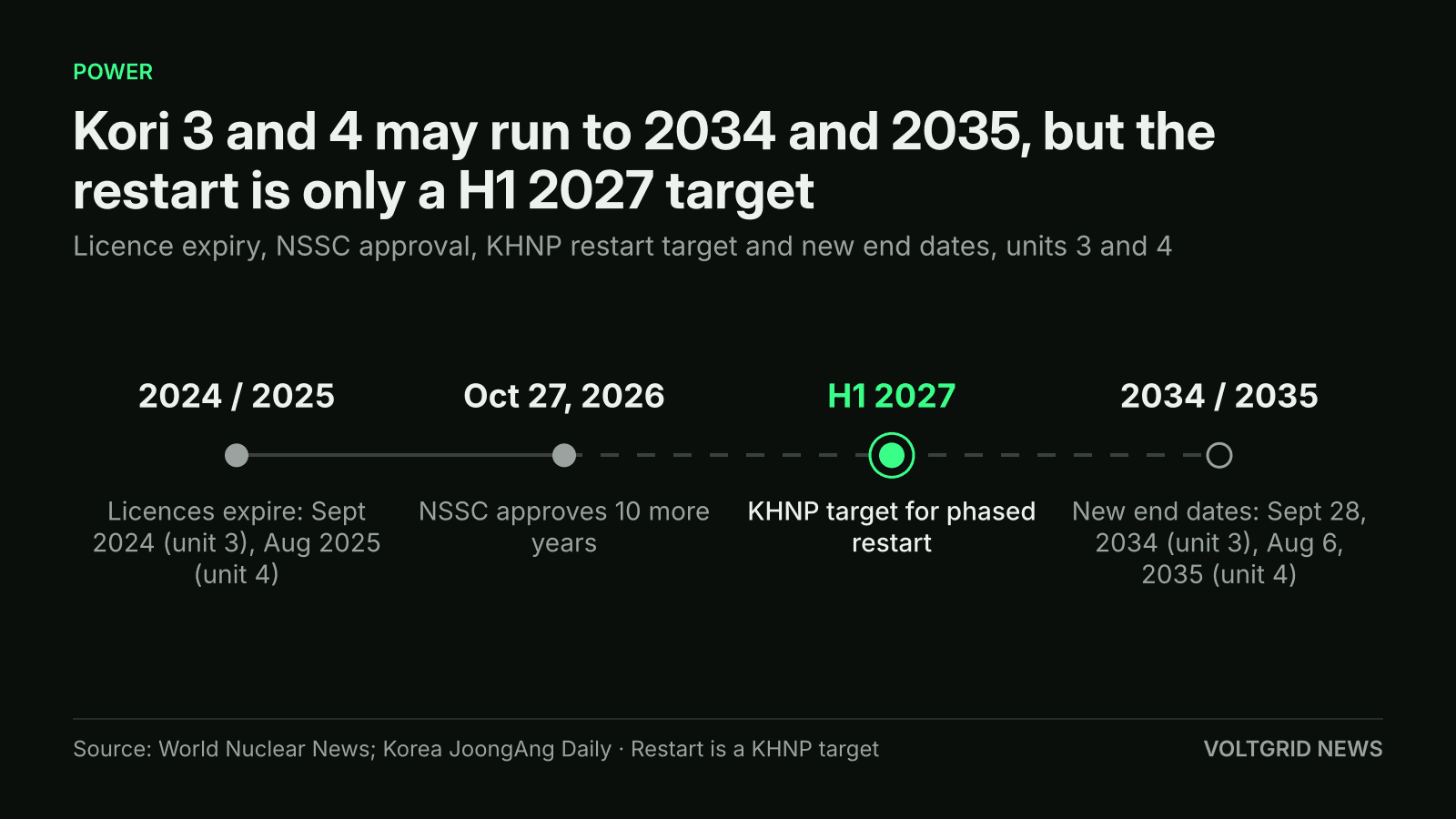
The NSSC approval is confirmed; the H1 2027 restart is a KHNP target, not a set date.
Illustration (AI-generated)
The two Westinghouse pressurised water reactors near Busan are rated at 1,025 MWe each, according to World Nuclear News; Korea JoongAng Daily writes 950 MW each and Aju Press about 1,000 MW each. Their 40-year operating licences ran out in September 2024 (unit 3) and August 2025 (unit 4). Under the decision, unit 3 may run until Sept. 28, 2034, and unit 4 until Aug. 6, 2035, as reported by Korea JoongAng Daily and Seoul Economic Daily.
For power planners, this is firm capacity returning to a grid under pressure from data centers and chip plants. KHNP President Kim Hoe-cheon cited rising demand from semiconductors and AI in KHNP's statement, as quoted by World Nuclear News. Korea JoongAng Daily puts the regained capacity at 1.9 GW, twice the 950 MW per unit it uses, and notes that a single AI data center can need 500 MW to 1 GW. Those are the outlet's figures, not an NSSC or KHNP load forecast.
Restart is a target, not a date
Approval does not switch the units on. KHNP plans to replace equipment to add safety margin, and an NSSC official said the restart will follow on-site inspections confirming compliance, according to Seoul Economic Daily. KHNP says it aims to restart the units in phases during the first half of 2027. Korea JoongAng Daily says industry observers expect commercial operation as early as February or March 2027, which is an expectation and not a KHNP commitment.
The extension dates count from the original licence expiry, so the idle months come out of the decade: Korea JoongAng Daily calculates that a restart in early 2027 would leave Kori 3 with about seven years of operation and Kori 4 with about eight.
How long it took
KHNP applied for a licence amendment on the operating period in November 2023, World Nuclear News reports, although Aju Press dates the filing to September 2022. World Nuclear News says the Korea Institute of Nuclear Safety ran a four-year safety review, alongside a radiation environmental impact assessment. The NSSC said the two units share a design but have different operating and maintenance histories, so it assessed structures, systems, equipment and ageing separately. On Oct. 15 the commission approved the units' accident management plans but postponed the continued-operation decision to a later meeting, SBS News reported.
The cost of waiting was large. KHNP data cited by Korea JoongAng Daily show four idled reactors, Kori 3, Kori 4, Hanbit 1 and Hanbit 2, missed about 1.9 trillion won ($1.42 billion) in potential electricity sales through Sept. 22.
This is Korea's fourth approved extension of an ageing reactor, after Kori 1 in 2008, Wolseong 1 in 2015 and Kori 2 in 2025, according to Korea JoongAng Daily and Aju Press. KHNP restarted Kori 2 in April after it had been offline since its permit expired in April 2023, World Nuclear News said. South Korea has 26 operable reactors that supply about one-third of its electricity. The NSSC also plans to begin reviewing continued operation for other reactors that have stopped or are about to stop at the end of their design lives, Seoul Economic Daily reported.
What is not confirmed yet
The commission's vote count differs between outlets: Aju Press reports 5-2, Seoul Economic Daily says six of the eight commissioners present voted in favor, and Korea JoongAng Daily says only that a majority approved. The combined capacity is also reported two ways, 1,025 MWe per unit by World Nuclear News and 1.9 GW in total by Korea JoongAng Daily. No restart date has been set for either unit, and neither the NSSC nor KHNP has said when the on-site inspections will finish.