Phison Shows NPU SSD with 64 GB at 130 GB/s on Nov. 17; No TOPS Figure
Phison said on Nov. 17 its computational-storage SSD pairs an NPU rated 36,800 DMIPS with 64 GB of memory. It gave no name, capacity, interface, dates or TOPS figure.
3 min read
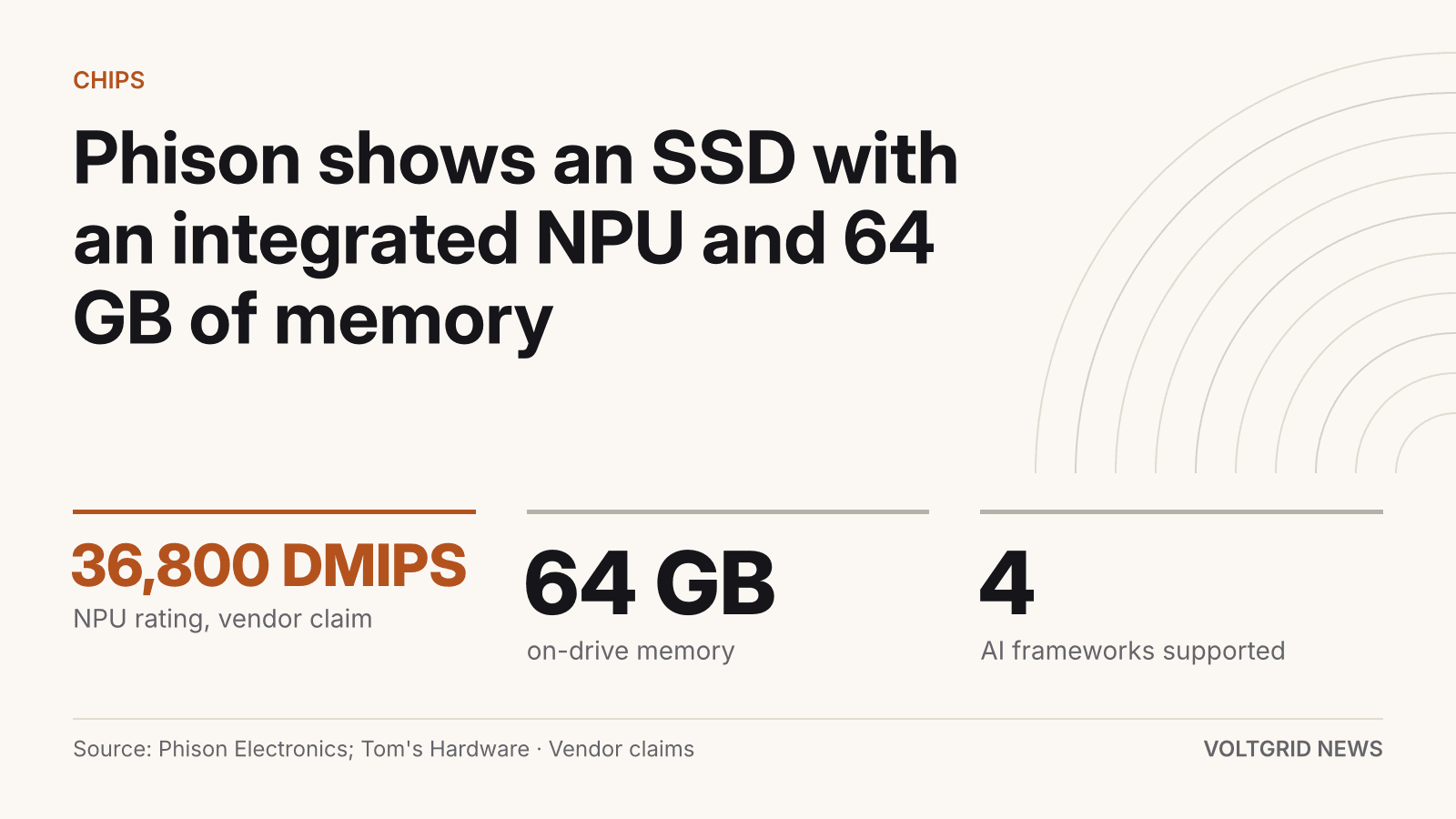
Phison's figures for its NPU drive shown at SC26 are vendor claims, not measurements.
Graphic: Voltgrid News
Phison Electronics said on Nov. 17, at the Supercomputing 2026 (SC26) show in Chicago, that it is developing a computational-storage SSD whose integrated NPU is rated at 36,800 DMIPS and that carries 64 GB of memory with 130 GB/s of bandwidth.
The company's release lists PyTorch, vLLM, OpenVINO and llama.cpp as supported frameworks, so developers can reuse familiar code on the drive. Phison says the design lets the SSD scan and process data in parallel and return only relevant results, which it says could cut data transfers by 10 to 100 times for applicable workloads and free host CPU capacity. Those are vendor claims, not measurements. Tom's Hardware covered the design on Nov. 20.
What Phison has not said
The release gives no product name, no flash capacity, no host interface for this drive, no sampling or shipping date, and no TOPS (trillions of operations per second) figure for the NPU. Phison's disclaimer says many of the products and features are still in development and will arrive as they are finalized, and that release timing may change.
Tom's Hardware points out that DMIPS is a Dhrystone CPU integer benchmark from the 1980s, while NPUs are normally rated in TOPS. It reads the figure as most likely describing the CPU cores that work alongside the NPU, not AI throughput. It also notes that Phison does not name the memory type, and that nothing was disclosed about how a host reaches the drive's compute.
Why it matters for data-center design
The pitch targets a real cost: moving datasets between SSDs, memory and CPUs. If a drive can filter data where it sits, a server spends less PCIe bandwidth and host CPU time on scans, which would matter in storage-heavy AI and HPC (high-performance computing) racks. Whether it does depends on the missing figures. Without a power rating per drive, the saving in host power cannot be set against the extra watts of an NPU and 64 GB of memory inside each bay.
Tom's Hardware notes that the idea is not new. Samsung showed its FPGA-based SmartSSD in 2018, and the drive has reportedly since left Samsung's lineup. ScaleFlux took a narrower route by compressing data inside the controller, which keeps the drive looking like an ordinary NVMe SSD. Phison's selling point is that code written for common AI frameworks should run without specialized tools.
The numbers in one place
Three figures frame the design, and none is a measured result. The NPU is rated at 36,800 DMIPS. The on-drive memory is 64 GB at 130 GB/s. Phison's claimed data-movement saving is 10 to 100 times for applicable workloads. For scale, Phison's separate X3 (PS5303) enterprise controller targets up to 28 GB/s sequential throughput and 6.8 million IOPS on PCIe Gen6 x4 with NVMe 2.3, so the memory bandwidth of 130 GB/s is about 4.6 times the X3's host-link target, a ratio Voltgrid computed from the two vendor figures and one that Tom's Hardware also describes as above 4x. The comparison is only illustrative, because Phison has not said the computational drive uses the X3. On the second design, Phison says that losing one drive out of 24 costs a 4% share of cache in its Mixed Media layout, against 25% with dedicated cache drives.
Phison claims 130 GB/s for the NPU drive's memory; the X3 controller targets 28 GB/s. Both are vendor figures and not like-for-like.
Graphic: Voltgrid News
Also shown at SC26
Phison also described Mixed Media, which puts high-endurance pSLC and high-capacity QLC flash behind one 16-channel controller, and said its PS7161 is the first PCIe 6.0 redriver on the PCI-SIG Integrators List. Tom's Hardware says the X3 figures are unchanged since Computex in June and that the SC26 release gives no dates. Voltgrid has covered other NPU-class silicon with thin specifications, such as DeepX's DX-M2 on Samsung's SF2P 2nm process, reported on Nov. 13.
What is not confirmed yet
Phison has not confirmed a product name, capacity, interface, sampling date, TOPS rating, memory type or power draw for the NPU drive, and has not said whether it will share a drive with the Mixed Media or X3 technology. The company's own figures remain targets and claims until samples are tested.
Sources
- 01Phison details SSD with a built-in NPU and 64GB of memory that supports AI frameworks on the driveTom's Hardwaretomshardware.com
- 02SC26: Phison Unveils Three Next-Generation Storage Innovations for the New Compute EraPhison Electronicsphison.com
- 03Phison Previews an SSD That Runs AI Frameworks on Its Own NPUTechPowerUptechpowerup.com
- Published
- Sources
- 3 cited