SD Optics EUV Pellicle Inspector: 4B Won vs Japan's Reported 10-18B
SD Optics delivered its first EUV pellicle inspection system to S&S Tech on Nov. 20 for about 4B won, The Elec reports, against a reported 10B-18B won for Japanese tools.
3 min read
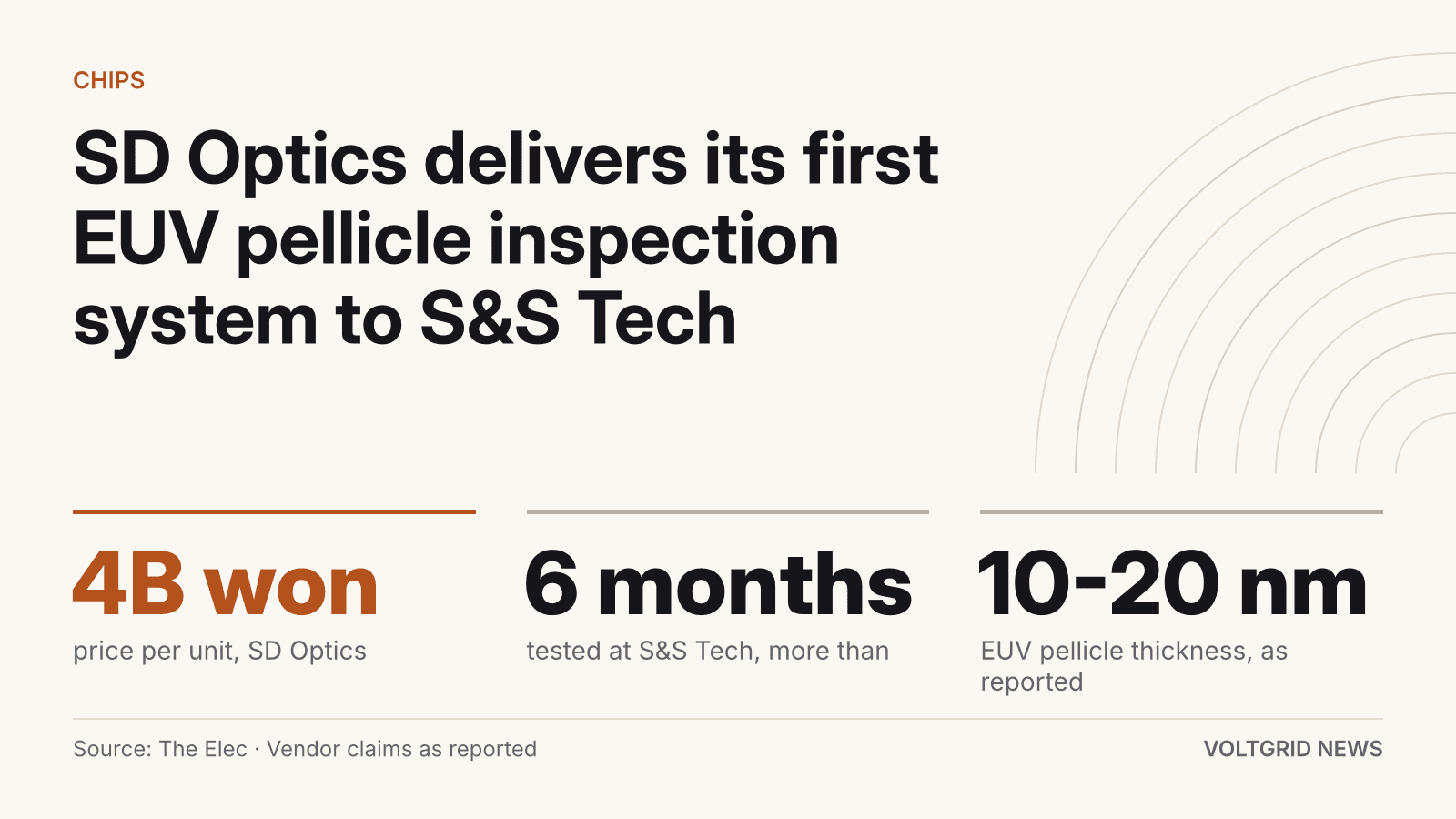
SD Optics' first EUV pellicle inspection system went to S&S Tech, according to The Elec; figures are SD Optics' statements as reported.
Graphic: Voltgrid News
South Korea's SD Optics said on Nov. 20 that it has delivered its first automated extreme ultraviolet (EUV) pellicle inspection system, one unit priced at about 4 billion won, to S&S Tech, according to The Elec.
S&S Tech evaluated the machine for more than six months before the delivery, The Elec reported. Citing industry sources, the outlet put comparable Japanese inspection systems at more than 10 billion won per unit and up to 18 billion won depending on configuration, which puts SD Optics' price at about 22% to 40% of the Japanese range, The Elec said.
SD Optics' stated price of about 4B won sits below the 10B to 18B won that industry sources put on Japanese systems, The Elec reported.
Graphic: Voltgrid News
On the reported figures, the Korean tool sells for about 4 billion won against more than 10 billion won and up to 18 billion won for the Japanese systems.
Why a Pellicle Needs Its Own Inspection Tool
A pellicle is a membrane held in front of a photomask so that stray dust lands on the film instead of the mask. The film is extremely thin, 10 to 20 nm by The Elec's account, against 50 nm for ASML's polysilicon version in a 2021 Semiconductor Engineering report, so small vibrations move it and an inspection tool must keep refocusing.
SD Optics says its MALS lens refocuses by steering about 6,000 micro mirrors rather than moving glass, and the tool tells upper-surface from lower-surface particles, a classification Lasertec also lists for its PELMIS system. The stakes are the mask: Lead Economy puts a leading-edge EUV photomask above 500 million won, and a particle that detaches can cause chip defects.
How the System Holds Focus on a 10-20 nm Film
The system must also find particles of about 0.7 micrometers and tell whether each sits on the upper or lower surface, the outlet reported.
SD Optics says it solved the focus problem with MALS (Micro-mirror Array Lens System), its ultra-high-speed variable-focus technology, which steers an array of micro mirrors to adjust focus without physically moving the lens. Etnews described MALS in March as a lens that uses about 6,000 micro mirrors to steer light and set focus in real time, and said Germany's Carl Zeiss uses it. The pellicle tool adds 2D and 3D line scanners to inspect the pellicle edges and the inner walls of its frame, and SD Optics says it is the only South Korean company to have commercialized a system with those functions.
The tool came out of the Next-Generation Intelligent Semiconductor Technology Development Program, backed for four years by the trade ministry and the Korea Evaluation Institute of Industrial Technology, with help from the Korea Electronics Technology Institute. SD Optics is shifting from mobile-device inspection toward semiconductors, and a company official told The Elec it is in the final stages of securing about 30 billion won in investment.
Where It Sits in Samsung's EUV Supply Chain
Lead Economy reported on Oct. 2 that pellicles from S&S Tech and FST had passed customer quality evaluation and are due to ship to Samsung Electronics' Taylor, Texas foundry from 2027, and that Samsung ordered 24 billion to 25 billion won of pellicle mounting and defect-inspection equipment there from FST. That order does not involve SD Optics. Voltgrid has followed the Taylor fab's trial-run timing and, separately, Hoya's limits on EUV mask blank supply.
Lead Economy said Japan's Mitsui Chemicals has supplied virtually all the world's EUV pellicles under a license with ASML. SD Optics' sale concerns the inspection step behind the pellicle, not the pellicle itself. In Voltgrid's analysis, a cheaper local inspection tool could lower the cost for Korean makers trying to become a second pellicle source.
What Is Not Confirmed Yet
The 4 billion won price and the delivery come from SD Optics' statement as reported by The Elec; no second outlet had reported the delivery when this story was written. The Japanese price range is attributed only to unnamed industry sources, and The Elec named no Japanese maker or model.
SD Optics says S&S Tech is still seeking final customer qualification for its EUV pellicles, while Lead Economy reported in October that they had passed customer quality evaluation. More inspection orders depend on that qualification and on higher pellicle output, and no order beyond the first unit has been announced.
Sources
- 01SD Optics Commercializes EUV Pellicle Inspection Equipment, Breaking Japanese DominanceTheElecthelec.net
- 02SD Optics develops on-axis confocal inspection module with 0.0012 s focus locketnewsetnews.com
- 03Samsung, local suppliers break Japan's EUV pellicle monopoly, Taylor fab delivery next yearLead Economyleadeconomy.co.kr
- Published
- Sources
- 3 cited