Trinity Fab: SK hynix Yongin Testbed Opens May 2027, 874.5B Won
SK hynix, Korea's government and local authorities are funding the 300mm Trinity Fab with 874.5 billion won, TheElec reports; validation starts October 2027.
Chips & Power DeskEdited by Ege Erten
3 min readAI-assisted
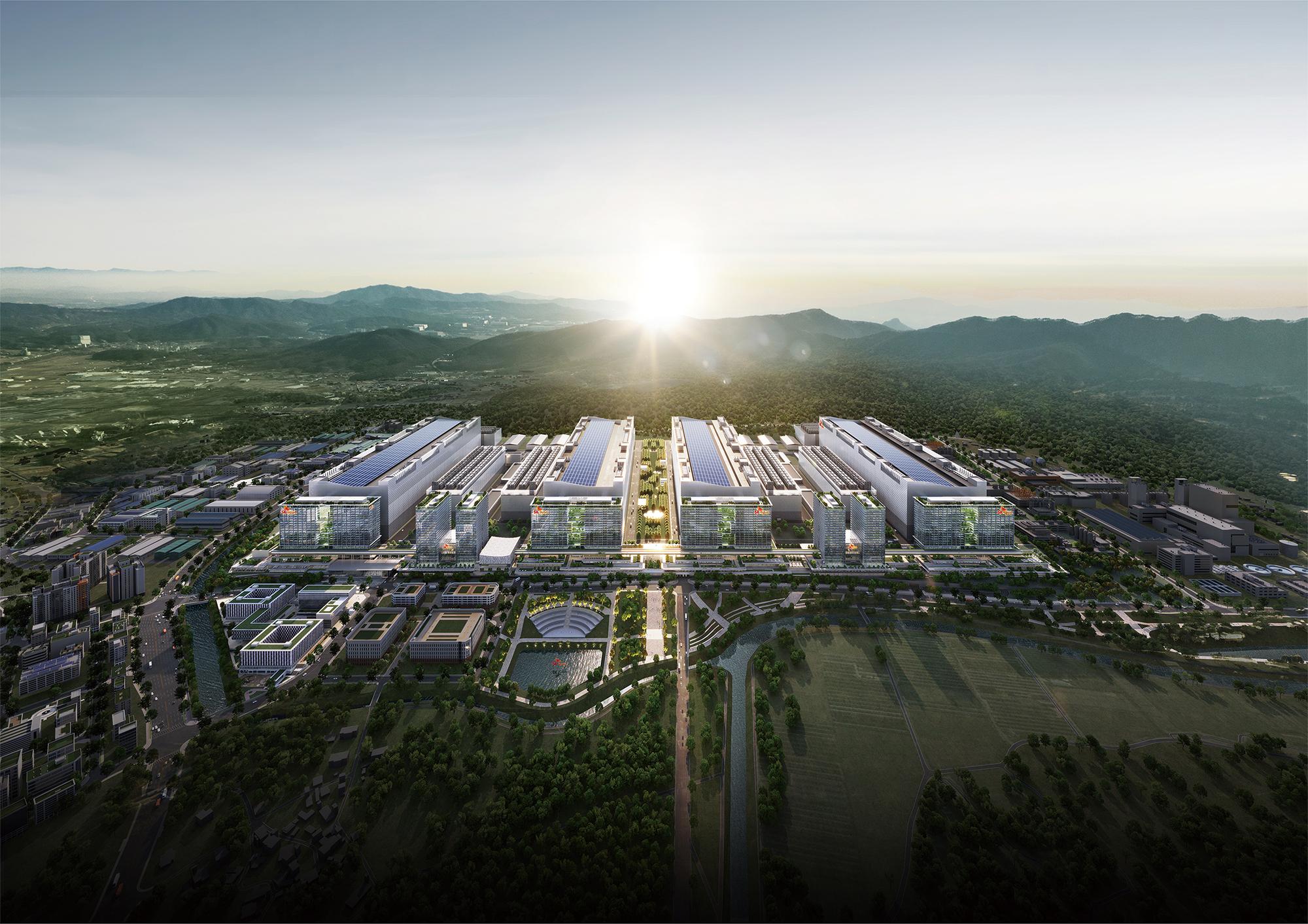
SK hynix's rendering of the Yongin cluster. Trinity Fab's cleanroom is planned inside the Phase 1 fab; this image does not show the testbed itself.
Image: SK hynix
Source · Press image from the SK hynix newsroom, used for news reporting.
Trinity Fab, a nonprofit 300mm wafer testbed inside SK hynix's first Yongin fab, will open its cleanroom in May 2027 and start full validation services in October 2027, TheElec reported on Nov. 8, citing industry sources on Nov. 6.
The foundation was set up by the South Korean government, Gyeonggi Province, Yongin City and SK hynix. TheElec lists the money as 443.2 billion won from SK hynix, 373.6 billion won from the central government and 57.7 billion won from Gyeonggi and Yongin, about 874.5 billion won in total. Seoul Economic Daily reported on Oct. 19 that the partners are jointly investing 870 billion won, so the two outlets agree on scale.
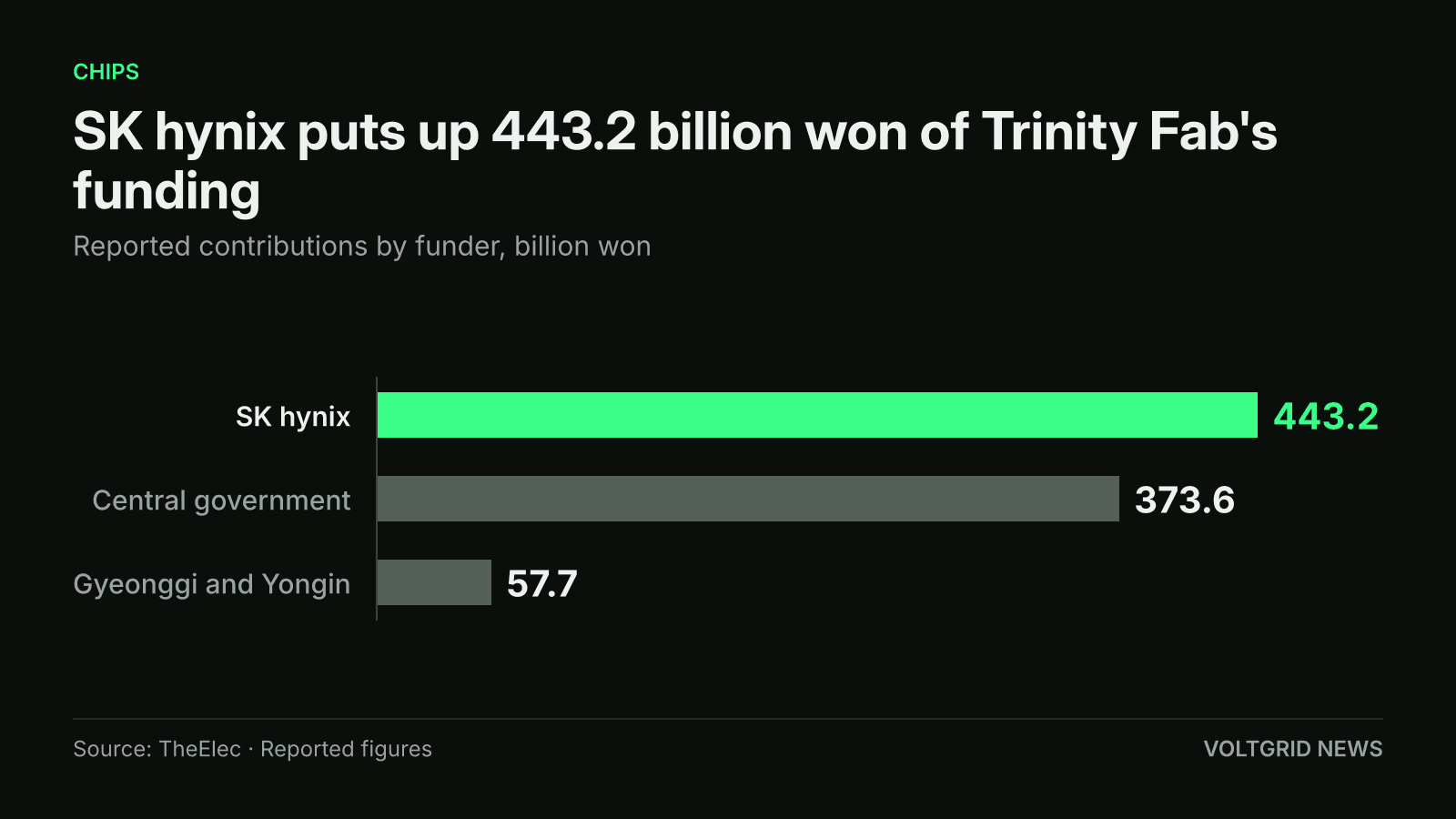
SK hynix is reported to contribute the largest share of Trinity Fab's funding, according to TheElec.
Illustration (AI-generated)
Voltgrid's arithmetic on those figures shows who carries the project. SK hynix covers about 51% of the funding, the central government about 43% and the two local governments about 7%. TheElec notes that, unlike existing publicly run nanofabrication facilities, Trinity Fab draws direct funding and specialist staff from a chipmaker.
What Trinity Fab will validate
The target users are Korean suppliers of materials, components and equipment. TheElec says they struggle to build production-grade cleanrooms, to buy tools that cost tens of billions of won each, and to get time on a customer's line. Overseas validation services such as Belgium's imec carry substantial costs, TheElec says, and Trinity Fab will charge less. It aims to cut the time from development to mass-production adoption by 30% and to support about 300 companies.
The cleanroom will occupy about 1,000 pyeong (3,306 square meters) of the roughly 12,000-pyeong Phase 1 area and will hold Class 100 or better. Of that, 800 pyeong is split into seven process areas: diffusion, lithography, etching, thin-film deposition, chemical mechanical polishing, cleaning, and metrology and inspection. The other 200 pyeong is a shared cleanroom of 15 units of about 13.5 pyeong, where suppliers can install their own tools. Trinity Fab is walled off from SK hynix's production areas but shares central utilities such as air handling.
Thirty-seven tools are planned, with 70% installed by October 2027 and the rest phased in through 2031. The equipment budget is about 300 billion won, roughly 34% of the total funding by our calculation. The most expensive tool is an ASML argon fluoride (ArF) immersion lithography system. Etch validation uses Lam Research, Applied Materials and Hitachi tools, and metrology comes from KLA and Park Systems.
Why it matters for the supply chain
The site puts a supplier test line inside SK hynix's first Yongin fab and applies the conditions and standards of SK hynix's mass-production lines, so a pass there says something about readiness for a real line. A Trinity Fab official says it will serve suppliers whether they sell to SK hynix, Samsung Electronics or another chipmaker. That promise is tested because SK hynix's record 83.3 trillion won Q3 profit gives it the cash to fund a line that mainly helps its suppliers, while Samsung still held 38% of Q3 DRAM revenue to SK hynix's 29%, so a neutral venue has to be credible to rivals.
Neither TheElec nor Seoul Economic Daily gives the site's electricity or cooling demand, which will matter because it shares central utilities with SK hynix's own production fab.
What is not confirmed yet
Trinity Fab is recruiting tenants for the shared cleanroom, with selection after an internal review in January 2027. TheElec says Dongjin Semichem and Soulbrain reportedly expressed interest in materials work, KoMiCo in components, and TES, Wonik IPS and Jusung Engineering in equipment. None of the companies has confirmed this in the sources we read.
The foundation targets at least 30 billion won in annual revenue, about 3% of the construction funding, and aims to self-fund upgrades after infrastructure work ends in 2031. Fee levels and the size of the imec discount have not been published. The schedule comes from industry sources, not a Trinity Fab release. In March, Seoul Economic Daily quoted SK hynix at an 860 billion won project cost, so the budget has moved since.