Alibaba Bets Its 2027 Compute on T-Head's Zhenwu V900 as US Rule Bites
Alibaba's AI cloud and chip segment grew 53%, but CEO Eddie Wu says a Nov. 16 US rule hits next year's products, leaving T-Head's Zhenwu V900, due in Q1 2027, to carry 2027-28.
5 min read

Alibaba Cloud's Apsara Conference, where T-Head showed the Zhenwu V900 in September. Event artwork, not a photo of the chip.
Image: Alibaba Cloud
Source · Press image from the Alibaba Cloud site, used for news reporting.
Alibaba's September-quarter results on Nov. 19 showed its AI Cloud and Compute Services segment, which now includes chip designer T-Head, growing 53% to RMB60,973 million, while chief executive Eddie Wu warned that a new US compute rule will affect next year's products. Read together, the numbers and the warning argue that Alibaba's growth from 2027 depends less on what it can buy and more on whether T-Head's Zhenwu V900 arrives on time and in volume.
What happened
Group revenue rose 10% to RMB271,519 million (US$40,498 million), the company said in its results release. Revenue from external cloud customers grew 64%, and the recurring part of it, which leaves out compute equipment sales, grew 67%. Compute equipment solutions, the line that captures hardware sold to customers, rose 55% to about RMB10 billion. The segment's adjusted EBITA more than doubled, up 121% to RMB8,838 million. The South China Morning Post, which Alibaba owns, reported that the segment's growth was its fastest since late 2020.
Spending rose with it. Capital expenditure reached RMB50,477 million, up 60% from a year earlier, and the release names higher prices across a broad range of chip components among the reasons. The SCMP noted that the figure was still below the 67.7 billion yuan spent in the June quarter. Free cash flow was an outflow of RMB34,472 million, against RMB21,840 million a year before.
On the chip side, the release restated the plan T-Head showed at Alibaba's Apsara Conference in September: the Zhenwu V900, a chip for both training and inference, has its commercial release scheduled for the first quarter of 2027, as does a supernode that pairs it with Alibaba's own interconnect, networking and storage chips. T-Head has also open-sourced SAIL, the software stack for Zhenwu chips. The current Zhenwu M890 has been sold as a supernode cloud instance since August.
On the call, Wu said "the new compute export control rules will affect next year's products and services," according to Reuters. He was referring to an interim final rule the US Commerce Department's Bureau of Industry and Security issued on Nov. 16, which Reuters says requires licences for overseas data-centre arrangements that give China-based companies significant computing power. Wu said Alibaba was still assessing the impact.
Why it matters: the gap is 2027 and 2028
The thesis rests on three pieces of evidence. First, Wu told analysts that 2027 and 2028 will be the years when compute supply is scarcest in China's domestic market, Reuters reported, and that the company might target cloud revenue growth of 30% to 45% next year, against the segment's 53% this quarter. Second, he tied the rebound, to 50% or more in 2028, to the expansion of domestic compute capacity. Third, he said Alibaba's progress on domestic computing power was "already ahead of our original expectations."
That points to T-Head. In Voltgrid's reading, the Nov. 16 rule would narrow part of the route Chinese firms had used to reach foreign accelerators abroad, the route Voltgrid described when Chinese AI firms reportedly rushed to secure overseas NVIDIA capacity. On the same day as the results, TSMC and Samsung were reported to have suspended some China shipments pending US licences. If both the foreign-chip route and parts of the foundry route narrow, the chip Alibaba designs itself becomes the main lever on how much compute it can add in 2027.
The V900 is the chip that has to carry it. Tom's Hardware, reporting the figures Alibaba presented in September, put the V900 at 216 GB of memory and 1,200 GB/s of chip-to-chip bandwidth, against 144 GB and 800 GB/s on the M890. Alibaba claims up to three times the M890's performance, without a FLOPS figure, precision or workload. T-Head says more than 1,000 V900s can work as one system, against a 128-chip M890 supernode. For large-model inference, memory capacity sets how big a model, or how long a context, each chip holds, and the chip-to-chip link sets how many chips can act as one, and the V900 raises both on the figures reported for Alibaba's chips, which do not come from a datasheet. Tom's Hardware also reported that Alibaba's May roadmap had placed the V900 in the third quarter of 2027, so the date has already moved forward once.
Reported Alibaba figures put the V900 above the M890 on memory, chip-to-chip bandwidth and system size; no datasheet has been published.
Graphic: Voltgrid News
The case against
The strongest objection is that none of the V900's decisive numbers are public. Tom's Hardware noted that Alibaba has given no FLOPS figure, no memory bandwidth, no power figure, no process node and no foundry for the chip. The threefold claim is Alibaba's own, with no independent measurement, and a chip that cannot be made in volume does not close a supply gap, whoever designed it.
The second objection is in Wu's own forecast. A growth target of 30% to 45% for next year is an admission that domestic chips will not fully replace lost access in 2027. Alibaba also said in September that global supply-chain shortages were already limiting how fast it can scale its compute, according to Tom's Hardware, before the new rule took effect.
Third, the money is heavy. A quarterly free-cash-outflow of RMB34,472 million, and capex that the company says was lifted partly by higher chip component prices, alongside faster compute scaling, suggest, in Voltgrid's reading, that each quarter of delay in its own silicon would be paid for in costlier bought-in hardware.
What it means for NVIDIA, domestic rivals and the grid
For NVIDIA, the signal is that China's largest cloud is planning its 2027 to 2028 capacity around chips it designs, not around licences it may not get. For other Chinese chip vendors the opening is narrower than it looks: Alibaba's own supernode bundles T-Head interconnect, networking and storage chips with the V900, a stack meant to keep Alibaba's cloud on its own parts.
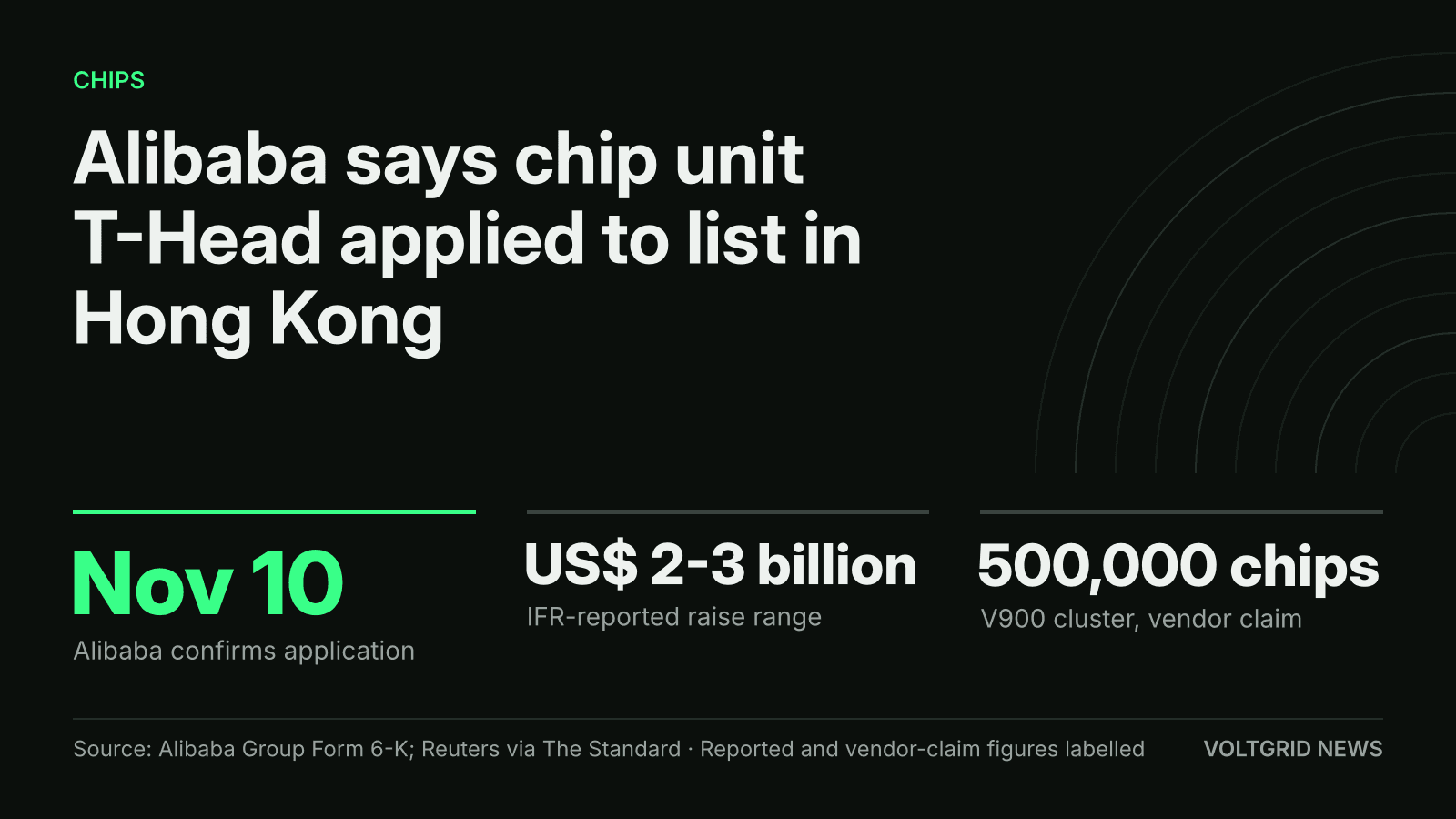
For power, the scale is large either way. Alibaba Cloud set itself a goal at Apsara of more than 20 gigawatts of data-center capacity by 2032, Tom's Hardware reported. How quickly that power fills with compute now depends on T-Head's output more than on any purchase order. T-Head's own Hong Kong listing, which Alibaba confirmed on Nov. 10, would give the unit its own capital to pay for that ramp.
What to watch
The first test is the first quarter of 2027, when Alibaba has scheduled both the V900's commercial release and the V900 supernode. The second is whether Alibaba or an independent tester publishes the V900's node, foundry and compute figures. The third is Alibaba's cloud growth through 2027 against Wu's 30% to 45% range, and whether it returns to 50% or more in 2028 as he expects.
Sources
- 01Alibaba unveils Zhenwu V900 AI accelerator, claims it's the most powerful AI chip in ChinaTom's Hardwaretomshardware.com
- 02Alibaba accelerates pivot to in-house chips after reporting jump in salesSouth China Morning Post · techscmp.com
- 03Alibaba tops revenue estimates on AI cloud growth; profit up on investment gainsReuters1049thewolf.com
- 04Alibaba Group Announces September Quarter 2026 Results and Interim Results for the Six Months Ended September 30, 2026Alibaba Groupfinance.yahoo.com
- Published
- Sources
- 4 cited