Amazon Pecos County Data Center Reportedly Tied to 7.65 GW Gas Permit
Amazon says its Pecos County, Texas campus is powered by new on-site generation, designed to move to grid service later. Reports tie it to Pacifico's GW Ranch, permitted for up to 7.65 GW of gas; no size is disclosed.
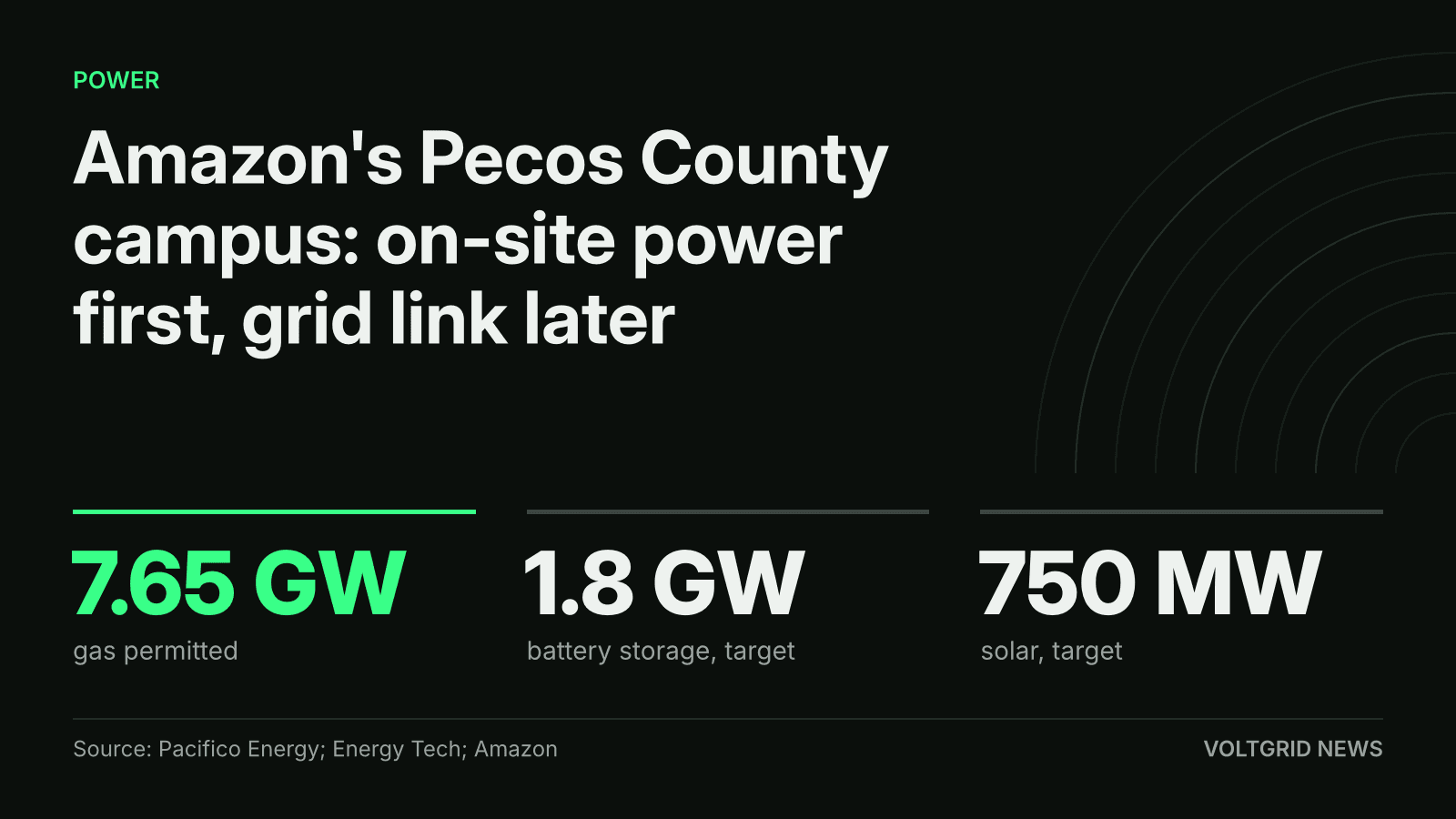
Pacifico Energy's GW Ranch plan: 7.65 GW is permitted gas capacity; battery and solar figures are targets. Voltgrid key-facts card; no official photo found.
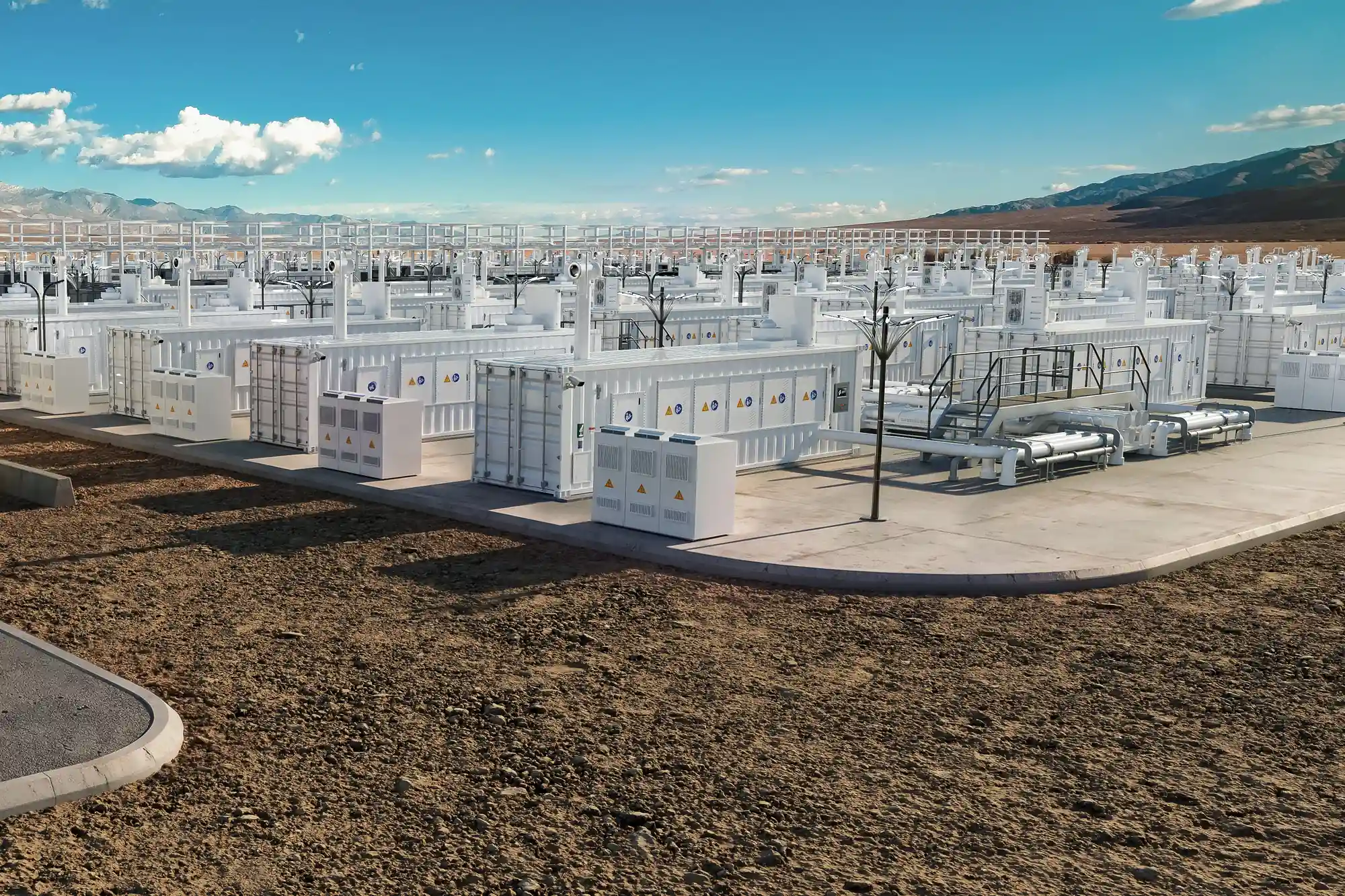
Illustration (AI-generated)
Amazon said Aug. 10, 2026, that its planned Pecos County, Texas, data center campus is powered by new on-site generation and is designed to move to grid service later; press reports tie it to Pacifico Energy's GW Ranch, permitted for 7.65 GW of gas. Amazon reports third-quarter results with a call on Oct. 29 at 21:00 UTC, the next scheduled point where it could say more.
Amazon's own statement is short. It says the campus is powered by new on-site generation that will not raise electricity costs for Texas households, and that it is designed to move to grid-connected service as interconnection timelines allow. Amazon says it is exploring solar and battery storage on site. It names no partner, no fuel, no megawatt figure, no investment and no dates. Every size, fuel and date below comes from the developer, a permit or a press report.
For supply, this is the important point. Cleanview calls it Amazon's first major off-grid data center investment, and if the gas-plant reports are right it is not a nuclear project, unlike Amazon's Talen Susquehanna supply deal. Amazon describes a transition to grid-connected service; Voltgrid reads that as a bridge. How firm that bridge is depends on gas supply and turbines, not on a reactor licence.
The Technology: A Private Gas Grid With Batteries
Pacifico describes GW Ranch as a private grid that combines natural gas turbines, solar and battery storage, according to Energy Tech's January 2026 report. Its plan lists a 1.8 GW battery (a power rating; Pacifico's page also cites 2 GWh of storage) and up to 750 MWac of solar beside the gas plant. POWER Magazine reported in August 2025 that the design includes two gas pipeline connections, is built in modules so it can grow in steps, and is meant to be "fully independent" of the ERCOT grid. The Houston Chronicle, citing Cleanview and The New York Times, reported a campus powered by 35 natural gas turbines capable of up to 7.65 GW, and the San Antonio Current, citing Distilled, said the permits reveal 35 turbines.
The idea that matters here is islanding. A campus that runs on its own grid has to match its generation to its load every second, with no utility to absorb a turbine trip. Pacifico lists the battery fleet and dual gas pipeline connections and claims N+2 redundancy and availability above 99.99%, which are its own claims. The sources read do not name the turbine models or supplier.
The 7.65 GW is an air-permit ceiling ("up to") for the whole site. Pacifico separately says the site can deliver over 5 GW from gas, battery and solar. Neither is a measure of what has been built, what has been contracted, or what Amazon's campus will draw.
Amazon and Pacifico: The Deal and the Money
No agreement between Amazon and Pacifico has been published. The Houston Chronicle reported on Aug. 8, citing Cleanview and The New York Times, that Amazon had acquired the GW Ranch site and plans to buy electricity from the plant Pacifico is developing. KEDT and Marfa Public Radio described Pacifico on Sept. 30 as the company developing the gas plant and AI data center for Amazon. Amazon's published statement names no partner, but Distilled reported on Aug. 7 that Amazon confirmed to Cleanview that it plans to buy power from the plant Pacifico is developing.
So the kind of contract (a power purchase agreement, a tolling deal or ownership of the plant), its term, the price and any financing are not disclosed. Cleanview reported that Amazon filed three state construction permits for data center buildings at the site and that satellite images showed land clearing, according to the Chronicle.
What a 7.65 GW Air Permit Does and Does Not Mean
An air permit caps what a plant may emit and run; it does not show what exists. Pacifico announced in January 2026 that Texas regulators granted GW Ranch a permit for 7.65 GW of gas-fired capacity, and press reports of the permit documents count 35 turbines. Pacifico's project page separately says the site can deliver over 5 GW by combining gas, battery storage and solar, so the permit and the deliverable figure rest on different bases.
None of it is shown as built or contracted. AEP Ohio's two fuel-cell contracts total about 98 MW, a contracted figure, so the Texas permit and the Ohio contracts are not like for like. Turning a permit into firm power takes turbines delivered, gas flowing through the pipelines and a signed supply agreement, and Pacifico targets first power in the first quarter of 2027.
GW Ranch Air Permit and Timeline
Pacifico said in August 2025 that permitting had begun with the Texas Commission on Environmental Quality (TCEQ). In January 2026 it announced that TCEQ had issued an air permit for 7.65 GW of gas-fired capacity, which the company called one of the largest ever granted in the US.
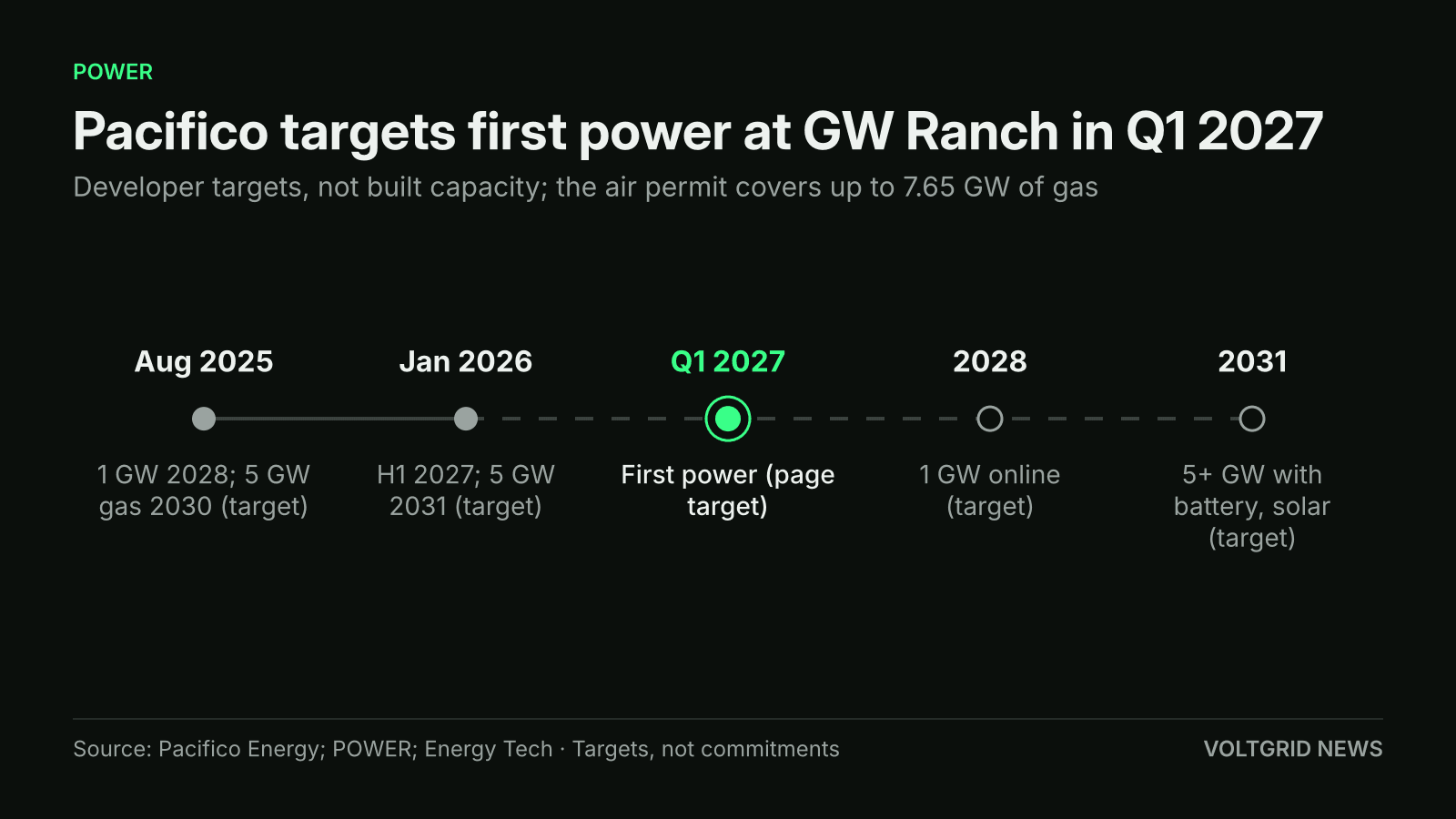
Pacifico's dates are targets, not built capacity, and they differ by source; the air permit covers up to 7.65 GW of gas.
Illustration (AI-generated)
Pacifico's dates have shifted since 2025. When it announced GW Ranch on Aug. 20, 2025, it said the first gigawatt would come online in 2028 and the full 5 GW of gas-fired power would be available in 2030, according to POWER. In January 2026 Energy Tech reported that Pacifico hopes to be operational by the first half of 2027 and has a 5 GW goal by 2031, now counting gas with battery and solar. Pacifico's project page lists first power in Q1 2027, 1 GW in 2028 and 5+ GW by 2031. The 2027 and 2028 dates may mark different milestones; what moved is the full build, from 2030 to 2031. None of the sources read explains the change, and Amazon has given no date of its own. All are the developer's targets.
The permit has drawn opposition. A March 2026 letter from three Democratic senators to Pacifico said the plant would emit 12,000 tons a year of harmful air pollutants and 33 million tons a year of greenhouse gases, KEDT reported. These are permitted maximums, not measured emissions.
What It Means for Amazon and the Texas Grid
The campus shows what a hyperscaler does when the grid cannot connect it fast enough: it builds its own power plant. AWS has used on-site gas as a bridge before, on a much smaller scale. In Ohio, AEP Ohio is installing Bloom Energy solid oxide fuel cells running on natural gas at facilities operated by AWS and Cologix so the data centers can start before the grid catches up, with the two customers paying the full cost, AEP said in June 2025. AEP's 10-Q reports two 2025 fuel-cell contracts totalling about 98 MW and does not name the customers. That figure is contracted capacity; the 7.65 GW in Texas is a permit ceiling, so the two numbers are not like for like.
The later grid connection is also uncertain. Gov. Greg Abbott ordered a pause in August 2026 on new large-scale data centers connecting to the Texas grid pending a review by state regulators, KEDT reported; development can continue in the meantime. If that pause lasts, a campus designed to run off-grid first is better placed than one waiting for ERCOT, but its move to grid service could slip. Microsoft is also tied to gas in West Texas: the Chronicle described Project Kilby as a 2.67 GW power facility being developed by a 50/50 Chevron and Joulent joint venture, with a 20-year power purchase agreement with Microsoft.
Pacifico is already pitching the same model next door. Pacifico representatives told Brewster County officials about an off-grid gas-turbine data center on a ranch in the Glass Mountains, KEDT reported on Sept. 30. They called it a feasibility-stage project and, per KEDT, spoke of an investment ranging from $5 billion to $60 billion. Voltgrid's project file on Oracle's Project Jupiter follows another large on-site power campus, where a requested 1,600 MW operating cap is part of a pending air-permit case.
What to Watch After Amazon's Q3 Call
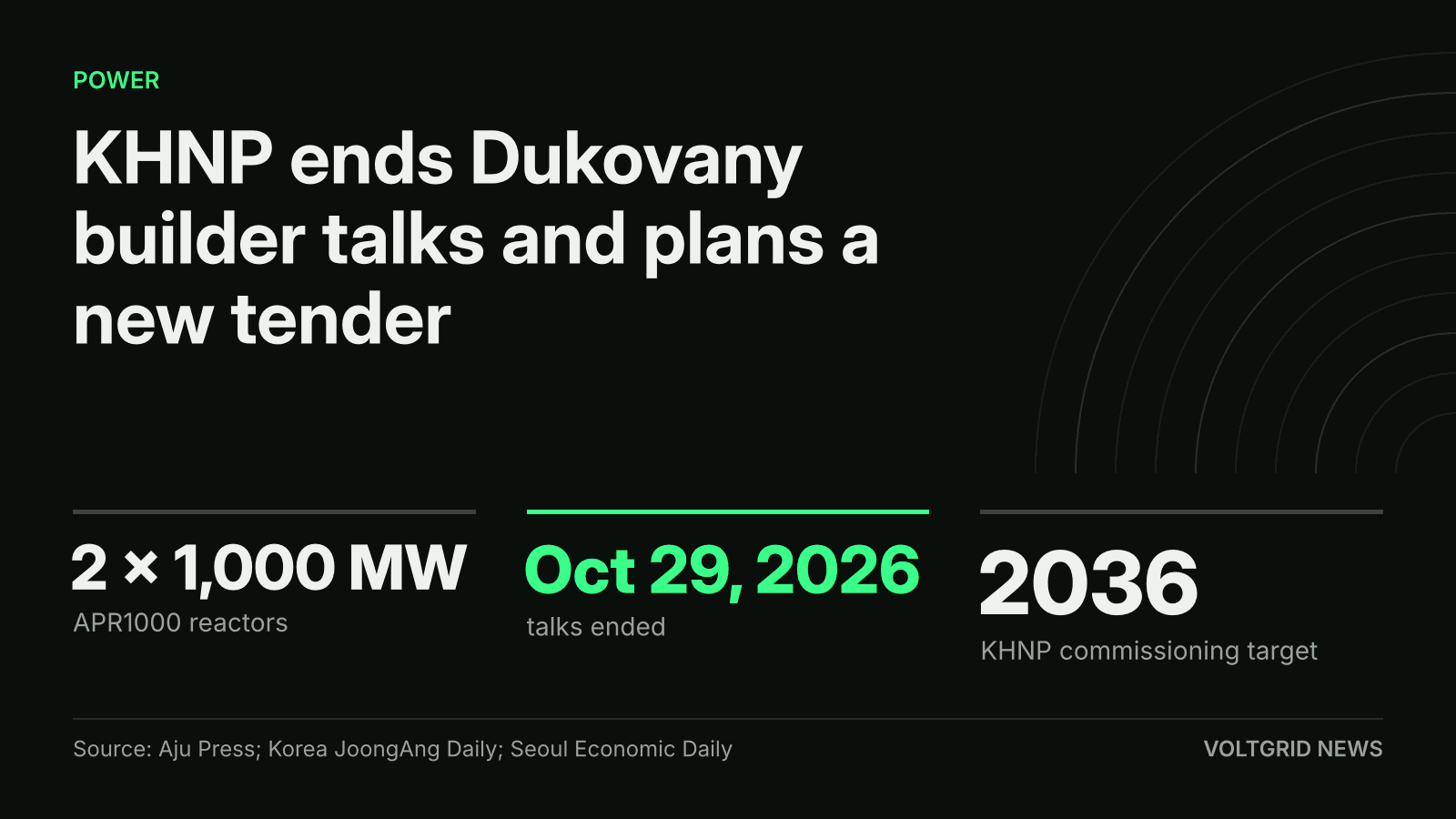
Amazon's Q3 call on Oct. 29 at 21:00 UTC is the first chance for Amazon to confirm contract terms, a size or a date. After that, watch for a published supply agreement with Pacifico, a turbine order, gas pipeline contracts, and the first unit running against Pacifico's target of first power in the first quarter or first half of 2027. Also watch Texas regulators' review of large-load connections, which decides when the campus can move to grid service. For Amazon's other power deals, see Voltgrid's preview of the earnings week.
Sources
- 01Data Center-Focused GW Ranch Project Clears Texas Air Permitting HurdleEnergy Tech · energytech.com
- 02Developer behind Amazon's Pecos County data center approaches Brewster County officialsKEDT (Marfa Public Radio) · kedt.org
- 03Pacifico Energy Building Massive Gas, Energy Storage Project to Serve Texas Data CentersPOWER Magazine · powermag.com
- 04Amazon's statement on a planned data center campus in Pecos County, TexasAmazon · aboutamazon.com