Apple M6 Specs: 2 nm, 12 CPU Cores and Up to 170GB/s vs M5
Apple's first 2 nm Mac chip adds CPU and GPU cores but, by Apple's claim, only up to 10% more memory bandwidth. Notebookcheck's Mac mini tests put it 21% ahead of M5 in multi-core work; MacBook Pro results are still to come.
5 min readAI-assisted
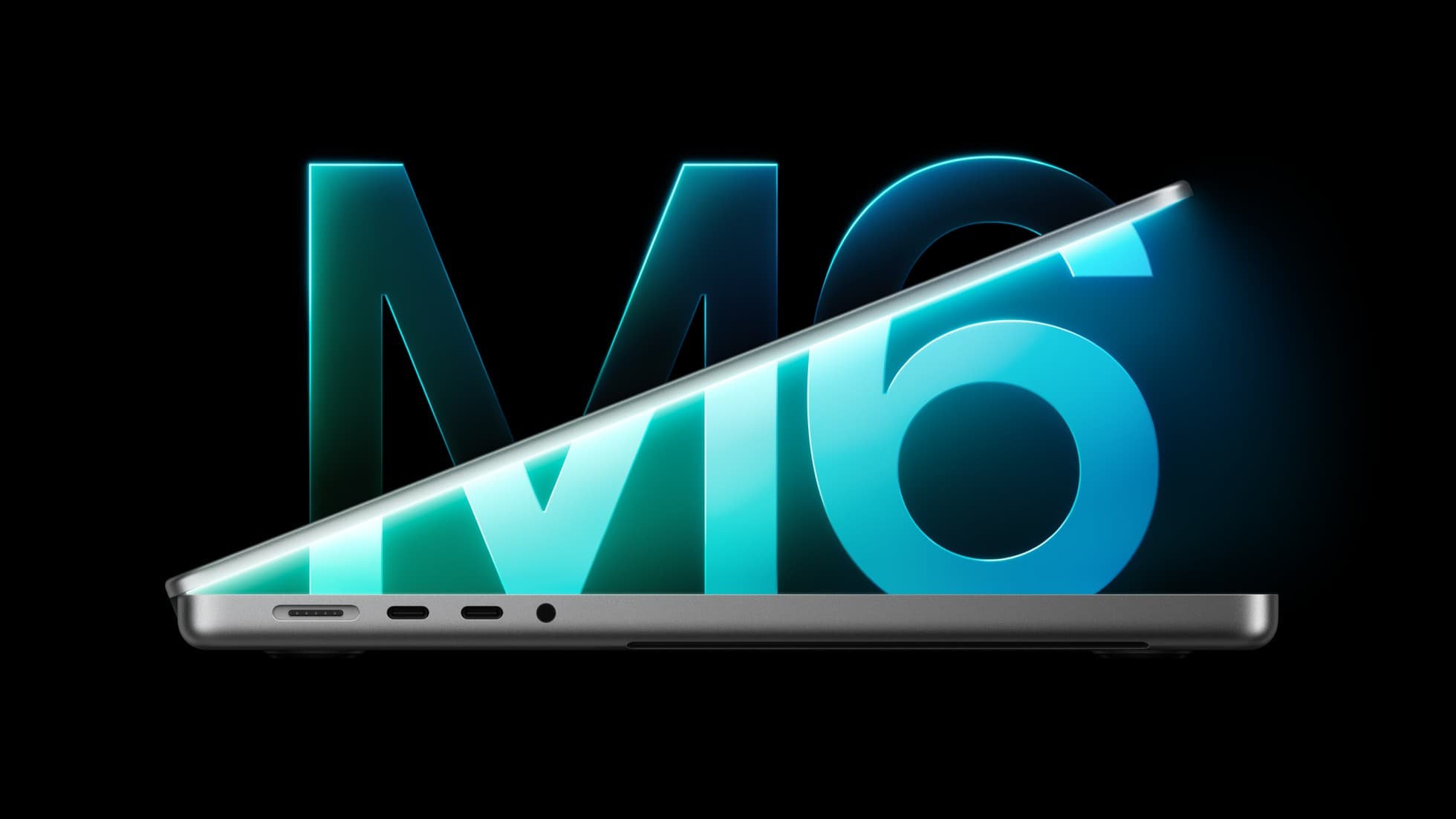
Apple's promotional image for the 14-inch MacBook Pro with M6, which opened for pre-order on Oct. 28.
Image: Apple
Source · Press image from the Apple newsroom, used for news reporting.
Apple M6, the company's first 2 nm Mac chip, reached its first pro laptop on Oct. 28, when pre-orders opened for the 14-inch MacBook Pro with M6 at $1,999, with deliveries from Nov. 6.
As Voltgrid reported, Apple's Oct. 27 release gave the laptop's price, dates and Apple's own performance claims. This file adds what that story could not: the process and core layout Apple disclosed when it launched the chip in August, the first independent measurements, and how M6 stacks up against M5 and Qualcomm's Snapdragon X2 Elite. One caveat runs through all of it. Every independent number so far comes from the M6 Mac mini, which went on sale in September. No outlet has yet published results from the MacBook Pro.
M6 is Apple's entry-level Mac chip, Notebookcheck says. Apple uses it in the Mac mini, the 14-inch MacBook Pro and, per an Oct. 27 announcement, the iMac (arriving Nov. 6). For buyers, the question is whether a base chip now covers work that used to need a Pro tier: code builds, photo and video work, and small local language models.
Apple M6 Specs: Cores, Clocks and Memory
Apple introduced M6 on Aug. 25 as its first chip on a 2-nanometer process. Voltgrid News reported earlier on the 2-nanometer A20 Pro in the iPad mini. Apple does not name the foundry; Notebookcheck reports it is built on TSMC's N2. The CPU grows to 12 cores, two more than M5, split into 2 super cores, 4 performance cores and 6 efficiency cores. Notebookcheck lists peak clocks of 4.78 GHz for the super and performance cores and 2.94 GHz for the efficiency cores. The GPU also has 12 cores, up from 10, each with a Neural Accelerator, and the single Neural Engine of M5 becomes a Dual 16-core Neural Engine.
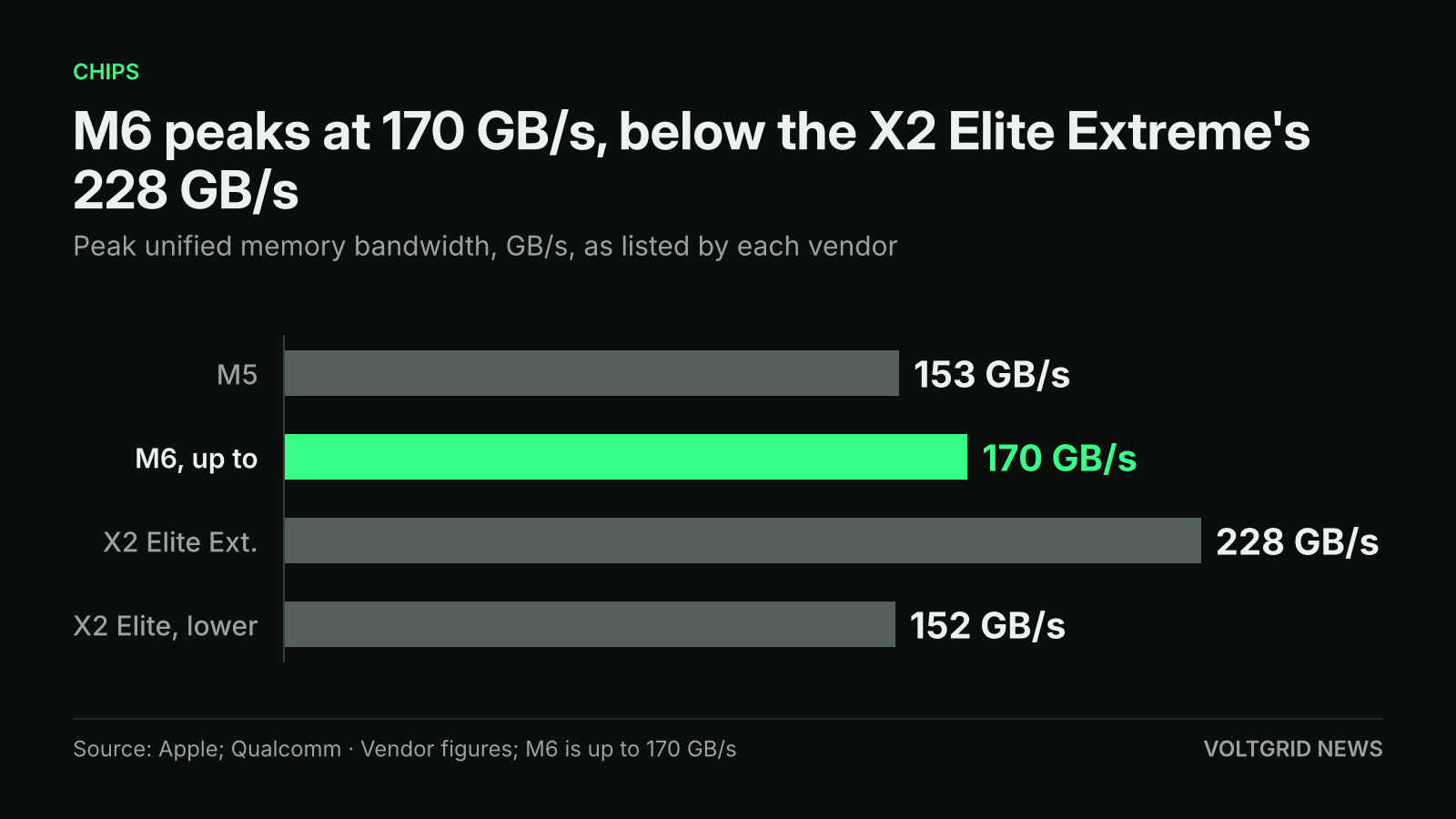
Apple's M6 lists up to 170 GB/s, 10 percent more than M5 by Apple's claim; Qualcomm lists 228 GB/s for the X2 Elite Extreme. Vendor figures.
Illustration (AI-generated)
The design choice that matters most for local AI is the memory system, and it moved least. M6 tops out at 32GB of unified memory, the pool the CPU, GPU and Neural Engine share, and Apple quotes up to 170GB/s of bandwidth, 10 percent more than M5's 153 GB/s. Bandwidth sets how fast a model's weights stream in for each generated token, so in bandwidth-bound decoding, where each token re-reads the weights, a 10 percent gain limits the speedup however many GPU cores are added. There is a catch for the $1,999 laptop, which ships with 16GB. Notebookcheck says Apple lists 153 GB/s for 16 GB configurations and up to 170 GB/s for 24 GB and 32 GB ones. Apple's MacBook Pro release says only "up to" 170GB/s.
Running a language model on a laptop has two phases. Reading the prompt is compute-heavy, so more GPU cores and a faster Neural Engine help; Apple's 25 percent and 1.3x time-to-first-token claims for M6 describe this phase. Writing the reply is different. Each new token re-reads the model's weights from memory, so speed is capped by how fast memory delivers them.
That delivery rate is memory bandwidth. Apple quotes up to 170GB/s for M6, 10 percent more than M5's 153 GB/s, a smaller step than the nearly 30 percent Apple claimed for M5 over M4. Notebookcheck says Apple lists 153 GB/s for 16 GB configurations such as the $1,999 base model. Apple's release gives no token-generation figure, so the base laptop may gain little in reply speed.
Apple M6 vs M5 and Snapdragon X2 Elite
Apple's own claims, made against a 14-inch MacBook Pro with M5 and 32GB, are up to 30 percent faster graphics, up to 25 percent faster on-device AI work such as LLM prompt processing, up to 1.3x faster time to first token, and a Neural Engine up to 1.9x faster. In August it also claimed up to 1.2x the multithreaded CPU performance of M5. These are vendor figures, and Apple does not name the model behind the token claim.
Against Qualcomm, the closest Windows-on-Arm rival, Notebookcheck found M6 more than 30 percent faster in single-core work than the Snapdragon X2 Elite Extreme, and more than 70 percent faster than Intel's Panther Lake and AMD's Zen 5 chips. In multi-core work the order flips at the top: the X2 Elite Extreme ran about 14 percent ahead of M6, while M6 beat the other X2 models. The X2 Elite Extreme also has more memory bandwidth on paper: Qualcomm lists 228 GB/s on a 192-bit bus for the X2E-96-100 and X2E-94-100, and 152 GB/s on lower X2 Elite parts. Bandwidth, more than core count, limits how fast larger models generate text.
M6 Benchmarks So Far, All From the Mac Mini
All of the following were measured on the M6 Mac mini, a desktop, not the MacBook Pro. Notebookcheck tested a 24 GB unit and recorded 221 points single-core and 1,468 multi-core in Cinebench 2024, against 200 and 1,172 for the M5 in a 2025 MacBook Pro 14. Across Cinebench 2024 and Geekbench 6 it put M6 about 10 percent ahead of M5 in single-core work and 21 percent ahead in multi-core, with the 21 percent measured against the M5 MacBook Pro 14. Apple's 1.2x claim rests on its own tests. Its GPU tests showed a lead of about 30 percent over the 10-core M5 GPU, in line with Apple's graphics figure, and Geekbench AI results usually 20 to 40 percent above M5.
Efficiency improved as well. Notebookcheck measured 15.2 points per watt in single-core Cinebench, against 13.1 for the M5 MacBook Pro and 5.83 for the X2 Elite Extreme in an Asus Zenbook A16. It estimates the CPU draws up to about 30 W under multi-core load, the same as M5, and saw the GPU at 18 W against 18 to 19 W for M5. The CPU figures are its own estimates, because macOS did not report CPU power on this chip.
Tom's Guide, also on a 24GB Mac mini, measured 4,708 single-core and 21,405 multi-core in Geekbench 6.7, against 3,838 and 14,838 for the M4 Mac mini. It transcoded a 25GB 4K video to 1080p in 2 minutes 45 seconds, against 4 minutes 42 seconds on the M4 model. The two outlets used different tests, so their percentages should not be mixed, but both point the same way.
Apple M6 Price, Availability and Software
The 14-inch MacBook Pro with M6 costs $1,999 in the U.S., or $1,899 with education pricing, with 16GB standard and 32GB as the ceiling. Pre-orders opened Oct. 28 in 35 countries and regions, and the laptop arrives from Nov. 6 with macOS 27, Wi-Fi 7 and Bluetooth 6. The iMac with M6 starts at $1,499 with a version of M6 that has 10 CPU and 10 GPU cores, and at $1,699 with the full 12-core part. The M6 Mac mini starts at $899, which Tom's Guide notes is $300 more than the M4 model. Apple pitches M6 for running LLMs locally, but Notebookcheck calls it Apple's entry-level chip and says the Mac mini is not designed for large AI models because of its memory limits.
What to Watch Next
The first independent reviews of the 14-inch MacBook Pro with M6 are the next test, with the laptop reaching customers from Nov. 6. They should show whether a laptop with a fan sustains the Mac mini results, and how close real use comes to Apple's 24-hour battery claim. Apple's 1.3x time-to-first-token claim still needs a measurement on a named model, and the 16GB base configuration needs a bandwidth test of its own.
Sources
- 01I just tested the Mac mini M6 - and it packs the power boost Apple's smallest Mac neededTom's Guide · tomsguide.com
- 02Apple introduces the new 14-inch MacBook Pro with M6Apple · apple.com
- 03Apple M6 SoC Analysis - Apple's 2 nm chip crushes AMD, Intel & QualcommNotebookcheck · notebookcheck.net
- 04Apple introduces M6 and M5 Ultra for a big leap in performance and AI computeApple · apple.com