Malaysia Seizes 30 AI Servers Worth 49.5M Ringgit at Kuala Lumpur Airport
Malaysian customs seized 30 servers carrying advanced AI chips, valued at 49.5 million ringgit ($12.1 million), and tied them to a syndicate behind five cases this year, with no brands or destination named.
2 min readAI-assisted
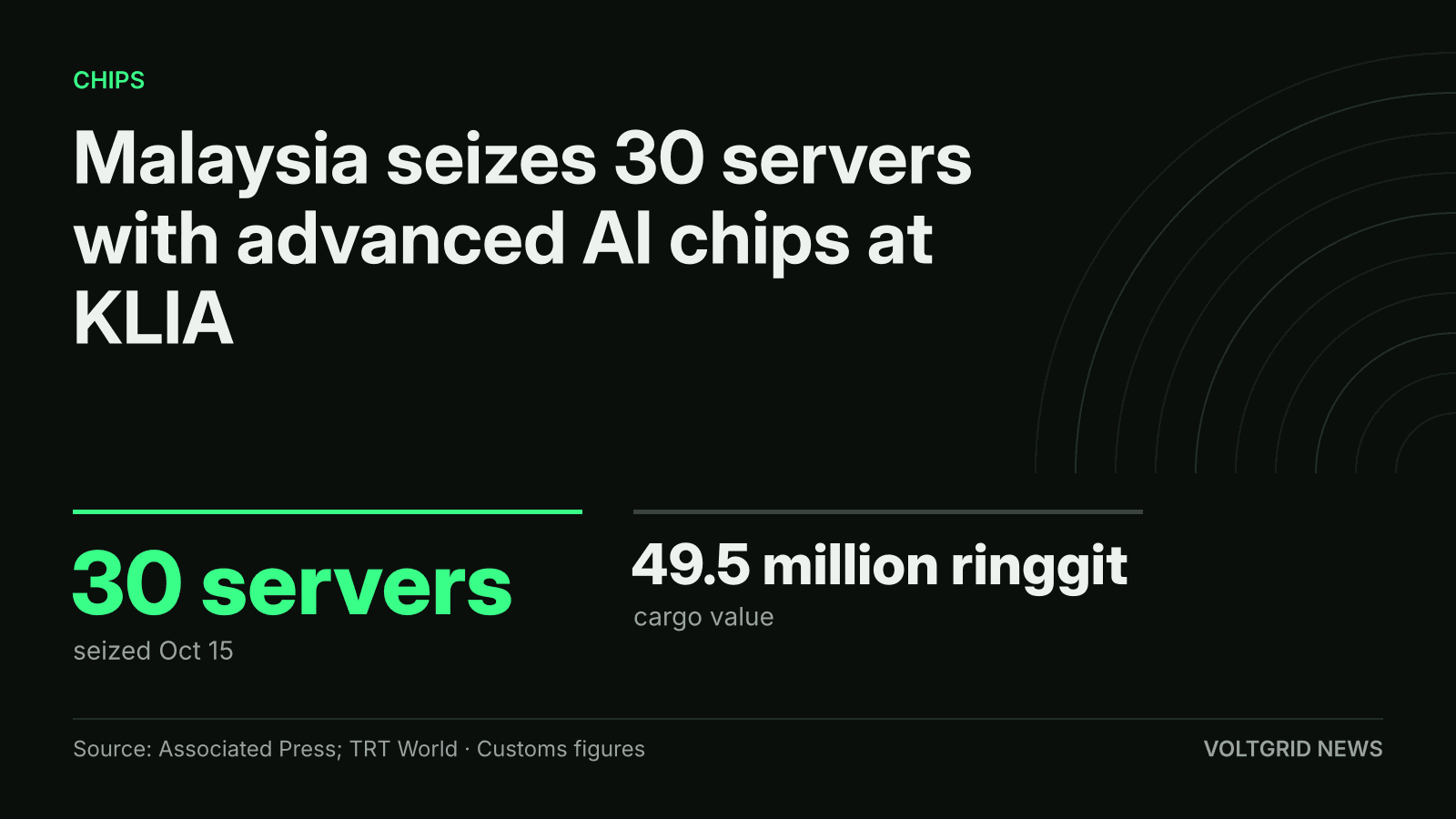
Customs seized the 30 servers on Oct 15 at the free trade zone of Kuala Lumpur International Airport and disclosed the case on Oct 28.
Illustration (AI-generated)
Malaysian customs seized 30 server units carrying advanced AI chips worth 49.5 million ringgit ($12.1 million) in the free trade zone at Kuala Lumpur International Airport on Oct. 15, and disclosed the case on Oct. 28, according to the Associated Press and TRT World.
Airport customs director Aspalila Ag Tuah told a news conference that the servers were declared as electronic components to avoid detection. Initial findings, she said, show they came from an unnamed Asian country and were due to be re-exported to another country in Asia. The Associated Press put the cargo at about 50 million ringgit ($12.2 million), a rounding difference from the 49.5 million ringgit TRT World reported.
The agency described a syndicate that uses Malaysia as a transit point so the servers meet no restrictions on the next leg of their journey. Customs links this shipment to five attempted smuggling operations this year, including a June seizure of 72 servers with advanced AI chips at the same free trade zone. TRT World reported the five cases together exceed $24 million in estimated value.
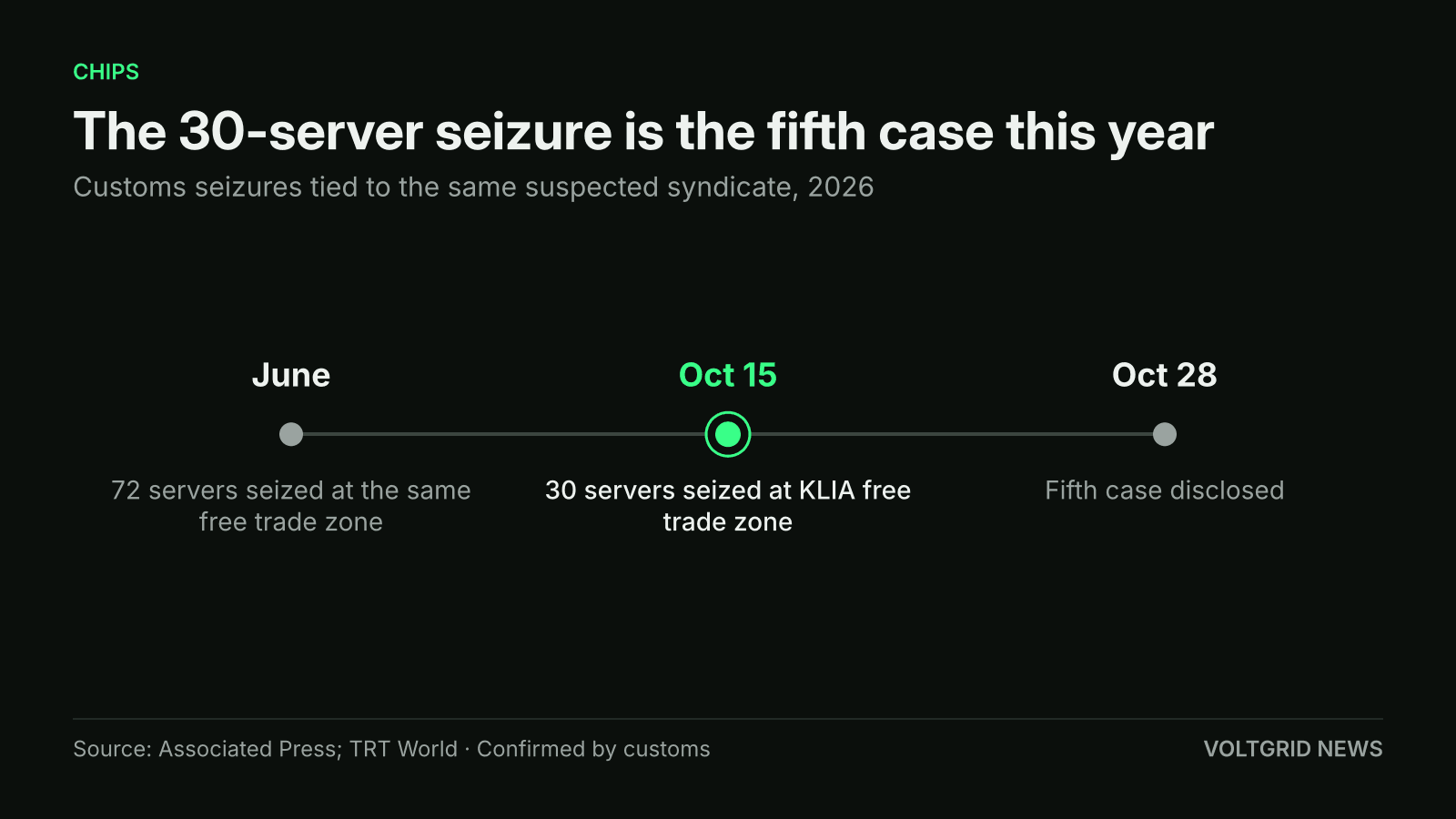
Customs links the 30-server seizure to five cases this year, including 72 servers seized in June, according to the Associated Press.
Illustration (AI-generated)
Why it matters for AI hardware supply
Malaysia is a growing data-center hub, and that is what makes the seizure relevant to capacity planners. Servers that pass through Kuala Lumpur on paper can end up in places the chip's country of origin did not license. Malaysia introduced permit requirements last year for the export, transit and transshipment of high-performance AI chips of US origin, under pressure from Washington to stop rerouting to China. The Associated Press said the shipment was moved onward without the required permit.
For operators building in the region, the practical effect is more scrutiny of any rack-scale hardware crossing the border, and longer lead times when documents do not match the cargo. As Voltgrid reported, Malaysia is also drawing large data-center investment, so the same airports and ports handle both legitimate and suspect flows.
What is not confirmed yet
Customs did not name the chip maker, the country the servers came from, or where they were headed, and TRT World's report says the exact origin and manufacturing location were declined. No arrests have been announced. The company that facilitated the shipment has been called in to assist the investigation, which remains open.
The link to US-made chips rests on the permit regime the agency cites, not on a stated brand in this case. Earlier Voltgrid coverage of a separate case, a US licence for NVIDIA GPUs bound for Kazakhstan, shows how licensed routes are meant to work. TRT World noted that Malaysia has other probes under way, including one into how servers with US-made NVIDIA chips bound for Singapore ended up in the country, where authorities earlier said they found no evidence of illicit trade in advanced semiconductors.