Intel and Oracle Plan Multiyear Xeon Push on OCI, Diamond Rapids X14
Intel and Oracle said on Oct. 27 they plan to expand Xeon computing on Oracle Cloud Infrastructure, with X14 offerings expected on Diamond Rapids. No launch date, price or capacity figure was given.
3 min readAI-assisted
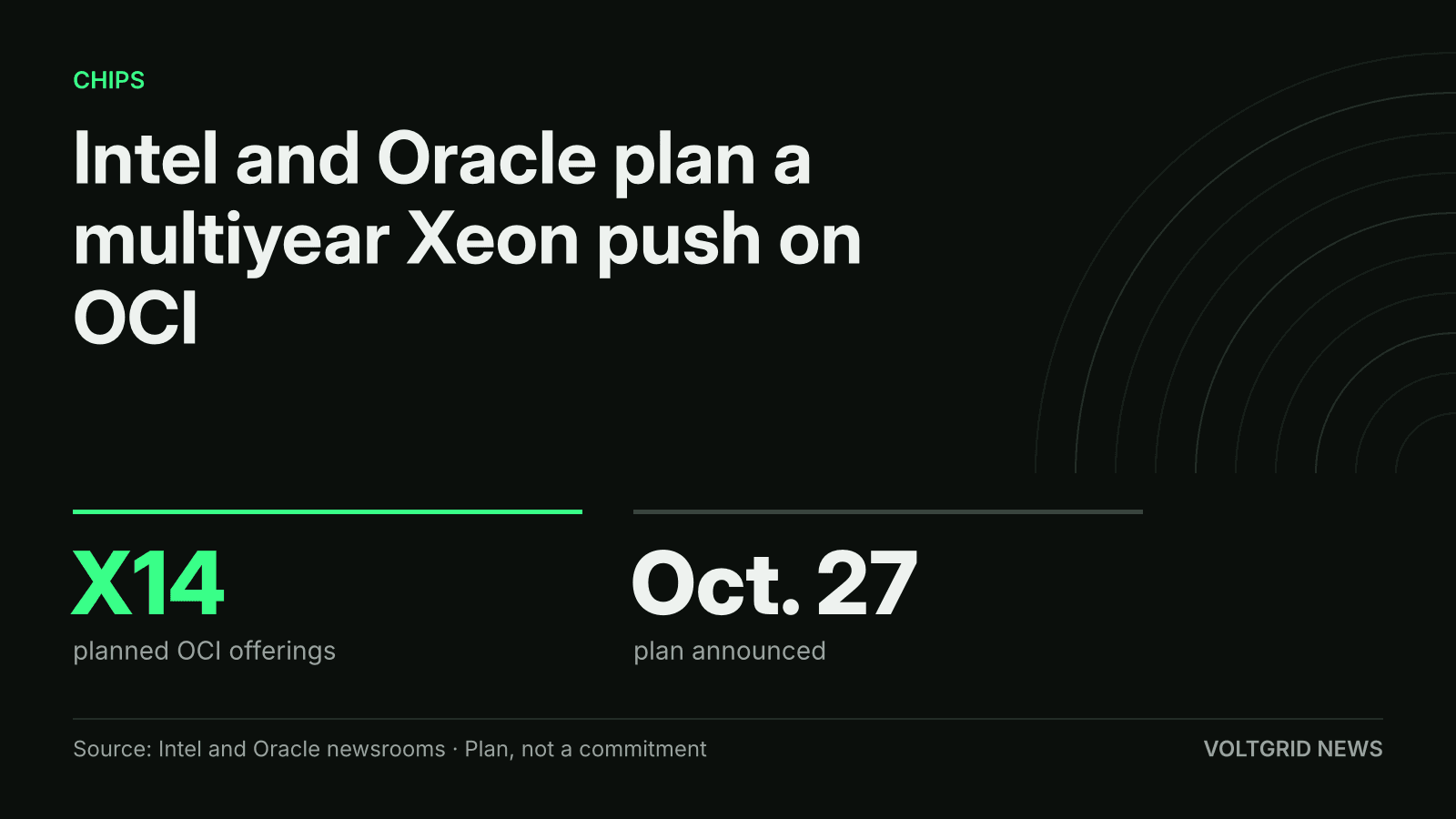
Intel and Oracle announced the plan on Oct. 27; both releases describe intentions, not a commitment.
Illustration (AI-generated)
Intel and Oracle said on Oct. 27 at Oracle AI World in Las Vegas that they plan a multiyear collaboration to expand Intel Xeon computing on Oracle Cloud Infrastructure (OCI), including planned OCI X14 offerings expected to be based on Diamond Rapids, Intel's next-generation server processor.
The two companies said in matching releases that they intend to coordinate roadmaps and processor capacity planning as OCI grows. Neither release gives a processor count, a megawatt figure, a price, a region list or a launch date for X14. Both are written as intentions and expectations, and both carry forward-looking-statement warnings that the plan may not be completed on time or at all.
The announcement covers the CPU tier of the AI build-out, not the accelerator tier. Intel's argument is that AI agents need processors to run application code, move and secure data, orchestrate actions and handle inference. Oracle's own accelerator plans are the larger power story, as Voltgrid reported on Oracle's Vera Rubin expansion and its plan to add Google TPUs. Intel's pitch here is that customers can size application and agent workloads separately from the accelerators that serve larger models.
What X14 is expected to add
The releases say Diamond Rapids-based X14 offerings are expected to bring enhanced Advanced Matrix Extensions (AMX) with FP8, FP16 and BF16 support for inference software, plus Advanced Performance Extensions (APX), which is expected to help optimized applications run with less instruction overhead. Intel and Oracle say these features are meant for embedding generation, reranking and smaller-model inference next to the services an agent calls. These are vendor expectations; no benchmark or power figure accompanies them.
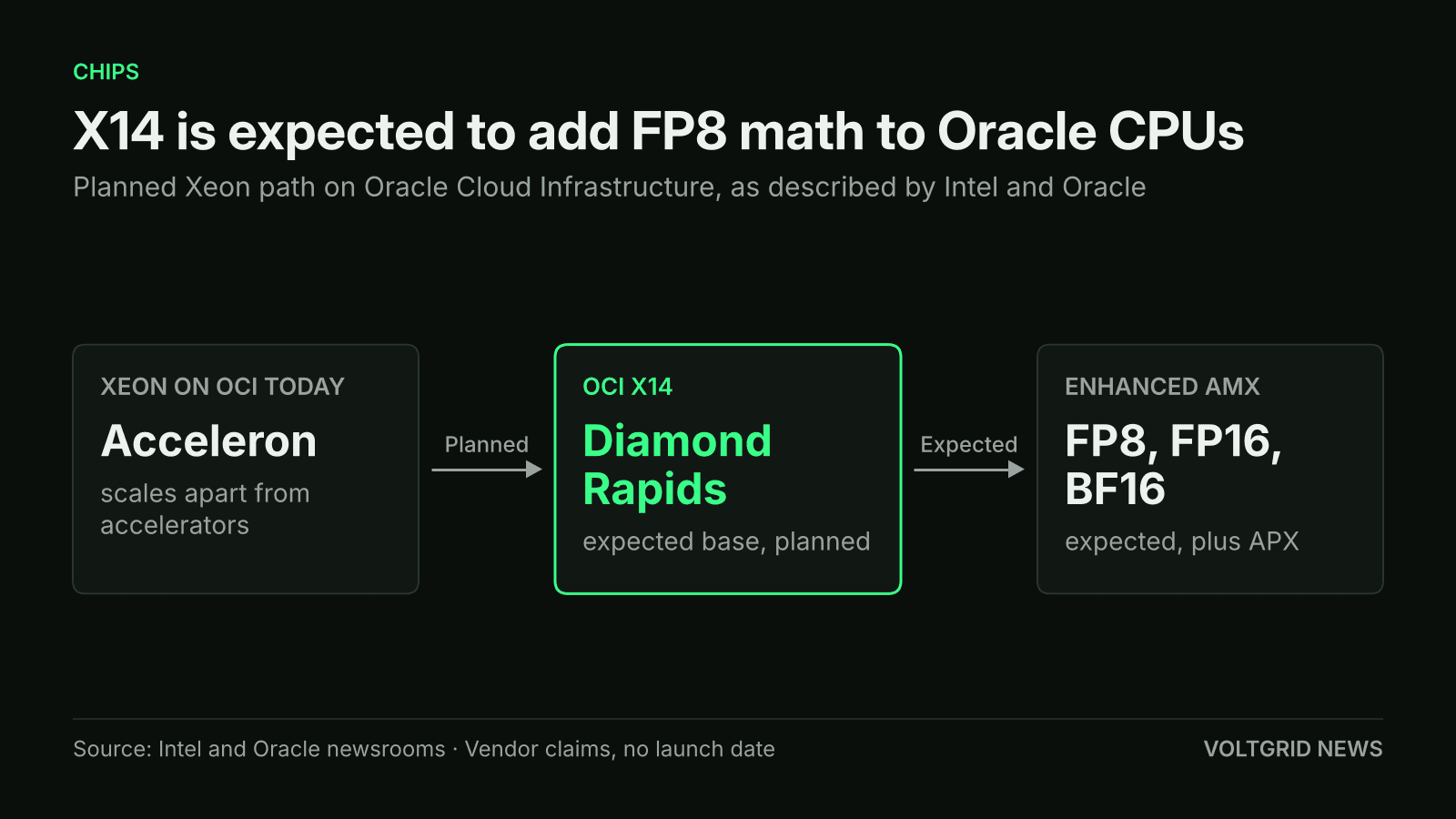
X14 is expected to be based on Diamond Rapids and add enhanced AMX, according to Intel and Oracle; no launch date is given.
Illustration (AI-generated)
Oracle's current Xeon-based OCI offerings pair Intel compute with built-in AI acceleration, flexible CPU and memory configurations and Oracle Acceleron networking, according to the release. Kevork Kechichian, executive vice president and general manager of Intel's Data Center Group, pointed to hardware-based confidential computing as part of Xeon's case. Pradeep Vincent, executive vice president for compute and AI infrastructure at Oracle Cloud Infrastructure, said the collaboration is intended to help grow the compute capacity behind enterprise AI workloads.
For Intel, the deal is a named cloud home for a server part with no stated ship date. Its accelerator effort is a separate track: as Voltgrid reported, the Intel D270 is a 350 W, air-cooled card with no launch date or price.
What enhanced AMX means for CPU inference
Advanced Matrix Extensions (AMX) are matrix-math instructions built into Xeon cores, so a server can run part of an AI model on the processor itself instead of handing every job to an accelerator. FP8, which X14 is expected to add, is an 8-bit number format. Narrower formats take less memory per model weight, which suits the smaller models the releases name: embedding generation, reranking and smaller-model inference.
The consequence is for capacity planning. Work that fits on the CPU tier does not queue for accelerator racks, and each tier can be sized and powered on its own, as Oracle's release says. All of this is an expectation: neither company has published a benchmark, a power figure or a launch date.
What is not confirmed yet
The releases do not say when Diamond Rapids will ship, when X14 will reach customers, how much capacity Oracle will buy, or on what terms. Both releases carry a product-direction disclaimer saying the outline is not a commitment to deliver. Until a date, a shape list or a volume appears, this is a statement of intent between two long-standing partners.