Applied Materials Q1 Guidance: $11.1B Revenue After Record $10.41B Quarter
Applied Materials guided Q1 revenue above the $10.89 billion LSEG average estimate, Reuters reported, as DRAM rose to 33% of chip-tool sales in the quarter ended Oct. 25.
Chips & Power DeskEdited by Ege Erten
2 min readAI-assisted
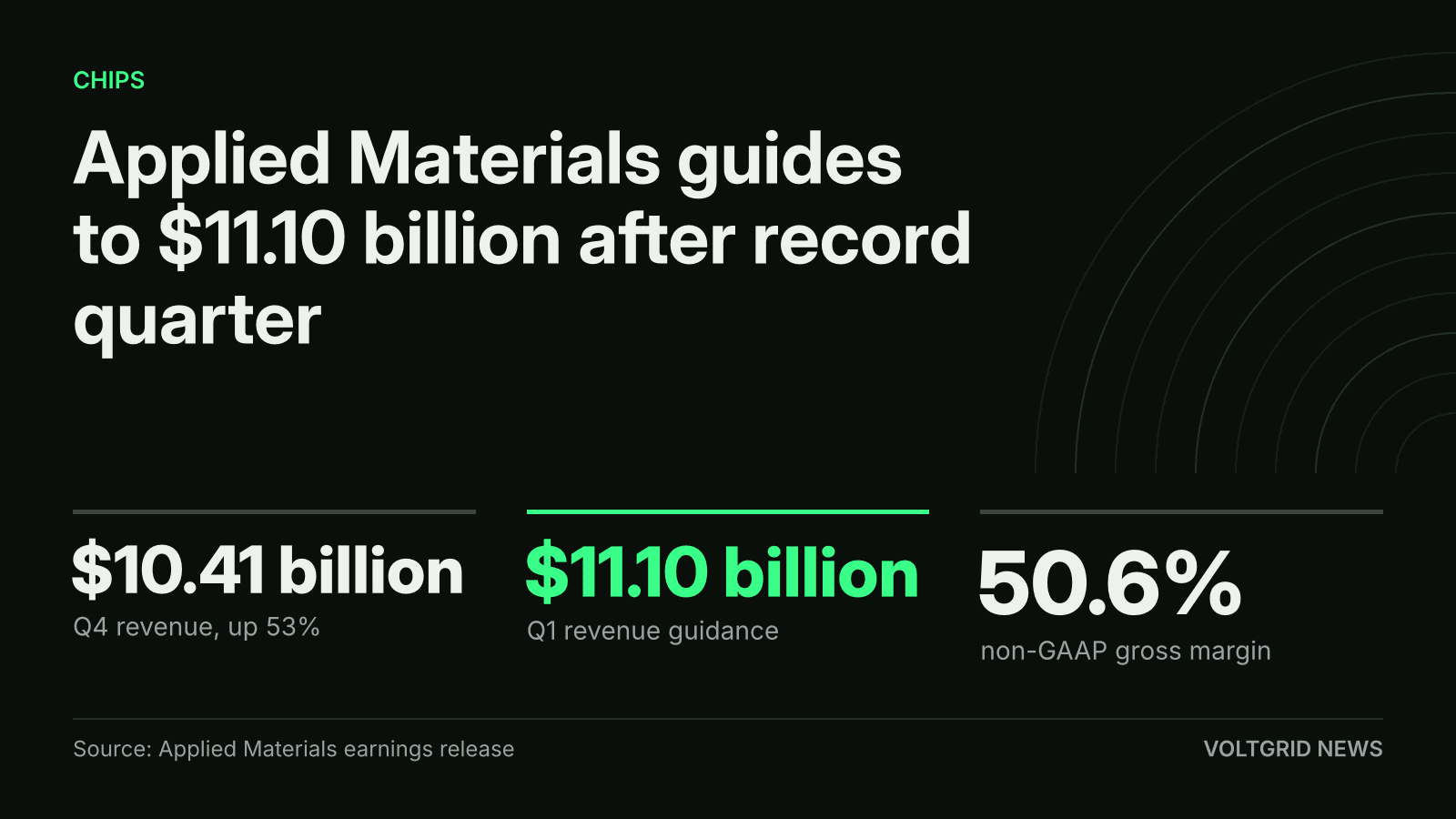
Applied Materials' fiscal fourth-quarter figures and first-quarter revenue guidance, from the company's earnings release.
Illustration (AI-generated)
Applied Materials issued fiscal first-quarter 2027 guidance of $11.10 billion in revenue, plus or minus $500 million, after a record fiscal fourth quarter of $10.41 billion, up 53% from a year earlier, the company said on Nov. 12.
The numbers come from the company's earnings release, filed with the US Securities and Exchange Commission for the quarter ended Oct. 25. Non-GAAP earnings per share were a record $4.16, up 92%, and GAAP EPS was $3.40, up 43%. Non-GAAP gross margin was 50.6%, up 2.5 points. For the fiscal year, revenue was $34.45 billion, up 21%, with non-GAAP EPS of $12.89.
Reuters reported that the first-quarter forecast compares with the $10.89 billion average of analyst estimates compiled by LSEG, and that fourth-quarter revenue beat an average estimate of $10.30 billion. Shares were up 3% in extended trading, according to Reuters. The company also guided non-GAAP EPS to $4.35, plus or minus $0.20. Against its own August guide in the third-quarter release, which called for $10.25 billion plus or minus $500 million and $4.02 EPS, the quarter landed $159 million above the revenue midpoint. The new midpoint is 6.6% above the fourth-quarter result.
DRAM Rises to 33% of Semiconductor Systems Sales
Semiconductor Systems, which sells the wafer-fab tools, generated $8.00 billion in the quarter, up from $4.88 billion a year earlier. Its mix shifted toward memory: DRAM was 33% of those sales, against 28% a year ago, and flash was 9%, against 6%. Foundry and logic fell to 58% from 66%. By our arithmetic from those rounded shares, DRAM tool sales were about $2.6 billion, nearly double the roughly $1.4 billion of a year earlier. Applied Global Services, its installed-base business, brought in $1.90 billion.
DRAM was 33% of Semiconductor Systems sales in the quarter, up from 28% a year earlier, while foundry and logic fell to 58% from 66%.
Illustration (AI-generated)
Chief executive Gary Dickerson said in the release that the company is on track to grow Semiconductor Systems more than 40% in calendar 2026, and that AI continues to fuel strong incremental demand for semiconductors. Voltgrid News also covered Lam Research's record quarter and December guide, a peer tool maker's report.
Revenue by Region: Taiwan, China, Korea and the US
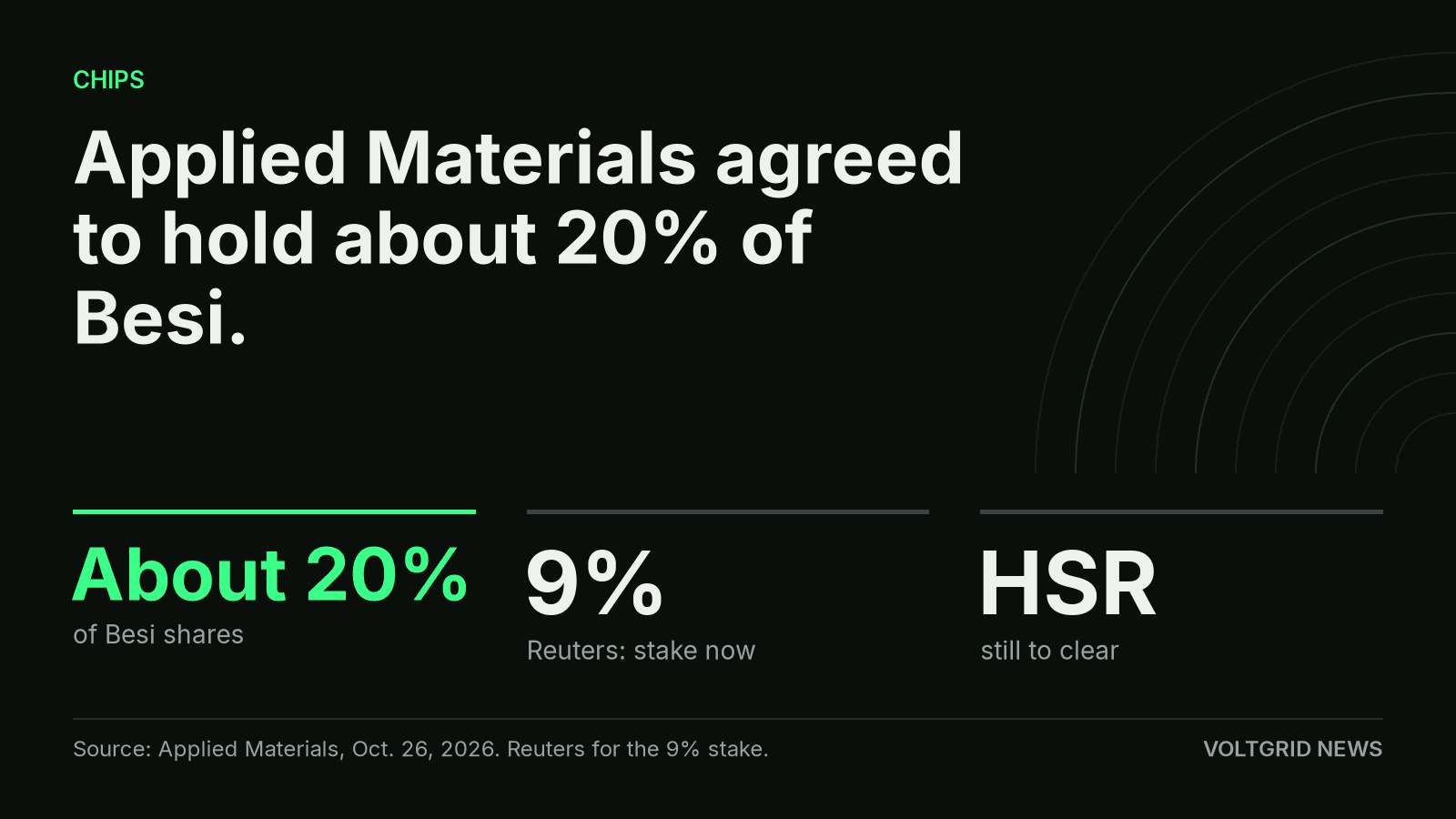
By region, Taiwan was the largest market at $2.92 billion, or 28% of revenue. China was $2.64 billion, or 25%, down from 29% a year ago even as the dollar figure rose from $1.96 billion. Korea contributed $1.81 billion and the United States $1.32 billion, roughly double the $655 million of a year earlier. Voltgrid News reported earlier on Applied Materials' plan to raise its Besi stake.
For the supply chain, the memory shift matters most. Tool purchases typically precede wafer output by several quarters, so a larger DRAM share points to more high-bandwidth memory and server DRAM capacity entering production in 2027. HBM is the stacked memory attached to AI accelerators. The release does not break out HBM, so that link is our inference, not a company statement. Applied also named Intel as a founding partner of its EPIC Center research facility, with Kioxia and Besi as innovation partners. Another chip supplier, Infineon, also guided higher on AI demand.
What is not confirmed yet
Guidance is a range, and the company's outlook excludes items it cannot predict. The EPS figure is non-GAAP, and the release gives no GAAP guide. Applied did not publish an HBM or advanced-packaging revenue split. China's share fell but export-control effects were not quantified in the release.