Canon FPA-6300AS6 ArF Scanner: First Dry ArF Since 2002, NA 0.93
Canon will take orders for the FPA-6300AS6 ArF scanner in early December and has published no price, throughput, ship date or customers; SEMICON Japan on Dec. 9-11 brings a panel display.
3 min read
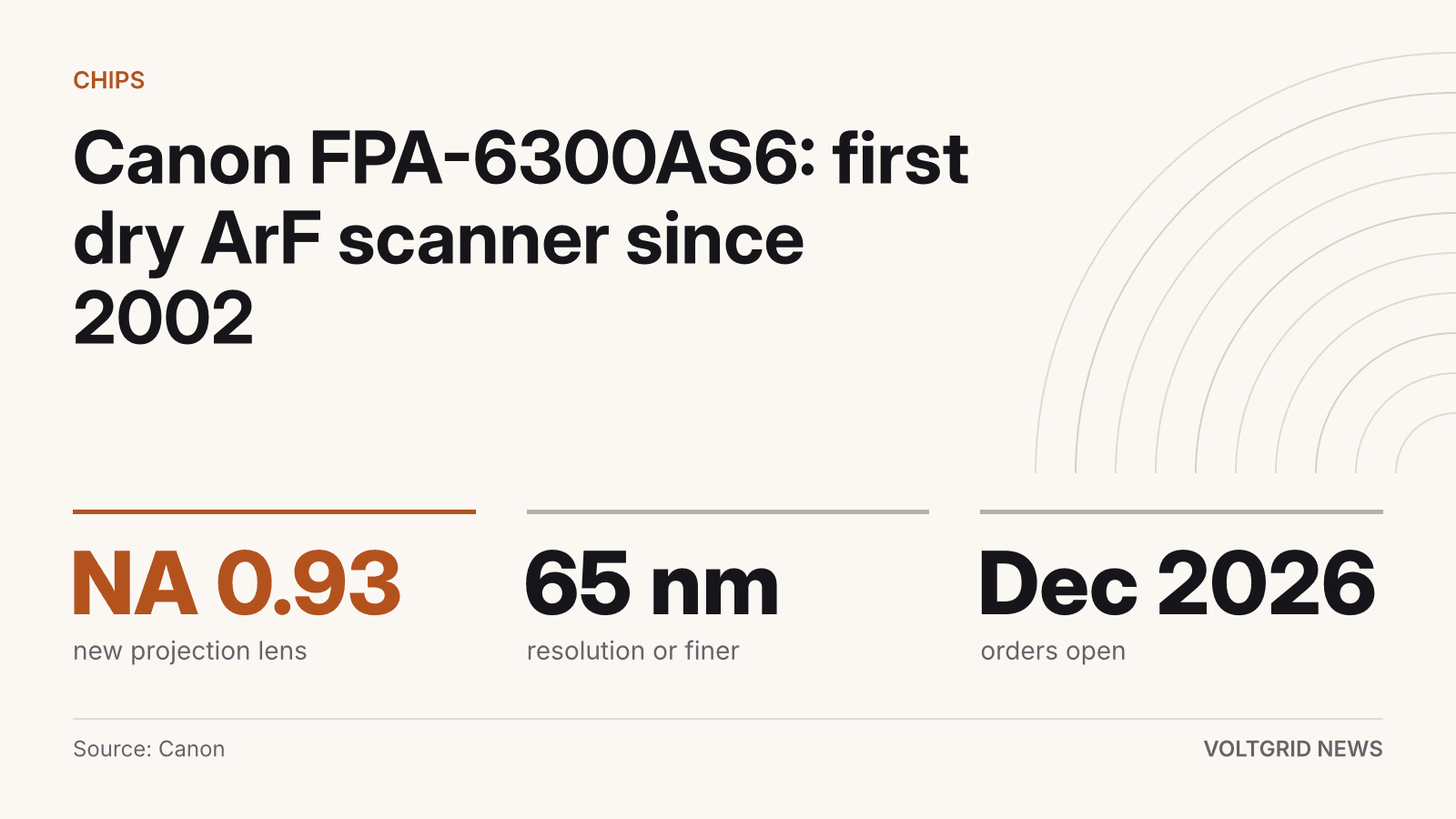
Canon's FPA-6300AS6 is its first dry ArF scanner since 2002, with a new NA 0.93 lens (Canon, vendor figures).
Graphic: Voltgrid News
Canon will begin taking orders in early December 2026 for the FPA-6300AS6 ArF scanner, a 193 nm argon fluoride dry tool built around a newly developed lens with a numerical aperture of 0.93, the company said on Nov. 24.
It is Canon's first ArF dry lithography system in more than two decades, after the FPA-6000AS4 of 2002. The tool reuses the platform of the FPA-6300ES6a, Canon's krypton fluoride (KrF, 248 nm) scanner, and Canon aims it at memory, power and sensor devices. Canon has not published a price, a throughput figure or a shipping date. Canon says the tool will be introduced through a panel display at SEMICON Japan 2026, at Tokyo Big Sight on Dec. 9 to 11.
The point for the AI build-out is supply, not the leading edge. Memory, power-conversion and sensor chips sit around every accelerator rack, and Notebookcheck, reporting the launch on Nov. 25, noted that dry ArF stays in volume production for memory, automotive power devices and sensors while EUV draws the attention. Another vendor taking orders for 193 nm dry tools could give those fabs one more place to buy patterning capacity for the layers that do not need immersion or EUV, although Canon has named no customers.
FPA-6300AS6 Specs: NA 0.93, 65 nm Resolution
Resolution depends on the light's wavelength and the lens's numerical aperture, the measure of how much light the lens gathers: a larger NA prints finer lines. In a dry scanner, air fills the gap between the last lens element and the wafer, which keeps NA below 1; immersion tools put water in the gap to go further, and EUV moves to a far shorter wavelength. At 0.93, Canon's lens sits just under that limit. Its spec page lists resolution of 65 nm or finer, a variable NA of 0.60 to 0.93, 4:1 reduction, a 26 mm by 33 mm field, overlay accuracy of 4 nm or better (Canon states no basis for it), 6-inch reticles and a choice of 200 mm or 300 mm wafers. Canon also says the tool handles small-diameter, thin and thick substrates and backside alignment, and plugs into Lithography Plus, its equipment-data platform. All of these are Canon's figures; no independent measurement exists yet.
How It Compares With ASML's TWINSCAN NXT:1470
ASML's dry ArF tool, the TWINSCAN NXT:1470, shares the 0.93 top NA, in a variable range of 0.70 to 0.93 against Canon's 0.60 to 0.93, according to ASML's product page, with resolution of 57 nm or finer and more than 300 wafers per hour, ASML says. ASML gives on-product overlay of better than 4.5 nm; Canon does not say on what basis its 4 nm is stated, so the two overlay numbers are not like for like.
Canon states no throughput or overlay basis for the FPA-6300AS6; ASML gives over 300 wafers per hour and on-product overlay for the NXT:1470 (vendor figures).
Graphic: Voltgrid News
Because both lenses top out at 0.93, NA alone does not separate the two tools. Throughput would, since for memory, power and sensor layers it sets the cost per wafer, and Canon has not stated one. Canon's own KrF launch two weeks earlier gives a sense of the platform but no stand-in: Canon says it rates the FPA-6400ES6a, a 248 nm tool also due in early December, at 400 wafers per hour on 300 mm wafers at 96 shots and 4.0 nm overlay.
Price, Throughput and Ship Date Not Confirmed
Canon has named no customers, no price, no throughput and no delivery date. Orders opening in early December is not the same as tools shipping then, and the SEMICON Japan display on Dec. 9 to 11 is the next point where Canon may say more.
Sources
- 01TWINSCAN NXT:1470: ASML's dry ArF scanner on the NXT platformASMLasml.comas read on Nov 25, 2026
- 02FPA-6300AS6 High Resolution ArF Dry ScannerCanonglobal.canonas read on Nov 25, 2026
- 03Canon unveils new ArF Lithography Scanner after 24-year gap to support chip manufacturingNotebookchecknotebookcheck.net
- 04Canon introduces FPA-6300AS6 ArF dry scanner to support diverse semiconductor manufacturing requirementsCanonglobal.canon
- 05Canon launches FPA-6400ES6a KrF semiconductor lithography systemCanonglobal.canon
- Published
- Sources
- 5 cited