Centrus Ships First Piketon Centrifuge; New Capacity Targets 2029
Centrus Energy shipped the first new centrifuge from Oak Ridge to Piketon, Ohio, on Oct. 29, ahead of its year-end target. New enrichment capacity for LEU, HALEU and national-security customers remains a 2029 target; total cost is undisclosed.
Nuclear & Microgrids DeskEdited by Ege Erten
5 min readAI-assisted

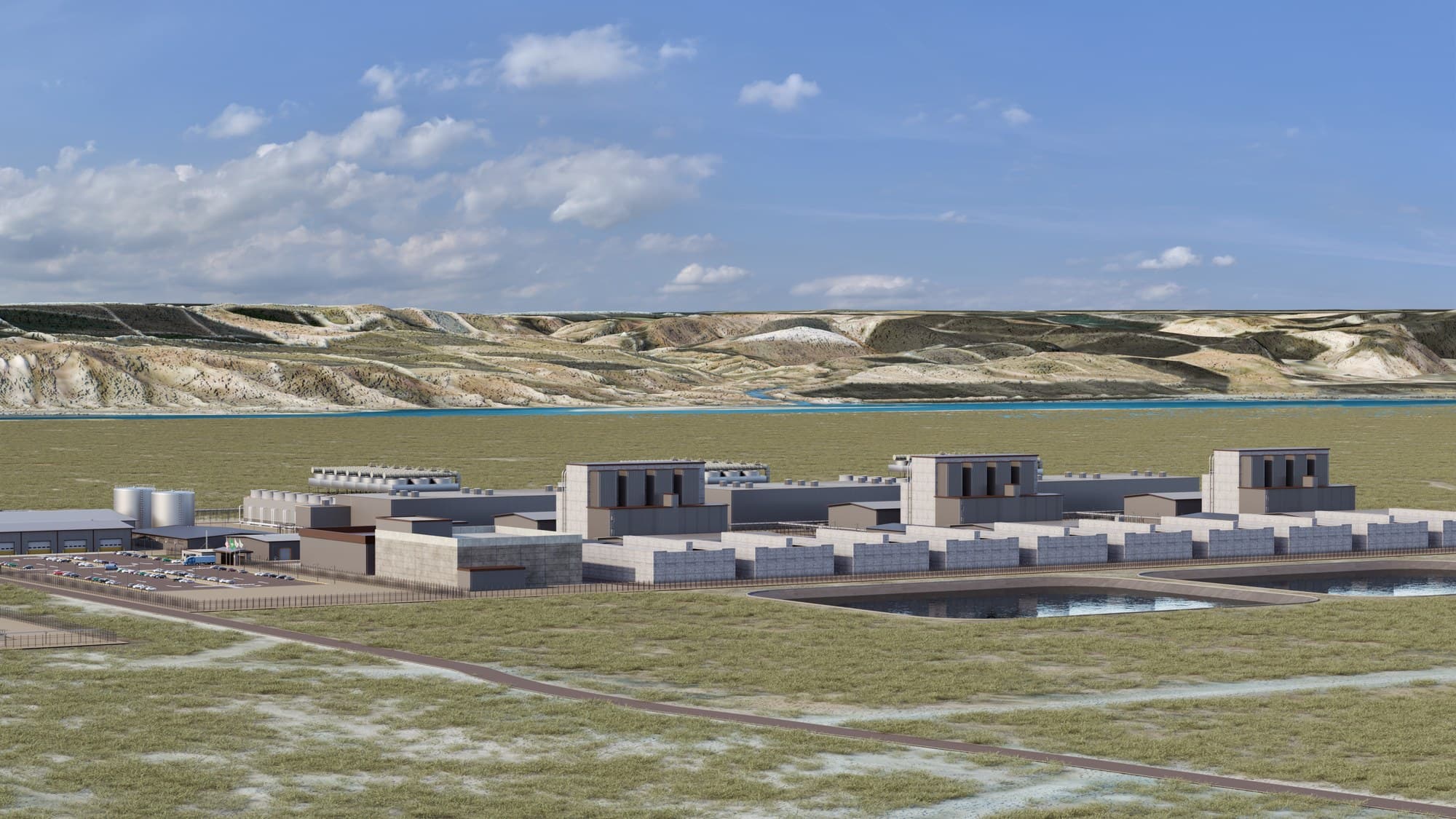
Centrus's Piketon, Ohio, site, where the enrichment expansion is planned. File photo from the company's Piketon page, not a picture of the Oct. 29 shipment.
Image: Centrus Energy
Source · Press image from the Centrus Energy website, used for news reporting.
Centrus Energy shipped the first new centrifuge for its Piketon, Ohio, enrichment expansion from its Oak Ridge, Tennessee, factory on Oct. 29, the first hardware for a project whose new capacity Centrus targets for 2029.
The company said the shipment and a complete manufacturing supply chain both came ahead of its own year-end target. Machines built in Tennessee go to Ohio for final assembly into cascades, at a rising rate, Centrus said. World Nuclear News reported the shipment on Oct. 30. Centrus has not published a total cost for what it calls a multibillion-dollar program.
The expansion matters because it would add commercial-scale production of high-assay low-enriched uranium (HALEU), the fuel many advanced reactors need, in a country with no commercial HALEU source today, according to WNN. Centrus has signed enrichment or HALEU supply agreements with X-energy, whose Xe-100 is the reactor Amazon is backing through X-energy, and with Radiant and Antares, plus a letter of intent with Oklo. Today its HALEU comes from a 16-centrifuge cascade built under a 2019 Department of Energy (DOE) demonstration contract, which had delivered 900 kilograms of HALEU, as uranium hexafluoride, to DOE by June 2025, according to Centrus's quarterly filing.
How Centrus Enrichment and HALEU Work
Enrichment raises the share of the fissile isotope uranium-235 in uranium hexafluoride gas by passing it through long chains of centrifuges, called cascades. Fuel for today's reactors, low-enriched uranium (LEU), typically carries 3.5% to 5% U-235. HALEU runs from 5% to 20%, and DOE's contract with Centrus specifies a nominal 19.75%. WNN notes the US has no commercial HALEU source today.
Centrus says its centrifuges have logged more than 4 million machine-hours and are built from an entirely domestic supply chain. Uranium enriched on US-origin technology carries none of the peaceful-use obligations attached to imported technology, WNN explains, so it can also serve national-security customers. The Ohio expansion is planned to produce LEU for the existing fleet, HALEU for new reactors, and material for national-security needs. Centrus has not stated, in the release or its latest quarterly filing, the expansion's capacity in separative work units (SWU), the industry's measure of enrichment output, or its HALEU output in tonnes a year.
DOE Funding and Customer Contracts
Three kinds of money stand behind the project. The first is Centrus's own. In January 2026 it announced a $560 million investment to turn the Oak Ridge center into a high-rate plant able to support thousands of centrifuges, and earlier this month it completed the purchase of Westerman Holdings, a supplier of centrifuge casings and other major parts. In April it hired Geiger Brothers as construction contractor at Piketon under a time-and-materials contract capped at $900 million and running to Jan. 30, 2031, its filing shows.
The second is DOE. On Jan. 5, 2026, DOE announced a $900.0 million task order for Centrus's subsidiary American Centrifuge Operating under the 2024 HALEU Production Contract, and the two sides signed the contract governing it on July 1, Centrus's second-quarter 10-Q says. The $900.0 million is a firm fixed price paid in milestones as Centrus deploys a specified amount of enrichment capacity and delivers 1 metric ton of uranium (MTU) as HALEU by July 2032. DOE also holds two options, at its sole discretion, for 5 MTU each at $17.0 million per MTU, or $85.0 million per option; WNN puts the total with options at $1.07 billion. Only the base is awarded; the options are DOE's to take or leave. When the work is done, Centrus's subsidiary takes title to the capacity. WNN reports that Centrus has also drawn on Tennessee's $70 million Nuclear Energy Fund; the amount Centrus received was not stated.
The third is customers. At June 30, Centrus reported an LEU backlog of about $3.7 billion, of which about $3.0 billion was contingent LEU and HALEU sales tied to building new Piketon capacity, and $2.4 billion of that under definitive agreements. The commercial HALEU agreements differ in strength. X-energy signed an enrichment agreement in August with phased prepayments tied to its reactor pipeline. Radiant and Antares signed multi-year contracts with prepayments, with deliveries to begin before the end of the decade. Oklo signed only a letter of intent in June, for fuel for up to five Aurora powerhouses with deliveries from 2029, and a definitive contract is still to be negotiated, according to WNN.
Licensing Status and Expansion Timeline
The shipment is a manufacturing milestone, not a regulator step. Centrus describes its technology as fully licensed, and its Piketon cascade has made HALEU since late 2023. The sources we read do not say whether the expansion needs further Nuclear Regulatory Commission (NRC) action at Piketon.
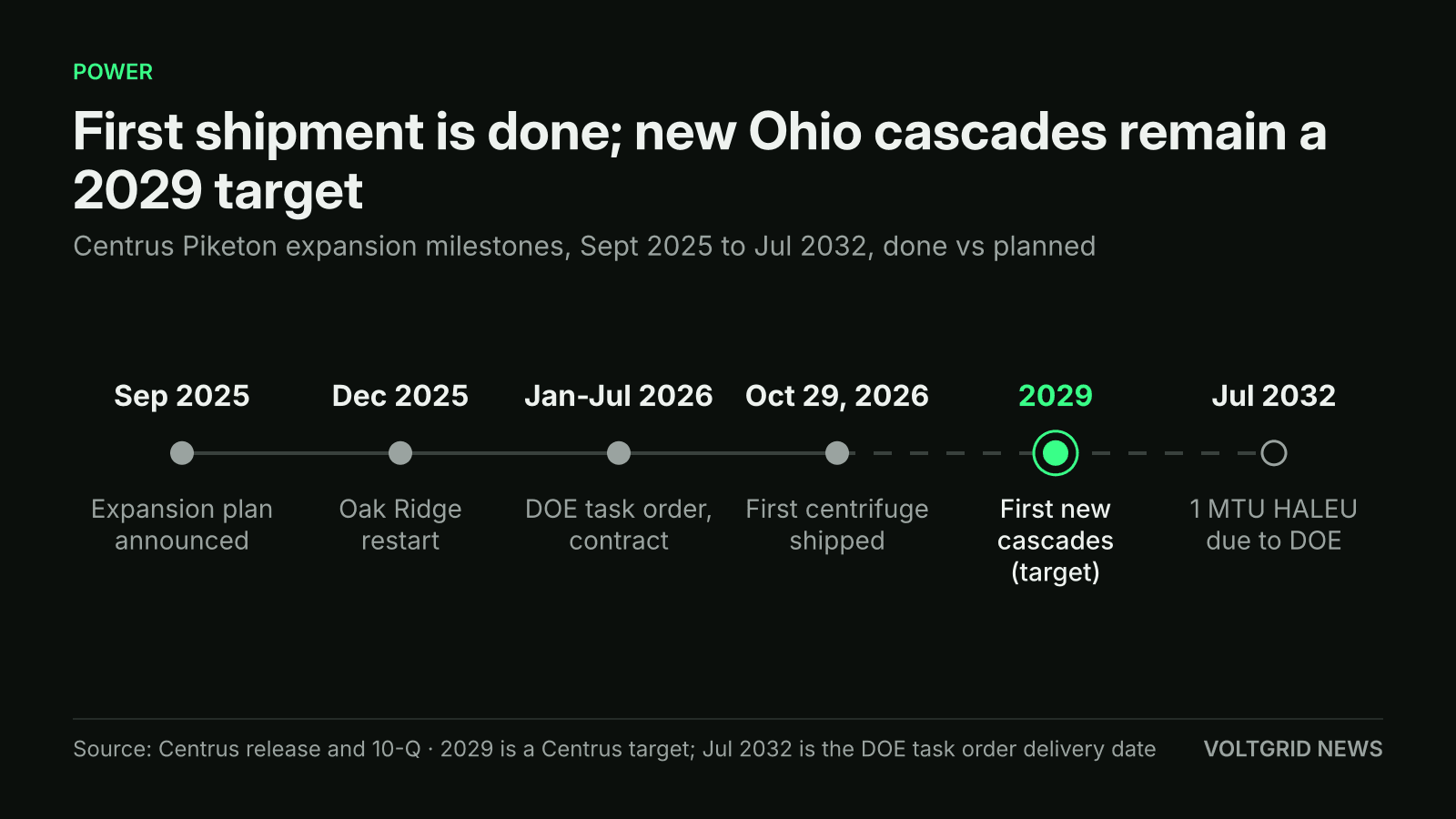
The Oct. 29 shipment is done; first new cascades in Ohio remain a 2029 Centrus target, per Centrus's release and 10-Q.
Illustration (AI-generated)
Since the expansion plan of September 2025, Centrus restarted centrifuge manufacturing in Oak Ridge in December 2025, won the DOE task order in January, signed its contract in July and shipped on Oct. 29. Ahead are the first new cascades in Ohio in 2029, which is a Centrus target, the end of the DOE contract's initial phase of performance in 2031, and the 1 MTU HALEU delivery due by July 2032.
What It Means for Advanced Reactors and Data Centers
For data-center buyers of new nuclear, the fuel date sits beside the licence date. X-energy designs each Xe-100 module for 200 MWt and 80 MWe, and a four-module plant for 320 MWe; it says plants can scale from four to twelve modules. Dow's Long Mott project in Texas is the Xe-100 project furthest along with the NRC, and Amazon has funded a study of an Xe-100 plant in Indiana with AEP. X-energy and Amazon share a goal of more than 5 GW of new US nuclear by 2039, a target rather than capacity under contract. X-energy's chief executive, Clay Sell, said in August that the Centrus agreement covers its customers' initial fuel needs until a broader commercial HALEU market forms. The agreement uses phased prepayments to scale HALEU production in step with X-energy's pipeline; Centrus has not said when its new cascades start making HALEU.
Other supply is further out or lower in enrichment. Urenco's HALEU plant at Capenhurst in England is scheduled for 2031, WNN reported, Orano's planned enrichment plant in Oak Ridge is under NRC review, according to ANS Nuclear Newswire, and GLE's Paducah plant would enrich only up to 8%.
What to Watch Next for Centrus
Centrus reports third-quarter results after the market closes on Nov. 4, with a call on Nov. 5 at 8:30 a.m. ET; the expansion's size in SWU, the production rate and the contingent backlog are the figures to watch. Oklo's definitive fuel contract has no date. The 2029 start of new cascades in Ohio remains a Centrus target, and DOE's first HALEU delivery under the new contract is due by July 2032.
Sources
- 01Centrus Begins Shipping Centrifuges to Ohio to Support Major Expansion of Uranium Enrichment CapacityCentrus Energy · centrusenergy.com
- 02Centrus ships first centrifuge for Piketon plant expansionWorld Nuclear News · world-nuclear-news.org
- 03Walsh, industry reps discuss “American energy hub” at Oak Ridge cleanup siteANS · Nuclear Newswire · ans.org