CXMT Entity List Request: Cotton Urges Commerce to Weigh DRAM Sales Ban
Sen. Tom Cotton asked Commerce on Nov. 12 to put CXMT on the Entity List and explore a US sales ban on the DRAM maker. It is a request, and Commerce has not said whether it will act.
Chips & Power DeskEdited by Ege Erten
3 min readAI-assisted
Follows our story: CXMT 4F² DRAM Platform Passes Sample Validation; Server DDR5 Due End-2026
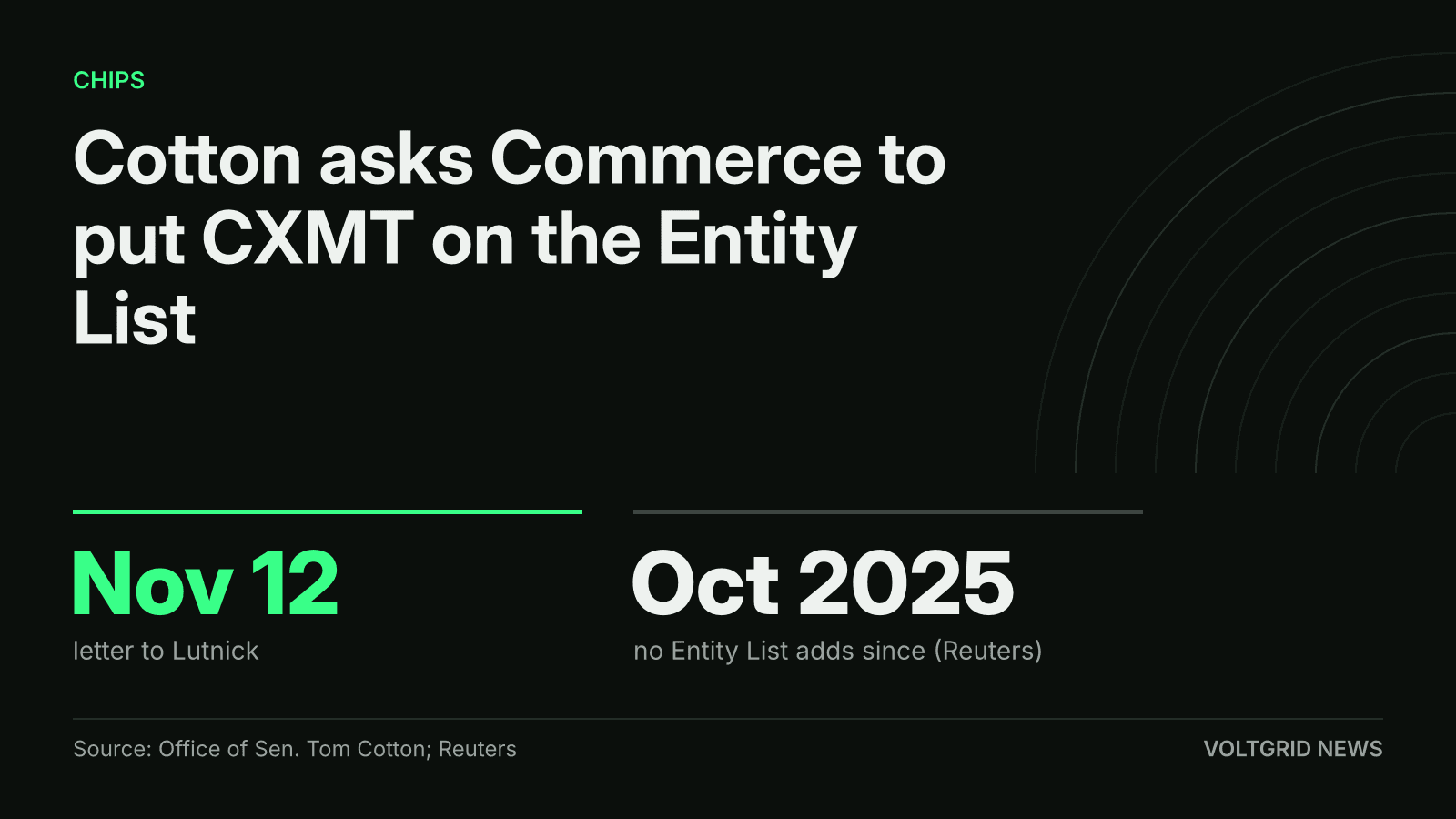
Sen. Tom Cotton's Nov 12 letter to Commerce asks for an Entity List listing of CXMT; Reuters says no additions have been posted since Oct 2025.
Illustration (AI-generated)
Sen. Tom Cotton, an Arkansas Republican, asked Commerce Secretary Howard Lutnick in a letter dated Nov. 12 to add Chinese DRAM maker CXMT to the Entity List and to explore a ban on sales of CXMT products in the United States, according to the senator's press release.
This is a request from one senator, not a Commerce decision. Reuters said Commerce did not immediately comment on the wider criticism of Lutnick it reported alongside the letter, and the release and the letter contain no reply from the department. Reuters describes Cotton as the Republican chair of the Senate Intelligence Committee. The letter follows our earlier report on CXMT's 4F² DRAM platform, which CXMT said had passed engineering-sample validation, with server DDR5 samples promised by the end of 2026.
What Cotton asked for
The letter makes two separate asks. The first is to add CXMT to the Bureau of Industry and Security's Entity List "to broadly deny the company access to U.S. technologies and technical support," including semiconductor manufacturing equipment and tools for any CXMT fabs. The second is to use the Commerce Department's information and communication technology services (ICTS) office to "explore a prohibition on sales of CXMT products," which would reach the US market itself rather than CXMT's supply of tools.
Cotton's letter lists three existing CXMT measures and adds two requests, an Entity List listing and an ICTS review of sales; neither is a decision.
Illustration (AI-generated)
Cotton lists what already applies. The Defense Department has put CXMT on its Section 1260H list of Chinese military companies, BIS end-use controls restrict exports of some advanced technologies to some CXMT fabs, and the fiscal 2023 National Defense Authorization Act curbed federal procurement of CXMT products. An Entity List listing would widen the equipment restriction from some fabs to all of them.
What it would touch at CXMT
The letter singles out high-bandwidth memory (HBM). Cotton writes that recent reporting shows CXMT will start producing HBM3E, that its chips perform poorly against rivals' equivalents and that yields hover at 20%. That echoes the Reuters report we covered, in which CXMT was said to plan limited HBM3E output at 20% to 30% yields. That figure came from two unnamed sources, and CXMT has not confirmed it. Cotton argues the move shows China's chip shortage and its weak access to advanced equipment.
For the 4F² server DDR5 plan, the exposure is equipment and technical support, which the letter targets by name. CXMT's samples are a company claim with no published speed, capacity or yield, so a tool ban would bear on how fast new lines can be built rather than on parts already shipping; that is our reading, not Cotton's.
On the supply side, the sourced picture is thin. Neither the letter nor Reuters says how much CXMT DRAM enters the US market today, so the effect of a sales ban on US supply or prices cannot be sized from what has been published. CXMT's third-quarter revenue of RMB 118.71 billion shows how large the company has become, not where it sells.
What is not confirmed yet
Commerce has not said whether it will act. Reuters noted that the US has posted no Entity List additions since October 2025, the longest gap in more than a decade, and that in June it reported the administration had held off adding CXMT, AI startup DeepSeek and more than 100 other companies flagged as national security risks. Reuters also reported that a growing number of lawmakers are criticizing Lutnick over that refusal.
Neither CXMT nor the Chinese government had responded in the reports we read. The next checkpoints are a BIS notice in the Federal Register, any ICTS review Commerce opens, and a CXMT statement.