Darlington SMR Project: First of Four BWRX-300 Units Targeted for 2030
Darlington SMR: Ontario named 14 supply contracts on Nov. 6 for OPG's first 300 MWe BWRX-300, targeted for grid connection by end-2030, but its operating licence still awaits a hearing date.
Nuclear & Microgrids DeskEdited by Ege Erten
4 min readAI-assisted
Follows our story: Darlington SMR: Ontario Awards 14 Supply Contracts for BWRX-300
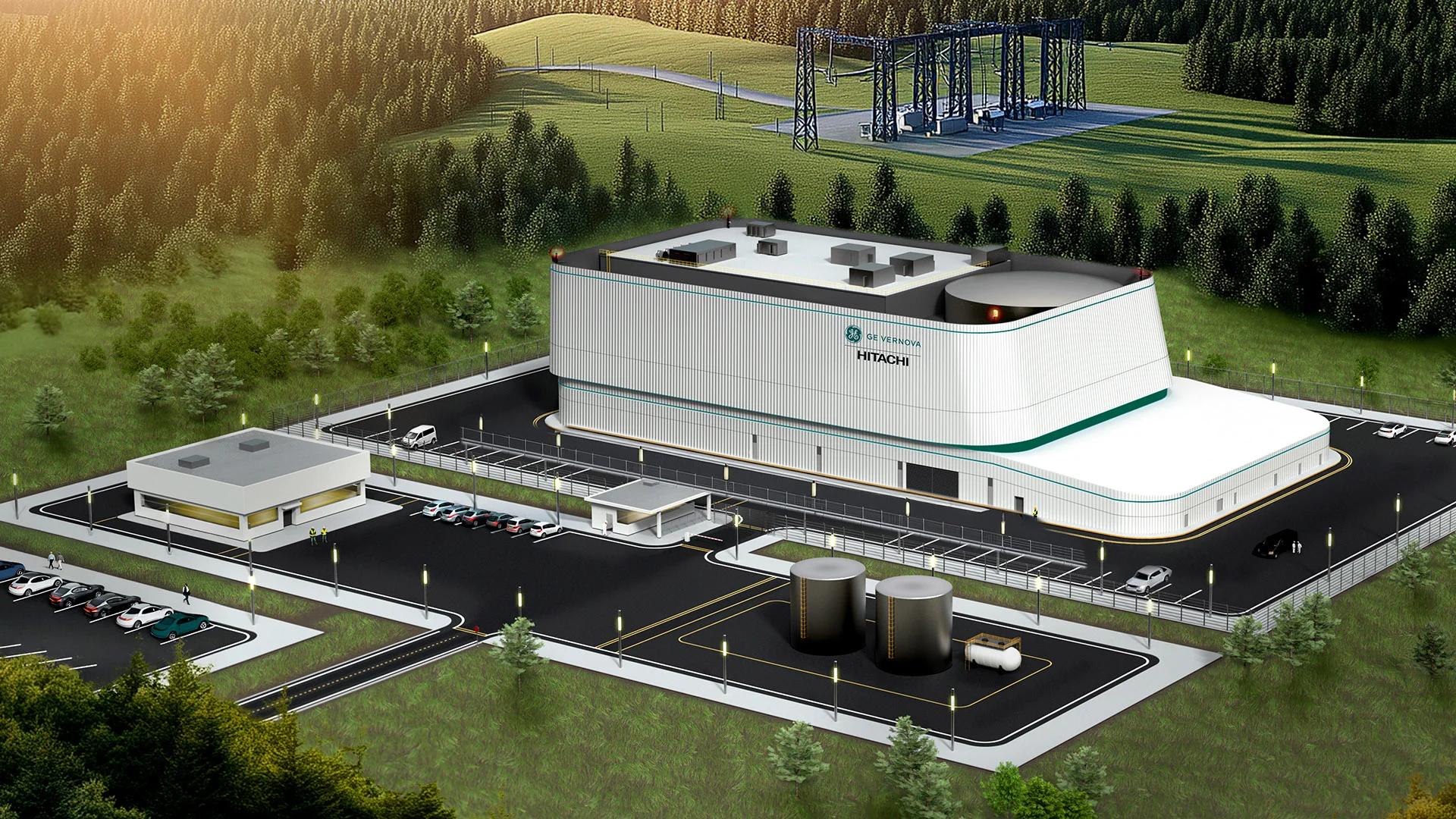
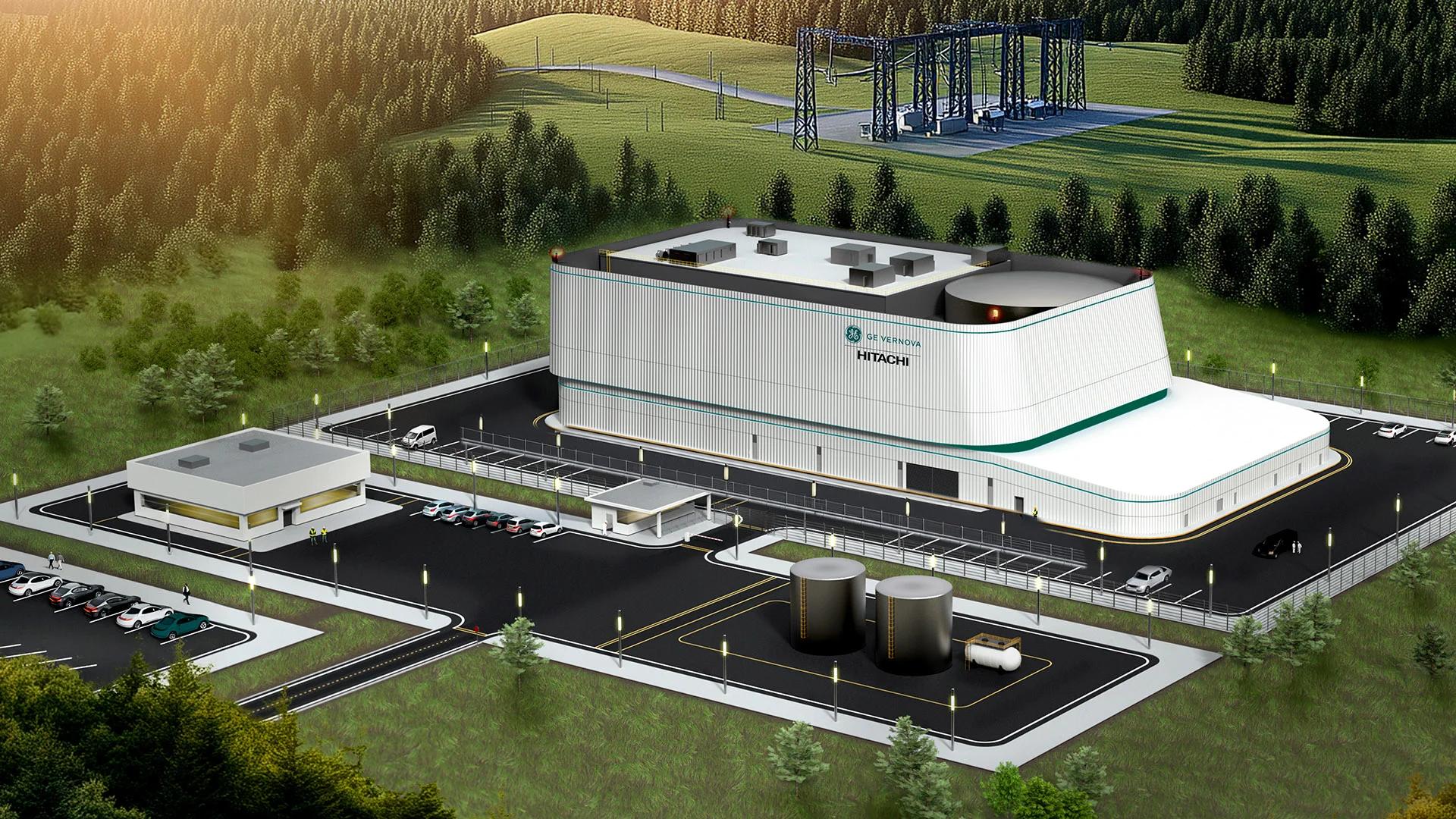
Rendering of a BWRX-300 plant, the design OPG is building at Darlington; it is a vendor illustration, not a photo of the Darlington site.
Image: GE Vernova Hitachi (rendering)
Source · Press image from the GE Vernova newsroom, used for news reporting.
Ontario named 14 supply contracts on Nov. 6, 2026 for the Darlington SMR project, where Ontario Power Generation (OPG) plans four BWRX-300 reactors; the first is a 300 MWe unit (the CNSC and OPG do not say net or gross) targeted for grid connection by end-2030. The Canadian Nuclear Safety Commission's (CNSC) project page, updated on Nov. 9, shows that OPG's March 25, 2026 application to operate that unit still has no public hearing date.
Voltgrid covered the contract awards as news on Nov. 8. This file sets out the whole project. It matters beyond Ontario because Darlington's first unit is the only BWRX-300 under construction; GE Vernova calls it the only grid-scale SMR under construction in the Western world. TVA's Clinch River unit holds a US construction permit but is not yet shown to be under construction. Buyers now looking at the design, including the Tennessee Valley Authority (TVA), can learn from Darlington what a first unit of GE Vernova Hitachi's design costs and how long it takes.
The technology
The CNSC describes the BWRX-300 as a 300 MWe water-cooled, natural-circulation small modular reactor (SMR); it does not say whether that figure is net or gross. GE Vernova's BWRX-300 page says the unit is engineered for up to 300 MW of electricity. GE Vernova says it runs on standard low-enriched uranium (LEU) fuel, GNF2, which commercial reactors have used for decades, rather than the HALEU that several advanced designs need.
The one idea that matters is natural circulation. Water boils in the core and the steam-water mix rises on its own, and the safety systems rely on gravity-driven circulation instead of pumps, GE Vernova says. GE Vernova says this keeps the plant safe for seven days after a station blackout without power or operator action. World Nuclear News adds that the design builds on the licensing basis of GE Vernova Hitachi's ESBWR, a larger boiling-water reactor the US Nuclear Regulatory Commission (NRC) has certified.
The deal and the money
OPG owns the site and will run the plant; GE Vernova Hitachi supplies the design. The Ontario release, as carried by Today's Northumberland, says the 14 contracts went to firms in the Greater Toronto and Hamilton Area for parts such as transformers, pumps and specialized steel, and will add over C$110 million to Ontario's GDP. Armstrong Fluid Technology received C$3.9 million for a pumphouse enclosure and pumps; the other values were not given. More than 100 Canadian companies have signed agreements with OPG, and 80% of project spending is to go to Ontario firms, the province said.
Public money includes a C$1 billion investment by the provincial Building Ontario Fund and a C$2 billion investment from the federal Canada Growth Fund, according to the same release. On cost, OPG's project page puts the first SMR at C$6.1 billion, plus C$1.6 billion for systems and services common to all four, and estimates the total budget for all four units at C$20.9 billion, the figure Ontario approved in May 2025. World Nuclear News, citing OPG, reports that the estimate covers licensing, engineering, procurement, construction, contingency, interest and escalation, and that estimates for units 2 to 4 are less developed than the one for unit 1. OPG expects costs to fall with each later unit.
Licensing and timeline
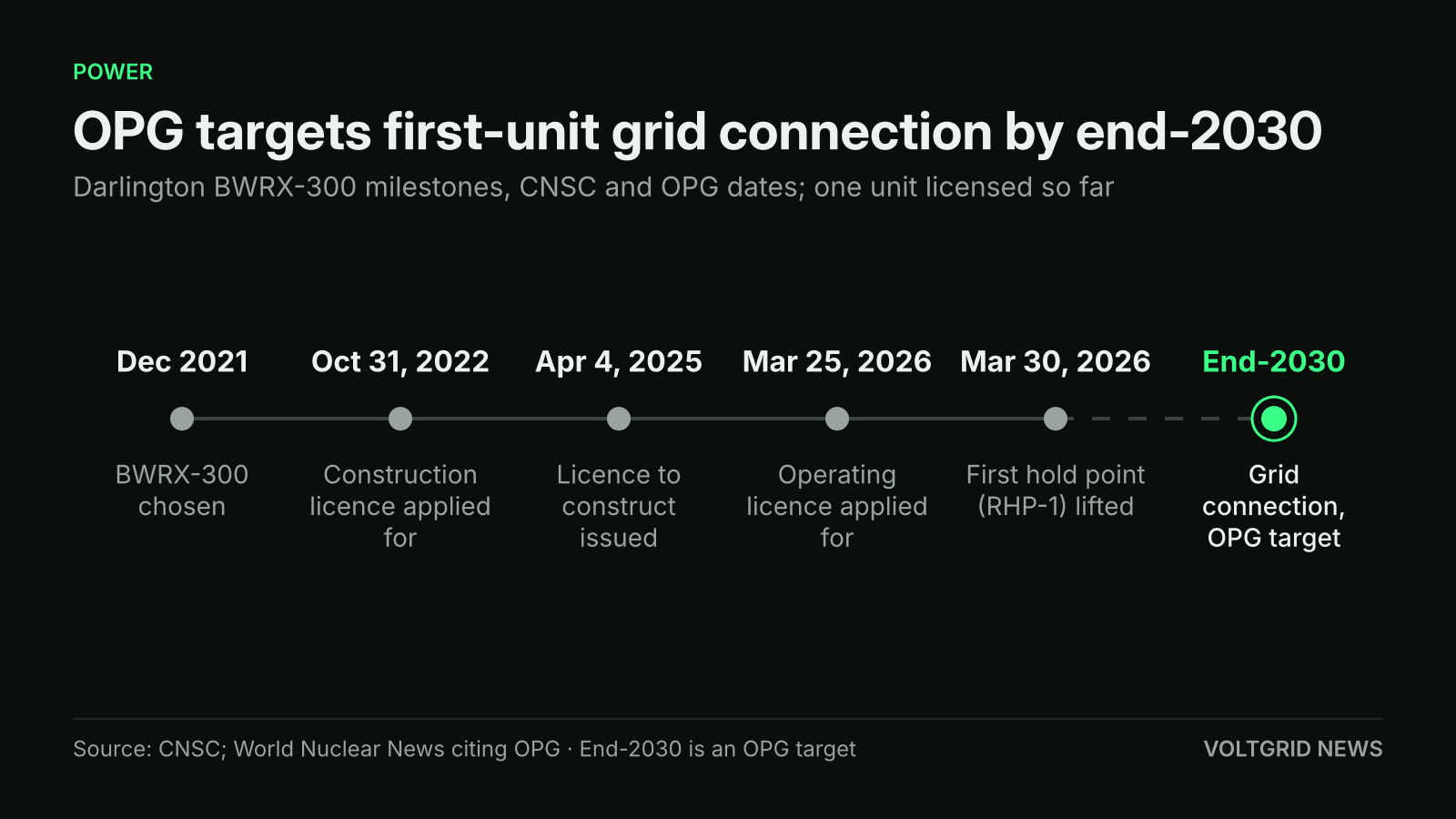
Five Darlington milestones are done; grid connection of the first unit by end-2030 is OPG's target, not a certainty.
Illustration (AI-generated)
The Darlington project's licences run in three steps: prepare the site, construct, operate. An application is not an approval: the CNSC decides on an operating licence after a public hearing. OPG chose the BWRX-300 in December 2021 and holds a site licence valid until 2031. It applied to build on Oct. 31, 2022, and the Commission granted a licence to construct one unit on April 4, 2025, valid until March 31, 2035. Ontario approved the start of construction the following month.
That licence carries three hold points that CNSC staff must clear before work goes on. In a March 30, 2026 letter, the CNSC consented to remove the first, for the reactor building foundation. The next is installation of the reactor pressure vessel, which World Nuclear News says OPG has already procured. Units 2 to 4 have no construction licence; the CNSC lists only the possibility of a future application for up to three more units.
What it means for data-center buyers
Ontario and OPG say the four units will deliver 1,200 MW once complete; OPG adds that this is pending regulatory approvals to build the three additional units. It cites the grid operator, the IESO, as estimating that replacing their output would take up to 8,900 MW of wind and solar with battery storage. For a buyer that needs firm power, that comparison is the case for the design.
The design is spreading. The NRC issued TVA a construction permit for a BWRX-300 at Clinch River, Tennessee, on Sept. 29, 2026, GE Vernova says, and Voltgrid argued on Nov. 10 that permits now outpace owners' decisions to build. A Swedish group targets four units of about 1.2 GW, and OPG's Origin Nuclear signed a non-binding letter of intent on 14 UK units. GE Vernova claims that later, nth-of-a-kind units can go from first nuclear concrete to ready for fuel load in about 36 months, a vendor claim rather than a Darlington schedule, and says Darlington's field data feeds the standard design. If Darlington meets its 2030 target, that claim gains evidence that data-center developers can price; if it slips, every copy inherits the doubt.
What to watch
The CNSC holds a public webinar on the construction and the operating-licence application on Dec. 4, 2026. The Commission has yet to set the hearing on OPG's licence to operate. On site, the next regulatory step is the hold point for the reactor pressure vessel. A licence application for the other three units would show how firm the full 1,200 MW is, and OPG says the cost estimates for units 2 to 4 are still being refined. Grid connection of the first unit by the end of 2030 remains OPG's target.
Sources
- 01OPG applies for operating licence for BWRX-300 SMRWorld Nuclear News · world-nuclear-news.org
- 02Letter to Ontario Power Generation regarding Regulatory Hold Point 1 - DNNP Unit 1Canadian Nuclear Safety Commission · cnsc-ccsn.gc.ca
- 03OPG gets go-ahead to build first SMR in CanadaWorld Nuclear News · world-nuclear-news.org