NRC Advanced Reactor Permits: 3 in 2026 Move the Bottleneck to Owners
Kemmerer, Clinch River and now Long Mott won NRC construction permits in 2026. Two owners have not decided to build, and Amazon's Xe-100 projects have not yet applied.
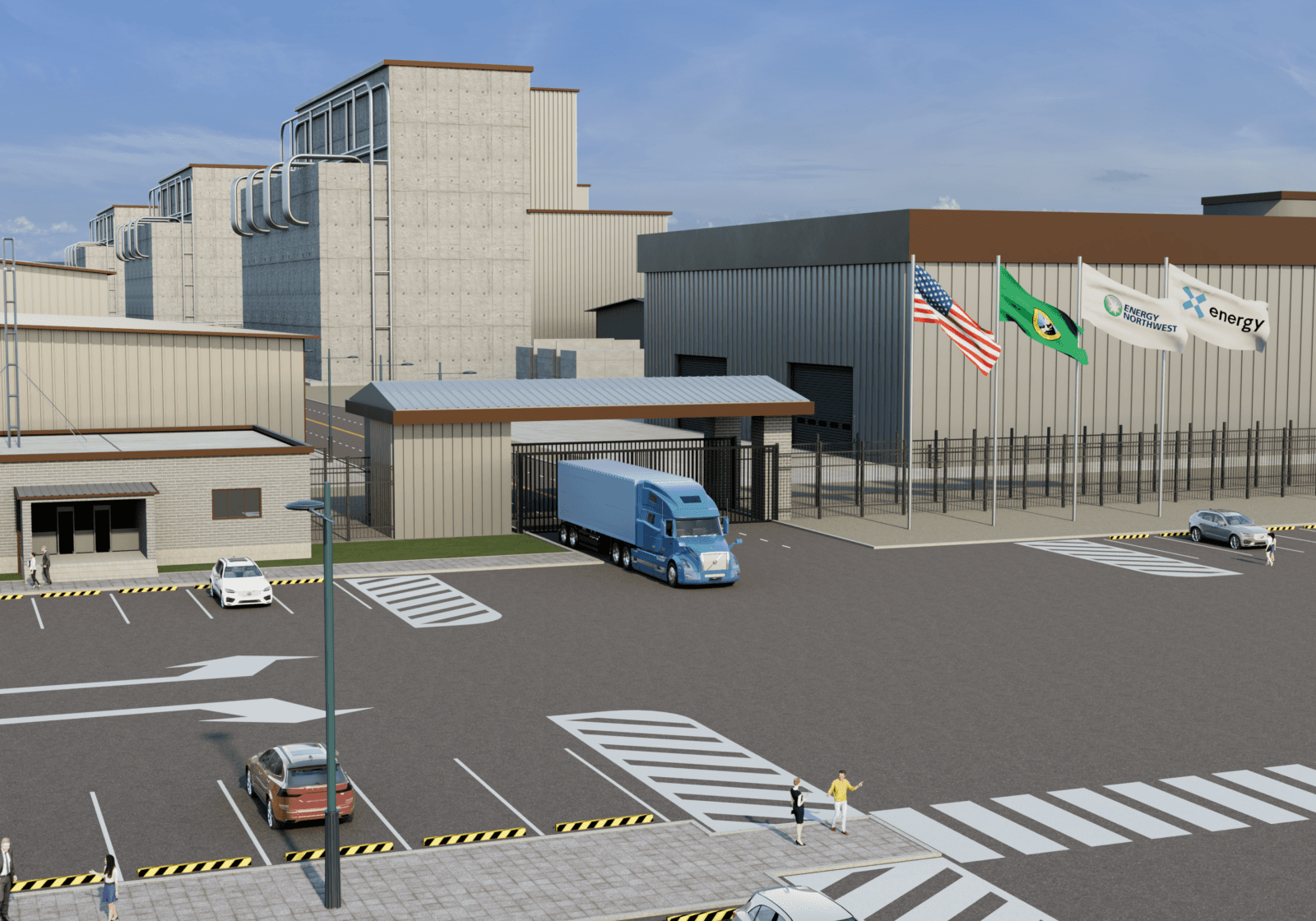
Rendering of Energy Northwest's planned Cascade facility for up to 12 Xe-100 units, which has no NRC permit application yet (Energy Northwest). It is not a photo of any permitted plant.
Image: Energy Northwest (rendering)
Source · Press image from the Energy Northwest website, used for news reporting.
The Nuclear Regulatory Commission (NRC) issued its third advanced-reactor construction permit of 2026 on Nov. 9, for Dow's four-unit Long Mott plant in Texas, and the NRC says Clinch River finished four months ahead of schedule and Long Mott met its 18-month schedule. That argues the licence has stopped setting the pace for new US nuclear supply: owners' investment decisions, fuel and contractors now do, and Amazon's own Xe-100 projects have yet to pass any of those gates.
Voltgrid reported the Long Mott permit on Nov. 9. On Nov. 1 we argued that the NRC's review lowered the Xe-100's design risk but not Amazon's project risk. Three permits in eight months widen that point beyond one design and one buyer.
How the NRC Issued Three Advanced Reactor Permits
The NRC's project page for TerraPower's Kemmerer Unit 1 in Lincoln County, Wyoming, records the construction permit decision on March 9. The plant is a pool-type sodium fast reactor rated 840 MWt, and World Nuclear News gives the design rating as 345 MWe. On Sept. 29 the NRC approved the Tennessee Valley Authority's (TVA) permit for one GE Vernova Hitachi BWRX-300 at Clinch River, near Oak Ridge, Tennessee, a 300-megawatt unit in the NRC's words. The agency said the review took 14 months and finished four months ahead of schedule.
Long Mott followed. Its four X-energy Xe-100 reactors, each rated 80 MWe and 200 MWt according to X-energy, will mainly make high-temperature steam for Dow's Seadrift Operations and export surplus power to the grid, the NRC said. Chairman Ho K. Nieh said the agency "delivered on the 18-month schedule", and staff finished the safety evaluation in October, a month early. X-energy's quarterly filing for the period ended June 30 had expected the permit in the first quarter of 2027. Heatmap, which tallied the three permits on Nov. 10, noted that Fort St. Vrain in Colorado, the first US commercial high-temperature gas-cooled plant, shut down after operating challenges.
Kemmerer's owner started construction on April 23; Clinch River has no construction date; Dow expects to consider a preliminary investment decision in 2027 (a target).
Each permit allows building, not running. All three owners still need a separate NRC operating licence before fuel load.
Why Owners Now Set the Pace for New Reactors
The first step is the regulator's record. By the NRC's account, Clinch River finished four months ahead of schedule and Long Mott met its 18-month schedule, with its safety evaluation a month early; the NRC's Kemmerer page lists no target dates to compare. X-energy's chief executive, J. Clay Sell, said Long Mott's permit came "earlier than expected." If that pace holds, an owner can plan around the licence rather than wait on it.
The second step is what each owner did with its permit. TerraPower announced the start of construction at Kemmerer on April 23, about six weeks after the decision, on a project backed by the Department of Energy's Advanced Reactor Demonstration Program (ARDP). After the permit, TVA said no construction date had been announced and that it "continues negotiations with industry partners" on cost sharing, World Nuclear News reported on Sept. 30. Dow expects to consider a preliminary investment decision in 2027, and full-scale construction would follow only a final one; Dow's Edward Stones said the company will weigh "competitiveness, execution readiness, and capital affordability" first. In our reading, two of three permit holders have not yet committed to build, which suggests money, not paperwork, is the binding constraint.
The third step is execution. Bechtel, TerraPower's construction contractor, is stepping away from Kemmerer, and TerraPower said in September it will rebid the engineering, procurement and construction contract while keeping its schedule, according to World Nuclear News. Fuel is the other limit. X-energy says TRISO-X received an initial tranche of high-assay low-enriched uranium (HALEU) from the Energy Department in April 2025 for Long Mott's first cores, and its 10-Q says TX-1 in Oak Ridge, still under construction, will have capacity to support the fuel needs of the first 11 Xe-100 reactors at steady state, and that a second plant, TX-2, is planned on the same site for up to 44 reactors annually.
The Case Against the Owner-Bottleneck Thesis
The strongest objection is that the licence is still ahead for the next wave of projects. Every 2026 permit was for a first unit whose owner had spent years in pre-application work, and, as far as the NRC pages we read show, none of the three has yet filed for an operating licence. On this year's evidence, a project filing in 2027 could still face a review of 14 months (Clinch River) to 18 months (Long Mott) or longer: Kemmerer's NRC page shows docketing on May 21, 2024 and a permit decision on March 9, 2026, about 21 months by our count, before it could pour nuclear concrete. For a buyer such as Amazon, whose projects have not filed, the NRC remains on the critical path.
There is also a fair reading of the owners' caution that has nothing to do with process. These are first-of-a-kind plants: no Xe-100 or BWRX-300 runs in the US, and the first US commercial gas-cooled plant, Fort St. Vrain, closed after a few years. Dow says it wants design, equipment and materials in place before committing major capital to cut cost and schedule risk. In our view, gas turbines and existing-plant deals may be faster options for a data-center campus, and a buyer weighing those could rationally wait.
What the Xe-100 Fuel Plants Can Supply
Xe-100 fuel is TRISO: uranium kernels wrapped in carbon and silicon carbide layers, packed into graphite pebbles, and X-energy says its Oak Ridge plants will make them. Each Xe-100 is rated at 80 MWe and 200 MWt, X-energy says. TX-1 is still being built, and TX-2, the plant that would close the gap above, is not yet under construction.
What It Means for Amazon's Xe-100 Projects and Other Buyers
Amazon is not a party to Long Mott. It invested in X-energy in 2024 and funds development of two Xe-100 projects, Cascade and the Indiana project, under funding agreements that are not power purchase agreements. The NRC lists Energy Northwest's Cascade facility in Washington, planned for up to 12 Xe-100 units, as a pre-application project with no construction permit application filed, as of a page update on Sept. 23; Energy Northwest calls Cascade a "fast follower" of Dow's project, with four Xe-100 modules producing 320 MW in its initial deployment, Energy Northwest says (X-energy's 10-Q gives 320 MWe, with potential to upsize to 960 MWe). Cascade's construction permit application target has slipped from the end of 2026 to the first half of 2027. In Indiana, AEP said on Oct. 19 that it signed a joint development agreement with X-energy to study the feasibility of a 960 MW plant of 12 Xe-100 units, with Amazon funding development and intending to buy the power under a long-term contract.
Neither project has an NRC application, a final investment decision or a signed power purchase agreement, as far as the NRC, AEP and Energy Northwest pages show. Long Mott's permit gives both a reviewed Xe-100 safety case to reference; X-energy says future applications should be reviewed more efficiently as a result, which is the company's expectation. It does not date Amazon's power. Our arithmetic, not X-energy's: Long Mott's four reactors, Cascade's up to 12 and the Indiana study's 12 would total up to 28 Xe-100 reactors, against the 11 that TX-1 will have capacity to fuel at steady state. The open question is when the planned TX-2 is built, not whether a second plant is planned. Our Oct. 28 Long Mott project file sets out the Dow plant in full.
What to Watch After the Permits
X-energy reports third-quarter results before markets open on Nov. 12 and holds its call at 8:00 a.m. ET, the company said. Dow expects to consider its preliminary investment decision in 2027. Cascade's permit application is now expected in 2027, as Voltgrid reported in October. TVA has yet to name a construction date or close its cost-sharing talks, and TerraPower has yet to name a new construction contractor for Kemmerer. Any of those owner decisions will test the thesis more than the NRC's next permit will.