Exelon FERC Complaint Seeks PJM Capacity Auction 2 Months Before Delivery
Exelon's complaint in docket EL27-11 argues PJM's three-year forward auction is no longer just and reasonable. No PJM response or FERC comment deadline has been found yet.
Energy & Cooling DeskEdited by Ege Erten
3 min readAI-assisted
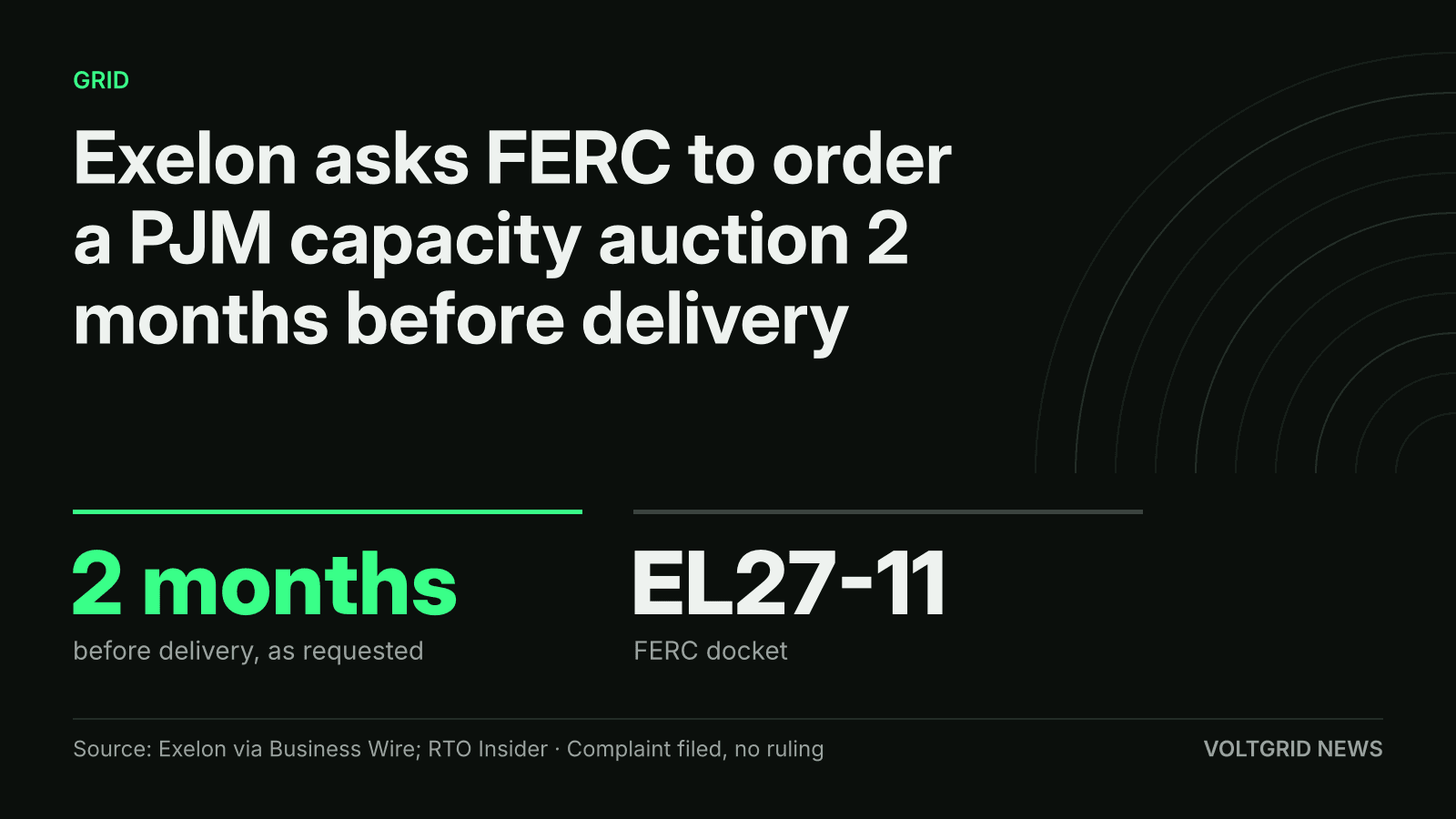
Exelon's complaint asks FERC to order a PJM capacity auction 2 months before delivery; FERC has not ruled.
Illustration (AI-generated)
Exelon said on Nov. 4 that it filed a complaint with the Federal Energy Regulatory Commission (FERC) asking it to order PJM Interconnection to hold its capacity auction two months before the delivery year, not three years ahead, in docket EL27-11.
FERC's eLibrary lists the filing as "Complaint of Exelon Corporation v. PJM Interconnection, L.L.C.", with the complaint dated Nov. 3 and three attachments: affidavits from Nicholson and Sears, and a form of notice. According to RTO Insider, Exelon argues that PJM's three-year forward Base Residual Auction (BRA) is no longer just and reasonable. The BRA is the main auction in which PJM buys the generating capacity it expects to need in a future delivery year.
What Exelon's FERC Complaint Asks For
In its release, Exelon calls the change a "targeted" and "surgical" reform that would move the buying decision closer to the delivery period, when PJM has better information on demand and on how much generation is available. It says the shift would bring PJM in line with other U.S. capacity markets that already run prompt auctions. Exelon's chief legal officer, Colette Honorable, said customers "cannot afford to wait" for a full package of market changes.
Exelon's core charge is that PJM's capacity market produces high prices without stimulating the investment needed, and locks in costs years before power is needed, while forecasts of supply and demand change quickly. The release gives no price figure and does not say which delivery year would be first under a prompt schedule.
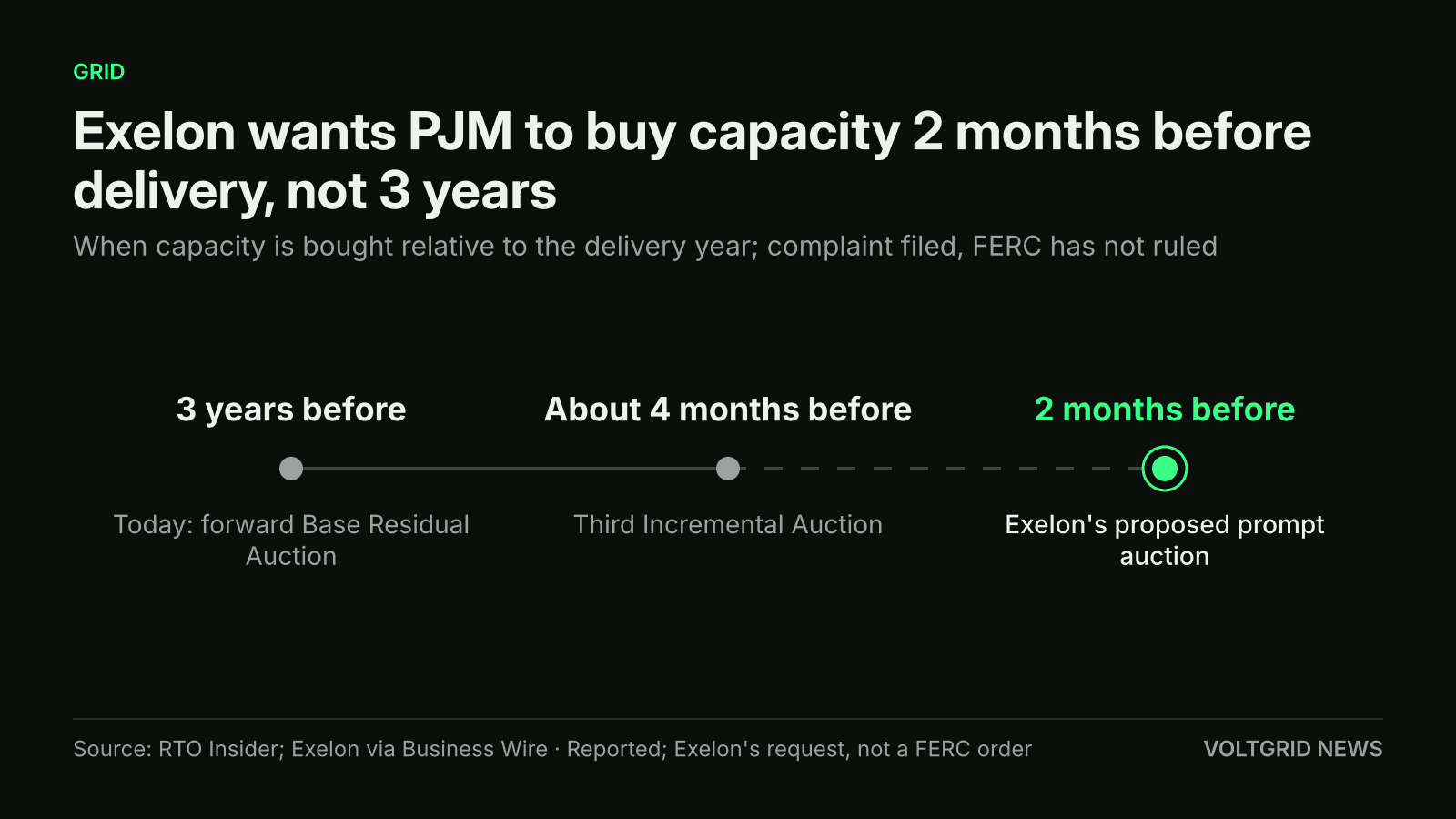
Exelon's proposal would move PJM's capacity purchase from 3 years to 2 months before delivery, as RTO Insider reports; it is a request, not a FERC order.
Illustration (AI-generated)
RTO Insider reported that the complaint includes an analysis by Emma Nicholson of Charles River Associates. It shows a positive correlation between shorter forward periods and the change in peak load forecasts between the BRA and the third Incremental Auction, which is held about four months before the delivery year, according to the figure's caption.
Exelon also says a prompt schedule alone will not fix affordability. It says PJM "urgently needs more generation" to keep pace with demand, and that it supports reforms that bring more supply onto the system.
Why a Prompt Auction Matters for Data-Center Load
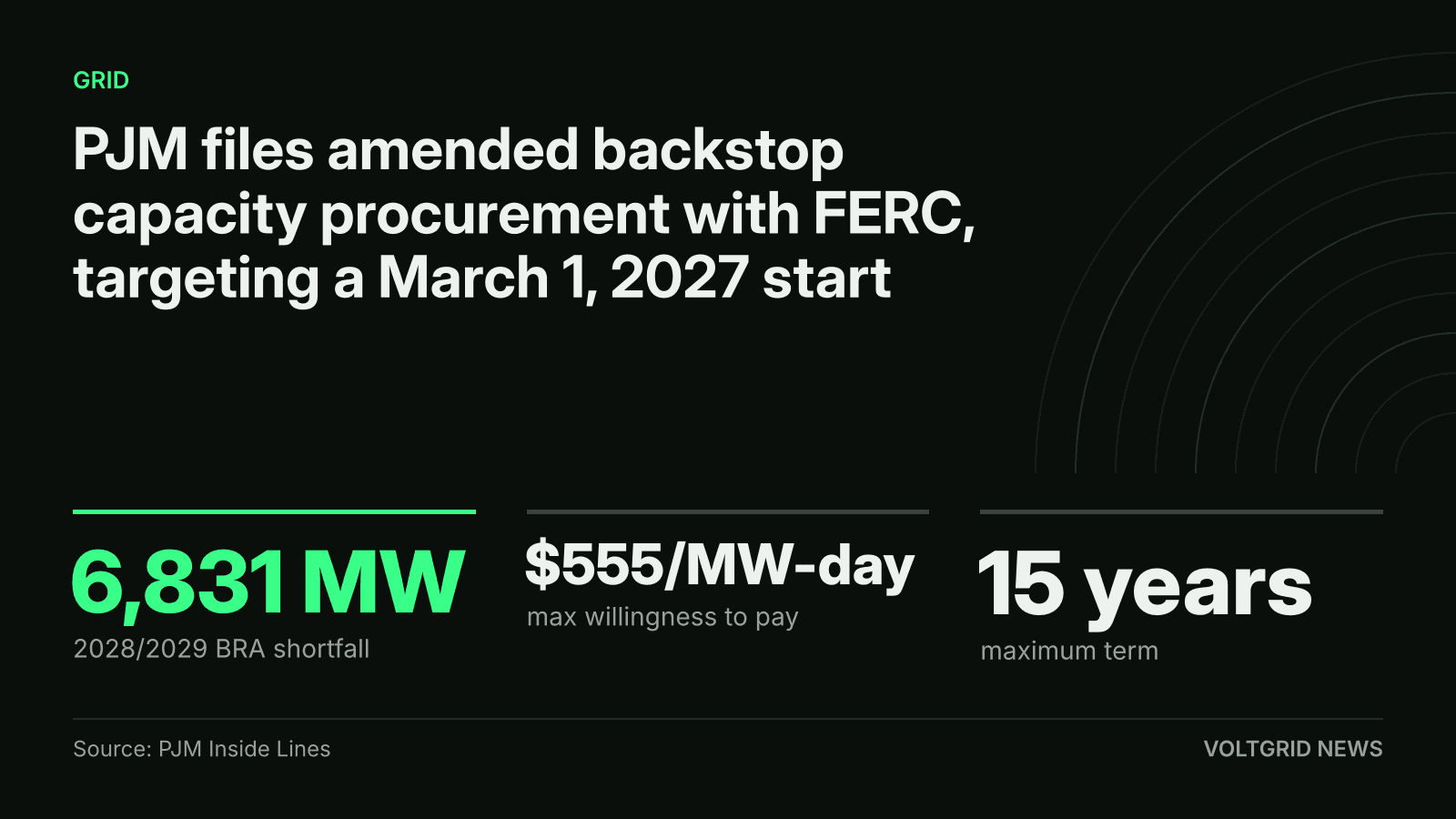
Forecast swings are the heart of the argument, and large loads drive many of them. PJM's 2028/2029 BRA cleared at the price cap and about 6,800 MW short of its reliability target, as Voltgrid reported. PJM now wants a separate backstop auction on March 1, 2027, with a maximum willingness to pay of $555/MW-day, as Voltgrid reported. Jefferies analysts have since estimated that backstop could shrink to 630 MW after utilities cut their large-load forecasts, Utility Dive reported on Nov. 3.
That gap between a target set years out and a forecast revised within months is the pattern Exelon wants to remove. A prompt auction would price capacity against a load forecast only two months old. For data-center developers, that could change the capacity cost passed to them, though Exelon itself says a prompt auction alone will not solve affordability or add supply.
What Is Still Not Confirmed
The complaint is only filed. FERC has not set a comment deadline in anything we reviewed, and no ruling exists. PJM has not publicly responded in the sources we found. The release and RTO Insider do not give a proposed transition date, so it is unclear which delivery year a prompt auction would first apply to, or how it would interact with PJM's pending backstop procurement.
Exelon says stakeholders would use the time a prompt schedule buys to develop new rules and then "transition timely" to them. Whether FERC treats a narrow schedule change as separable from that wider redesign is the first thing to watch.