PJM Amends Reliability Backstop Filing, Targets March 2027 at $555/MW-Day
PJM asked FERC on Oct. 29 to open its 6,800 MW backstop auction March 1, 2027, with costs tied to large-load growth, lower LSE credit rates and new exit rules.
Energy & Cooling DeskEdited by Ege Erten
3 min readAI-assisted
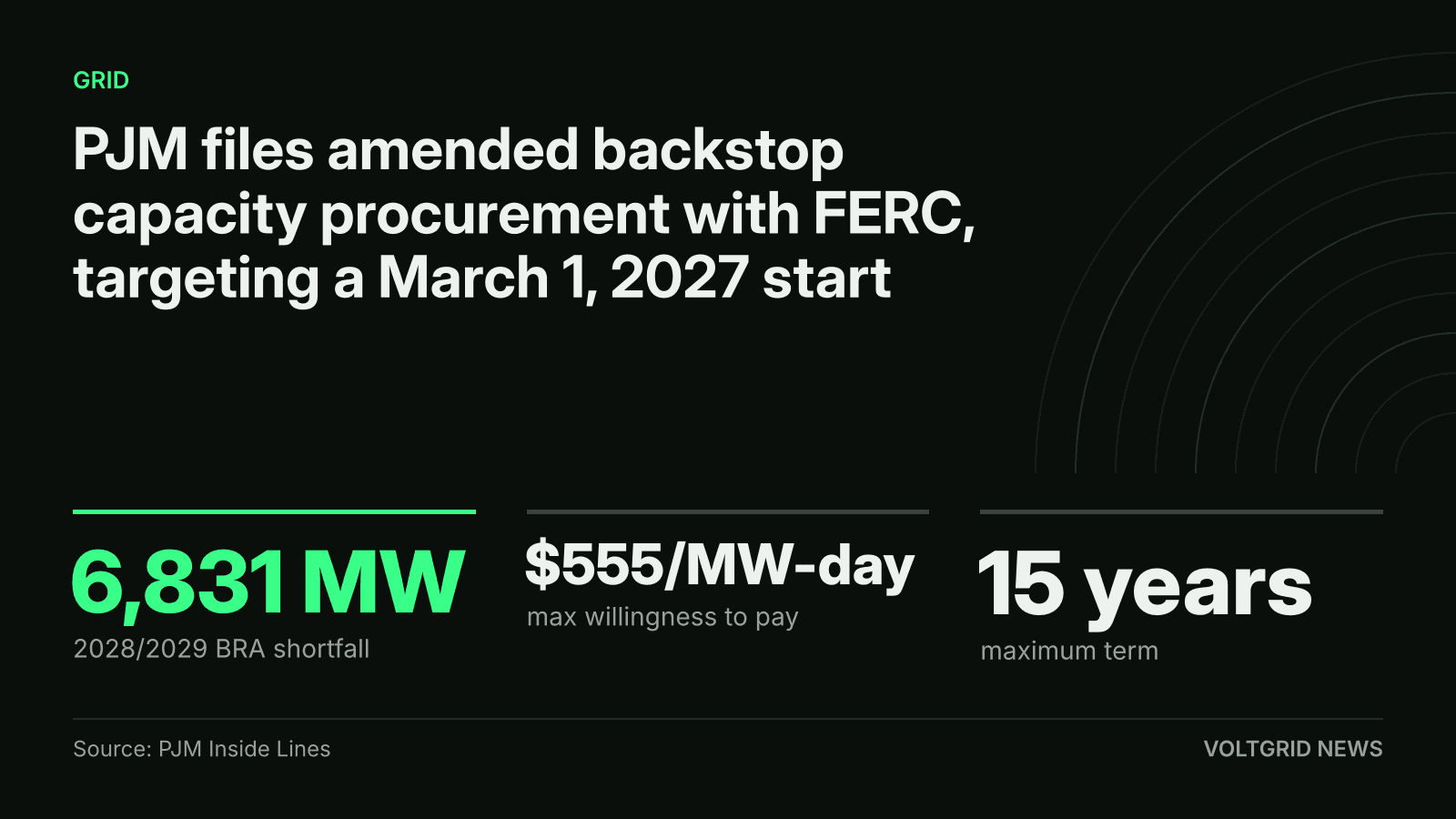
PJM's amended proposal targets a March 1, 2027 start and awaits FERC's ruling.
Illustration (AI-generated)
PJM Interconnection filed an amended Reliability Backstop Procurement with FERC on Oct. 29, asking to open the one-time capacity auction on March 1, 2027 and to charge its cost to the large loads, such as data centers, that create the need, PJM said.
The filing changes three elements of the original proposal: how backstop charges are allocated, what credit load-serving entities (LSEs) must post, and what an LSE owes if it leaves PJM. An LSE is a regulated entity that buys or manages power supply for end-use customers. PJM's announcement does not give a docket number for the amendment. The original proposal sits in FERC dockets ER26-3380-000 and EL26-108-000, according to FERC's order of Sept. 29.
PJM wants the procurement to fill a shortfall of about 6,800 MW from its 2028/2029 Base Residual Auction, which it puts at 6,831 MW. It says the figure will be recalculated with updated information under the new timeline. The target will also shrink by any qualifying megawatts procured through executed bilateral contracts, to avoid buying the same capacity twice.
What changed from the original filing
FERC's Sept. 29 order accepted the original proposal for filing but suspended it for five months, to take effect Feb. 28, 2027, subject to refund. The amended timeline starts after that date: electric distributors report new large-load quantities before the window opens on March 1, bids close March 28, PJM sets the final target and supply amounts on April 28, and results post on May 10.
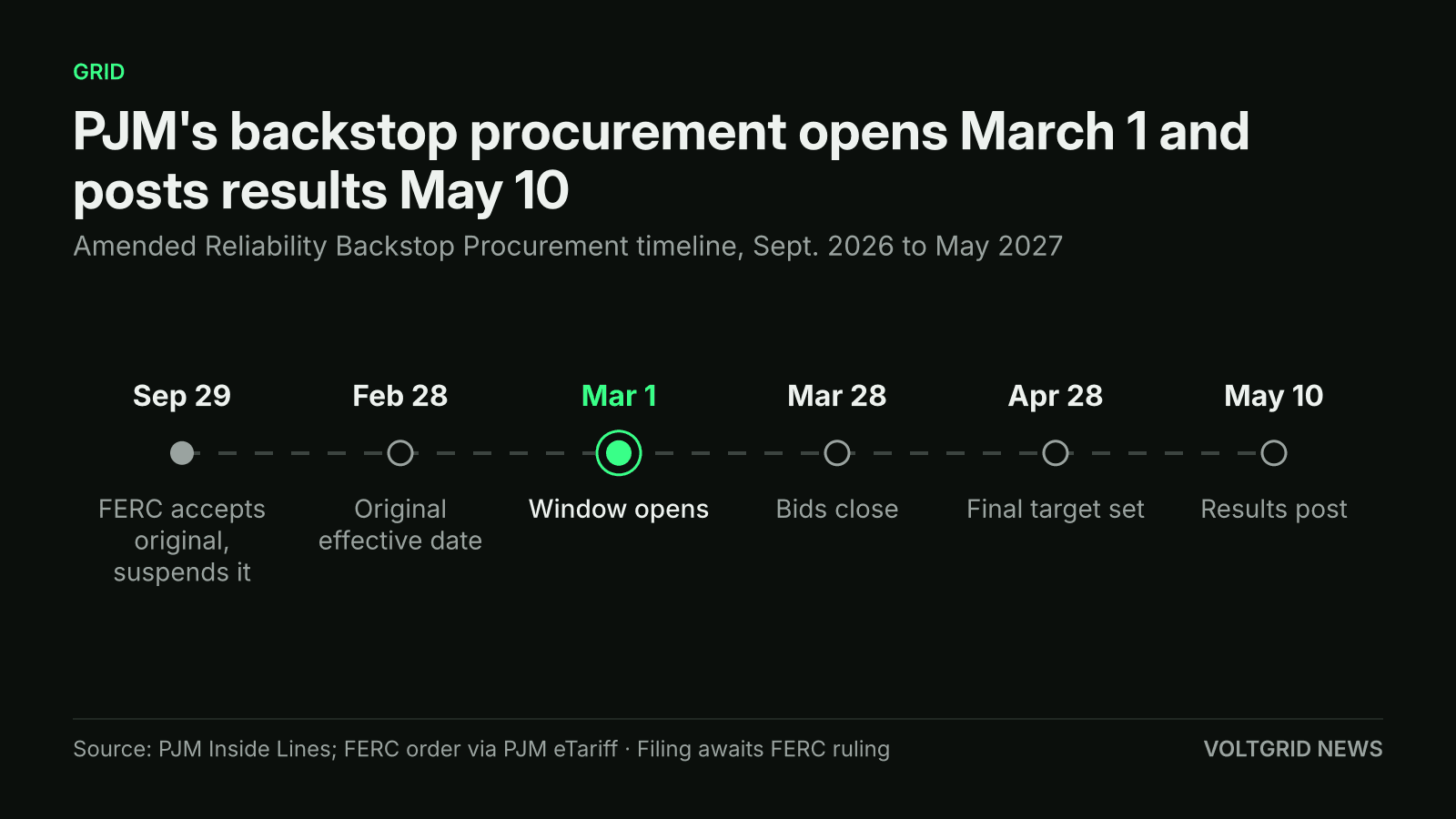
After FERC's Sept. 29 order, PJM's amended timeline runs from a March 1 window to May 10 results.
Illustration (AI-generated)
Cost allocation now follows large-load growth between the actual summer 2026 peak and the forecast for the 2028/2029 delivery year. Electric distribution companies must give PJM firm large-load growth, and PJM assigns it to each zone by that zone's contribution to the growth.
On credit, PJM proposes a revised, lower uniform credit rate and new payment terms for LSEs responsible for backstop charges. An LSE that exits PJM stays responsible for the charges through the rest of the commitment term.
Price cap and smaller rule changes
The procurement still seeks resources for up to 15 years, with a maximum willingness to pay equal to a MW-weighted average of $555/MW-day, PJM said. FERC's order cites the same figure.
PJM also lists several narrower changes. It removes the earlier provision that let certain municipal utilities and cooperatives opt out. It requires a Peak Shaving Adjustment plan of at least five years for that opt-out. It adjusts site-control requirements only for sell offers not already under PJM study, gives sellers more time to cure deficiencies after the window closes, and clarifies demand response and distributed energy resource rules for qualifying offsets.
What it means for data centers and capacity prices
Tying charges to large-load growth is the part to watch: a zone that adds data centers would carry more of the backstop bill. PJM runs two paths in parallel, the procurement and private bilateral contracts between large loads and capacity suppliers, and each megawatt signed bilaterally reduces what the auction must buy.
Voltgrid has followed the load side of this problem, including PJM's 3,900 MW backup-switching testimony and FERC's approval of a 50 MW load registry. On the supply side, Dominion's plan for 3.5GW of batteries was built against the same shortfall.
What is not approved yet
This is a filing, not an order. FERC has not ruled on the amendment, and the March 1 start, the $555/MW-day ceiling and the cost-allocation method all depend on its decision. The final procurement target is not set and will move with the recalculated shortfall and any bilateral contracts. The filing does not say how many megawatts of bilateral supply will qualify.