Itaipu Studies Up to 1 GW of Solar to Damp Paraguay Grid Oscillations
Itaipu's Cigre paper models 100 MW to 1,000 MW of solar with damping controllers on Paraguay's grid, where 8,800 MW of hydro may fall short around 2029. It is a simulation; no plant has been announced.
2 min readAI-assisted
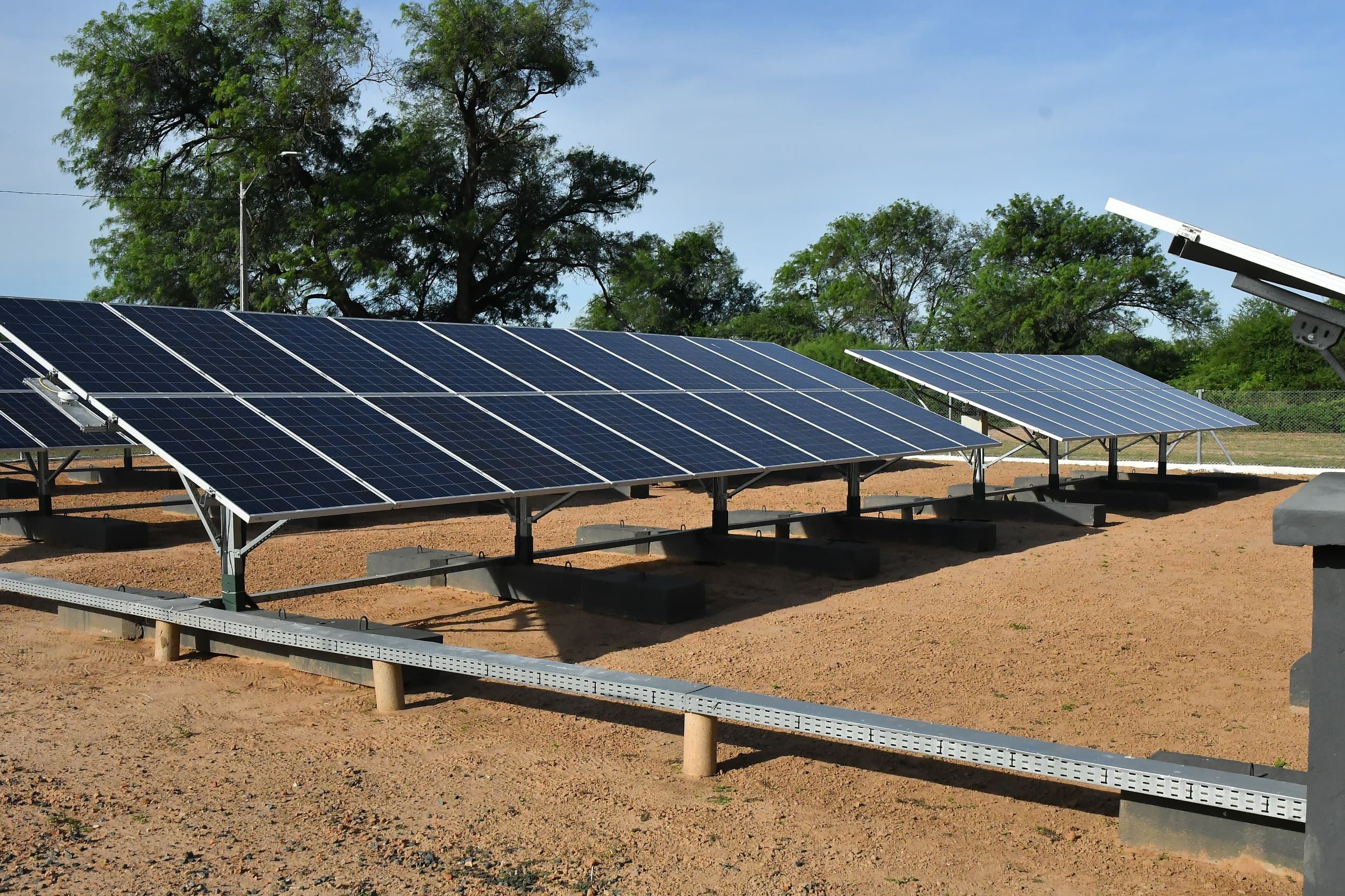
Ground-mounted solar array from Itaipu's news page on the study. It is not the 100 MW to 1,000 MW plant modeled in the paper, which has not been announced.
Image: Itaipu Binacional
Source · Press image from the Itaipu Binacional newsroom, used for news reporting.
Itaipu has presented a simulation study of adding 100 MW to 1,000 MW of solar to Paraguay's grid, finding that plants with a damping controller can stabilize a 0.4 Hz oscillation, pv magazine reported on October 28.
Itaipu engineer Manuel Sosa Ríos of the Technical Directorate presented the paper at the Cigre Energy Forum 2026 in Calgary, Canada, according to both pv magazine and Itaipu's own news release. It was heard by Cigre Study Committee C4, which covers power system technical performance. The study models solar plants of 100 MW up to 1,000 MW at several points of an equivalent of the Paraguayan network. No plant has been announced, ordered or scheduled.
Why Paraguay's grid is looking at solar
Paraguay's generation comes entirely from hydropower: 8,800 MW in total, made up of Itaipu's 7,000 MW 50 Hz system, 1,600 MW at Yacyretá and 200 MW at Acaray. Planning studies cited in the paper say that capacity could become insufficient around 2029 as demand grows. Solar is one of the alternatives considered, helped by average annual daily global horizontal irradiation of 5.08 kWh/m².
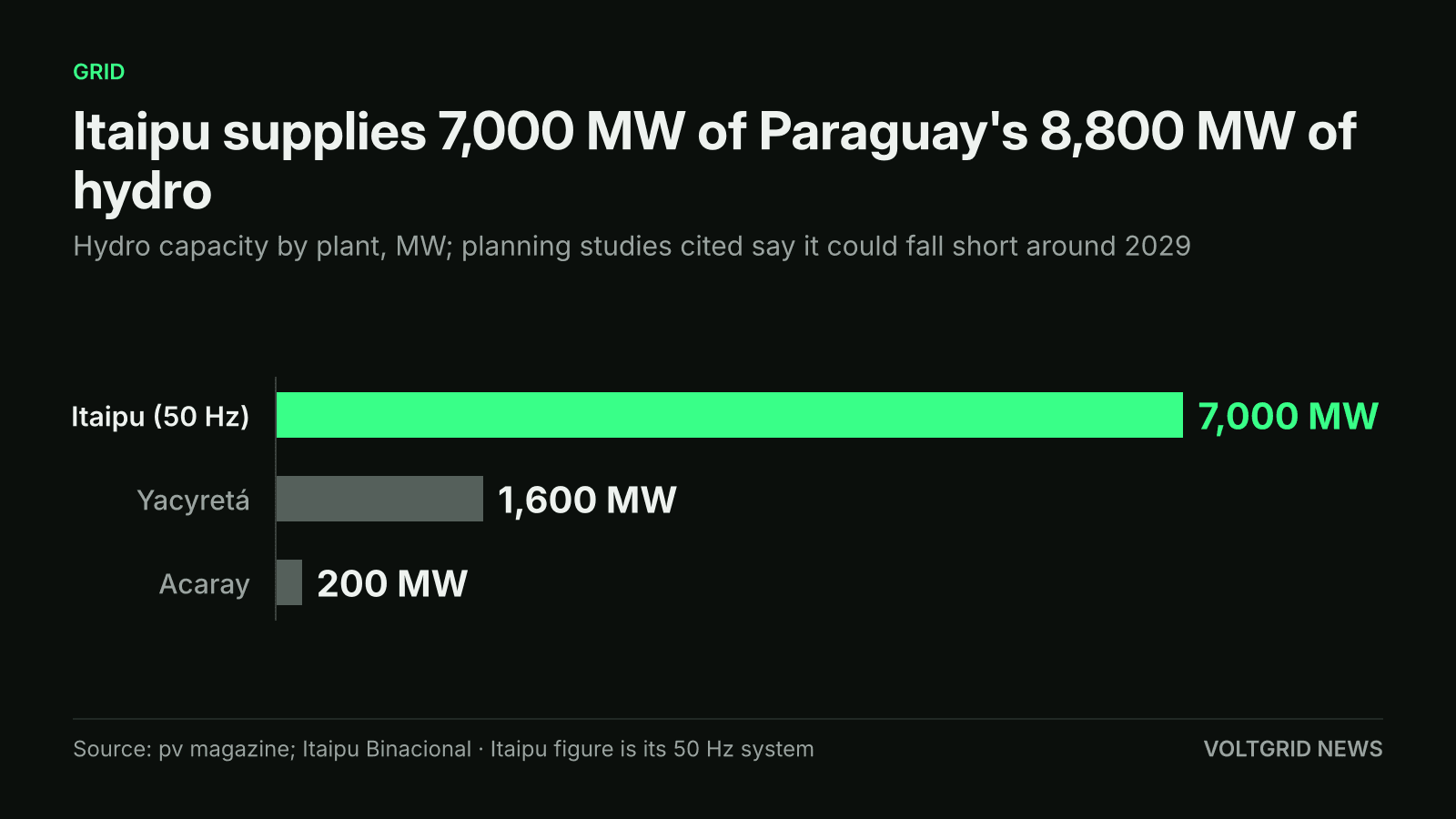
Itaipu's 7,000 MW is the bulk of Paraguay's 8,800 MW of hydro, which planning studies cited in the paper say could become insufficient around 2029.
Illustration (AI-generated)
For data-center developers the point is practical. Hydropower is the draw for large loads there, and Crusoe and Araico have planned a 106 MW AI data center beside the Itaipú dam. New large loads draw on the same 8,800 MW pool that the planners expect to tighten, so how fast new supply and grid stability tools arrive affects how much connected load the system can carry.
The second half of the paper deals with stability rather than energy. Since December 2022 Paraguay's system has run interconnected with Argentina's, and in that configuration it shows inter-area electromechanical oscillations at 0.33 Hz to 0.41 Hz. The main damping tool is the power system stabilizer (PSS) at Itaipu. According to Itaipu, real events have shown that its capacity can run out under underfrequency conditions because its control signal saturates.
To test a complement, the researchers added a power oscillation damping (POD) controller to the solar plant models and tuned it with the damped Nyquist method. They simulated connections at three points: the 500 kV Villa Hayes substation, the 220 kV Villa Hayes substation and the 220 kV Acaray substation, chosen for how well they observe the inter-area mode.
What the simulations showed
In the harshest case, with Itaipu's PSS out of service, the model produced an unstable 0.4 Hz mode with negative damping of 4.96%. With a solar plant carrying the POD controller, the modeled system was stable at all three connection points. The authors conclude that controlled solar can complement the damping Itaipu provides today. They also recommend running a battery energy storage system (BESS) alongside the solar plant, so that the response holds through transients and swings in irradiance do not feed new oscillations.
What is not confirmed yet
This is a modeling result, not a field test. The work used generic inverter-based plant models built in the Anatem power system simulation program, which has no predefined models for such resources, and a simplified equivalent of the Paraguayan system. The authors propose studying more connection locations and additional control signals in later work. Neither pv magazine nor Itaipu says a solar tender, a site or a capacity target has been set beyond the summary of the presentation.