FERC Approves Tougher MISO Penalties for 9.1 GW of Demand Response
FERC's Oct. 23 order largely accepts MISO's penalties for demand response and behind-the-meter generation that fail to perform, effective June 1; MISO has 30 days to fix one tariff inconsistency.
3 min readAI-assisted
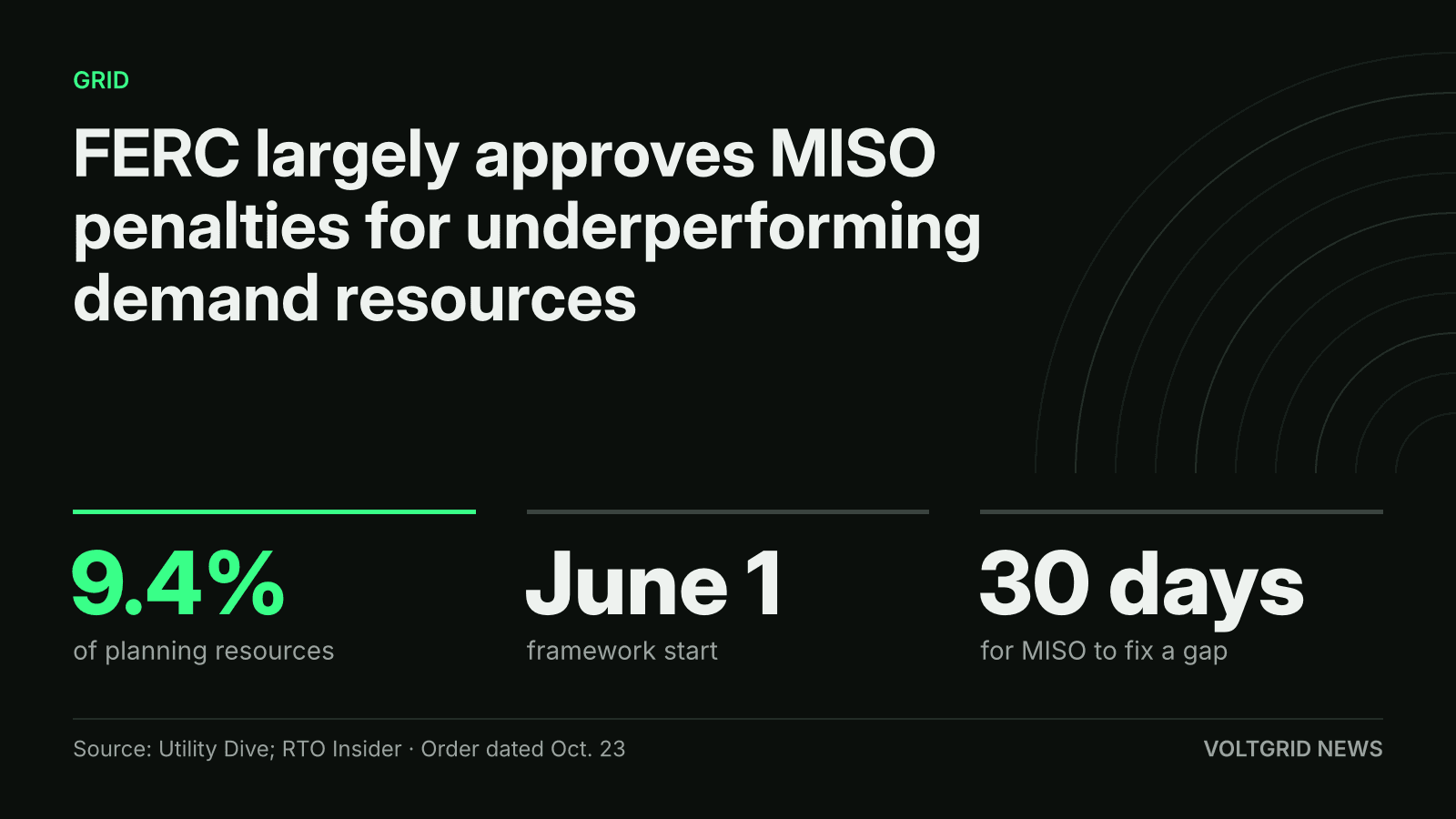
Key facts from FERC's Oct. 23 order on MISO's penalties for load modifying resources, as reported by Utility Dive and RTO Insider.
Illustration (AI-generated)
The Federal Energy Regulatory Commission said in an Oct. 23 order that it largely accepts MISO's tougher penalties for demand-side resources that fail to perform in grid emergencies, covering demand response that cleared 9.1 GW and behind-the-meter generation that cleared 4.3 GW in the grid operator's latest capacity auction, Utility Dive reported.
The new penalty framework applies to Load Modifying Resources, or LMRs: demand response and behind-the-meter generation assets that receive capacity payments for agreeing to respond to MISO orders during emergencies. It is set to take effect on June 1, according to Utility Dive. MISO says it caps a series of FERC-approved changes to its rules that followed several enforcement cases involving its demand response program.
What the MISO penalty framework changes
Under the approved framework, MISO will expand existing participation restrictions, differentiate between partial and complete performance failures, and add a new financial penalty based on auction clearing prices. FERC cited MISO's argument that the current penalty structure does little to discourage fraud and other manipulation, because LMRs are called on so rarely compared with the capacity payments they receive.
FERC called the proposal a "significant change" in the scale of penalties for underperforming LMRs, but rejected protests from Advanced Energy United, American Municipal Power and the Michigan Public Power Agency that it was too extreme. Layering several penalties at once is "not overly severe or unduly punitive," the commission said, because the penalties should push LMRs to perform when called and to backfill capacity MISO expects to be available.
Why 9.1 GW and 4.3 GW are in scope
In its most recent planning resource auction, LMRs backed by demand resources cleared 9.1 GW of capacity and those backed by behind-the-meter generation cleared 4.3 GW for the summer season, Utility Dive said, citing MISO. Together they made up 9.4% of all planning resources in that season. Penalties on that share of supply decide how much firm response MISO can count on when load shed is possible.
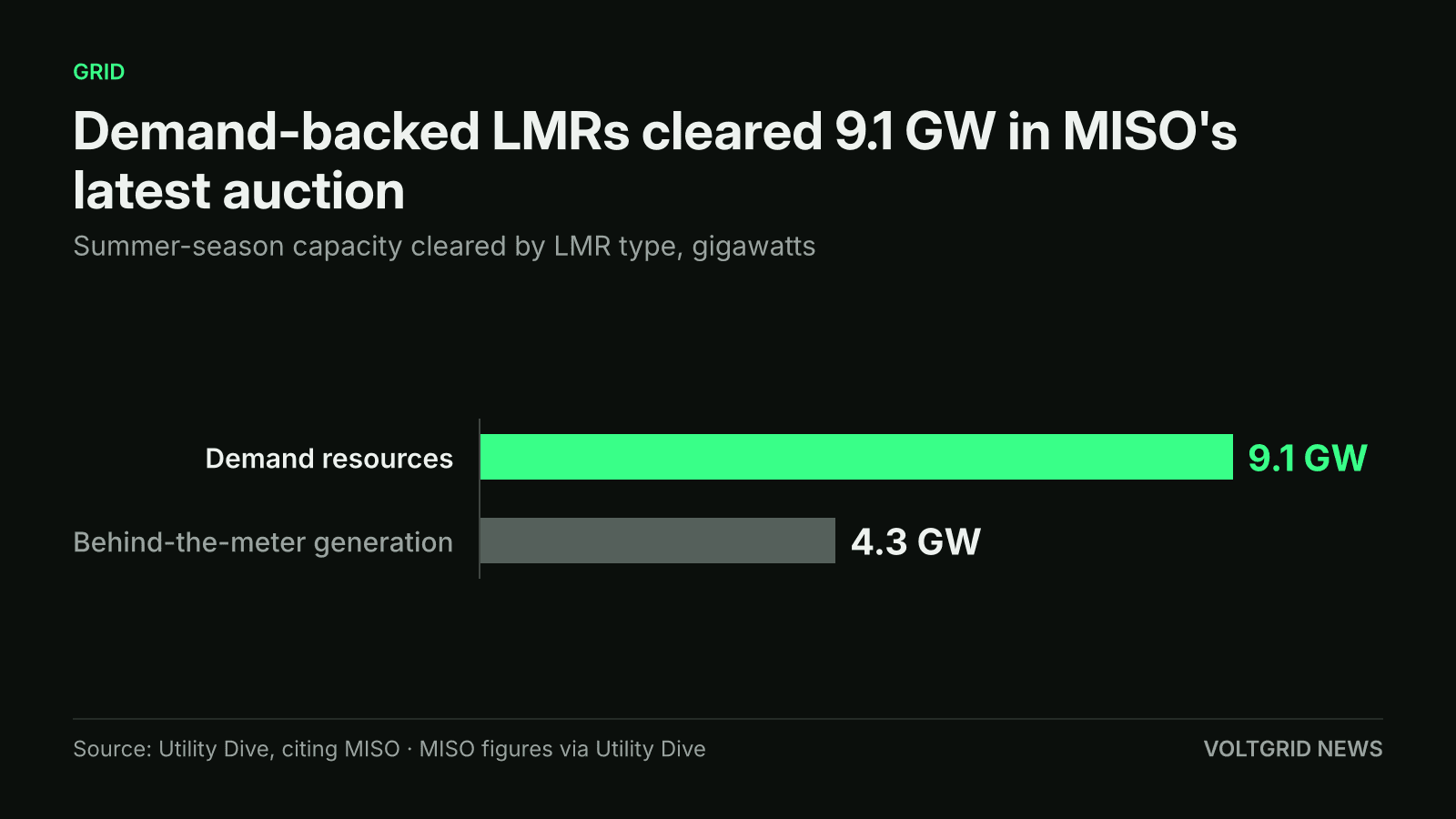
Demand resources made up the larger share of the LMR capacity covered by the penalty framework, MISO figures via Utility Dive.
Illustration (AI-generated)
The order follows enforcement actions that began in 2023. Voltus agreed to pay a $10.9 million penalty and return $7.1 million in profits over allegations that it registered uncontracted and overstated demand response resources with MISO. Big River Steel agreed to pay nearly $22 million, and Northern Indiana Public Service Co. and Linde Inc. agreed to pay $66.7 million, to settle market gaming charges. FERC also ordered Ketchup Caddy and its owner to pay about $27 million for using bogus demand response resources to make offers in MISO's capacity market.
For earlier Voltgrid coverage of the grid operator, see how MISO picked an Ameren-led group for a 187-mile Iowa line, and how FERC handled a PJM load registry filing in an Oct. 9 order.
What is not settled yet
FERC gave MISO 30 days to address an inconsistency in its proposed process for calculating two types of penalties for underperforming LMRs. Commissioners Judy Chang and David Rosner, in a joint concurring statement, urged MISO and market participants to monitor the new penalties and earlier LMR reforms. If the penalties create excessive economic risk, they wrote, resources will exit MISO's markets and the cost of meeting resource and energy adequacy would rise significantly.
Rao Konidena, president of consulting firm Rakon Energy, told Utility Dive that FERC "got this right" because MISO needs LMRs it can count on when load shed is on the line. He also warned that stiff penalties could push good resources out of the market, and noted that demand-side aggregators depend on utilities for node designations that have no firm timelines. That point sits outside FERC's order.