OpenAI Grid Protectors Program Takes Georgia 1,000 MW Pledge National
OpenAI said on Nov. 2 it will curb power at campuses it develops during grid emergencies, Axios reported. It names no sites or megawatts beyond Georgia's 1,000 MW of flexible demand.
Energy & Cooling DeskEdited by Ege Erten
3 min readAI-assisted
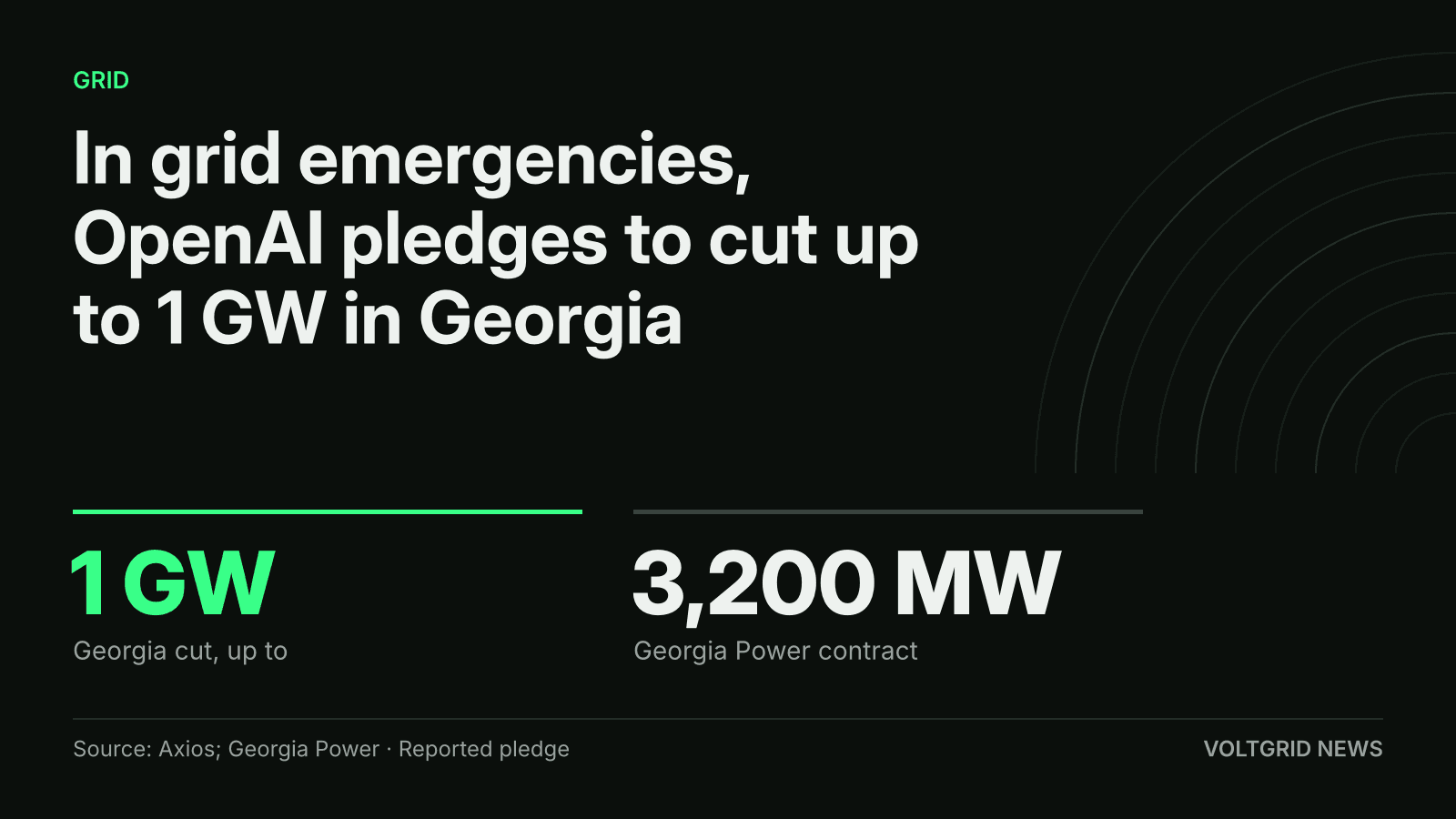
OpenAI's Georgia pledge sits inside a 3,200 MW Georgia Power contract, according to Georgia Power and Axios.
Illustration (AI-generated)
OpenAI on Nov. 2 launched a "Grid Protectors Program" that commits it to cut electricity use at the U.S. data center campuses it directly develops when extreme weather or other emergencies strain the grid, Axios reported.
The program takes an existing commitment and makes it a national template. At its planned campus in Effingham County, Georgia, OpenAI has pledged to reduce demand by up to a gigawatt when the grid needs relief, which Axios equated to the power use of roughly 700,000 homes. Axios quoted OpenAI's blog post as saying the company's "ambition is to make this kind of flexibility a core part of how we build and operate future campuses," by working with utilities "to agree on how much demand can be reduced, how quickly and for how long."
The terms are not yet set. Axios said the specific arrangements will vary by campus, with details announced as they are finalized, and it named no other site, utility or grid operator. OpenAI's head of energy policy, John McCarrick, told Axios the move reflects a shift in industry thinking away from "five nines" availability. The program covers the campuses OpenAI develops itself, Axios reported.
The Georgia Power contract behind it
The only worked example is Georgia. Georgia Power said on Aug. 26 that the Georgia Public Service Commission approved its contract to serve OpenAI's Effingham County project, which was filed in July and covers 3,200 MW of new demand. OpenAI pays the full cost of the infrastructure needed to serve it and has committed up to 1,000 MW of flexible demand response, which lets the utility reduce energy delivered to the site during high-demand periods and build fewer new generation resources.
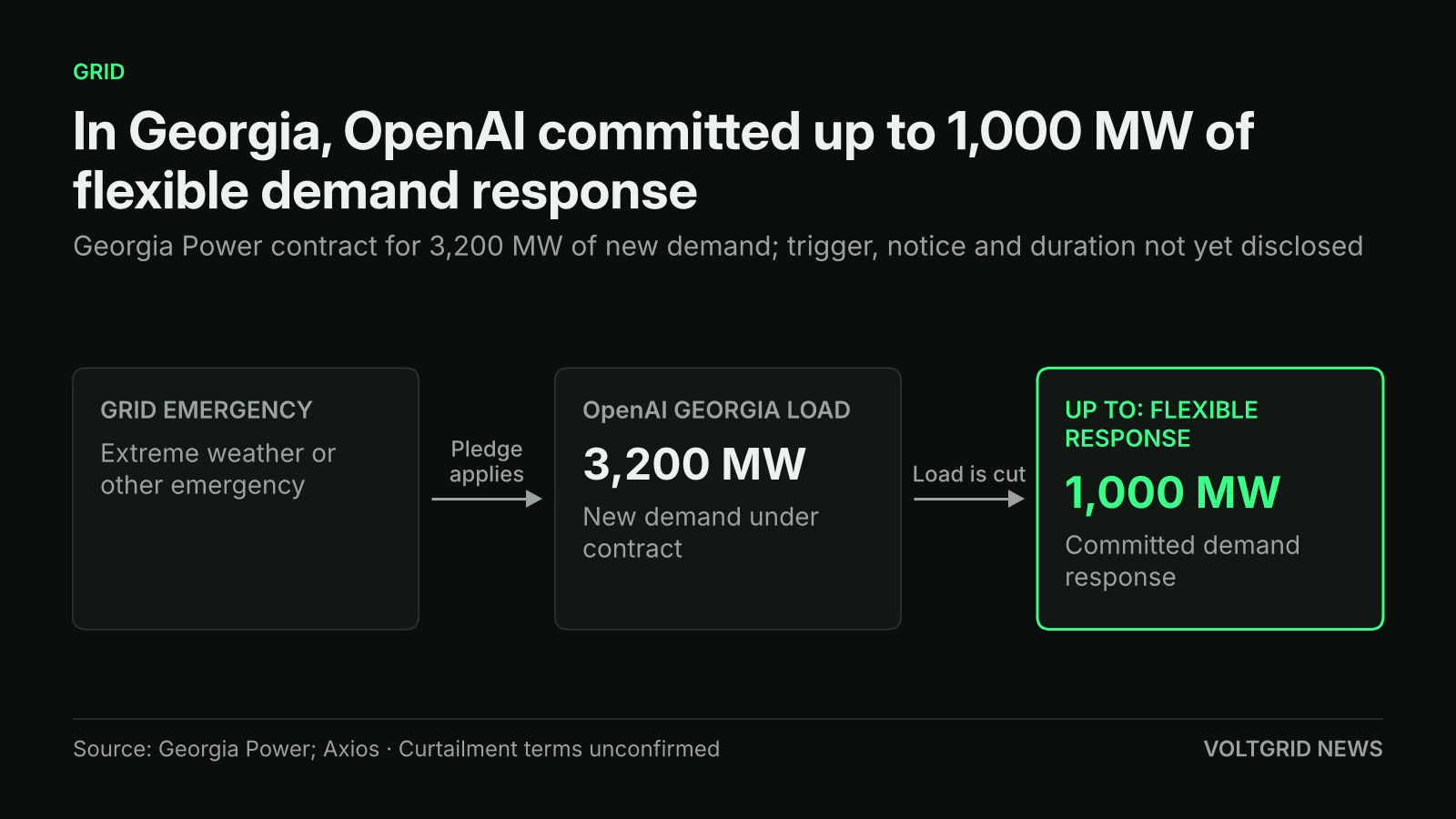
Georgia Power says OpenAI committed up to 1,000 MW of flexible demand response under a 3,200 MW contract; trigger and duration are not disclosed.
Illustration (AI-generated)
That is about 31% of the contracted load, by our arithmetic from Georgia Power's two figures. It also means the utility can plan to build fewer new generation resources for the site, which is the point of the clause for other Georgia Power customers.
Why it matters for the grid
For grid planners, what counts is how much load can be shed, how fast and for how long. A pledge is not a curtailment right until a utility contract defines the size and notice period. In Georgia that is up to 1,000 MW. For other OpenAI campuses it does not yet exist, so the program cannot enter any region's reserve-margin math today.
Regulators are pushing in the same direction. Axios pointed to FERC's demand that grid operators justify or reform how they connect large power users, which includes provisions that promote flexibility, and to a Senate permitting bill that would let states require data centers to limit power use at times as a condition of grid service. Voltgrid has tracked the operational side of this: PJM told FERC that 3,900 MW of data center load switched to backup power in July, and NERC's committee approved a data center ride-through project.
What OpenAI promised in January
This is not OpenAI's first flexibility pledge. In January 2026, when it announced its Stargate Community plans, OpenAI said every Stargate site would get its own locally tailored plan and that it would pay its own way on energy, according to Tom's Hardware, which read OpenAI's release. The listed approaches included funding the generation and grid upgrades its load requires and developing flexible loads that cut consumption at peak periods or forecast grid stress.
What is new on Nov. 2 is the program name, the national scope and the framing as an operating framework rather than a general intention, which Axios described as a shift from aspirational pledges to a nuts-and-bolts approach.
What is not confirmed yet
OpenAI has not given a list of covered campuses, a total of megawatts, the utilities or grid operators involved, or the trigger and duration of a cut. The program details here rest on Axios's report of OpenAI's post and on Georgia Power's release. Until another utility contract puts a number on the curtailment, Georgia's up to 1,000 MW is the only firm figure.
Sources
- 01OpenAI pledges data center power cutsGoogle News · data centers · news.google.com
- 02OpenAI pledges data center power cutsAxios · axios.com
- 03Georgia Power's contract with OpenAI approved; includes up to 1,000 MW flexible demand responseGeorgia Power · georgiapower.com
- 04OpenAI commits to paying its own way on energy at Stargate sites, including flexible loadsTom's Hardware · tomshardware.com