Michigan AG Seeks Rehearing of DTE's 20-Year Google Data Center Deal
Nessel's Oct. 30 petition says the MPSC's 20-year cost aggregation lets DTE customers subsidize Google's 1 GW Van Buren site in 2035-2038; DTE says the deal saves $1.7 billion.
Energy & Cooling DeskEdited by Ege Erten
3 min readAI-assisted
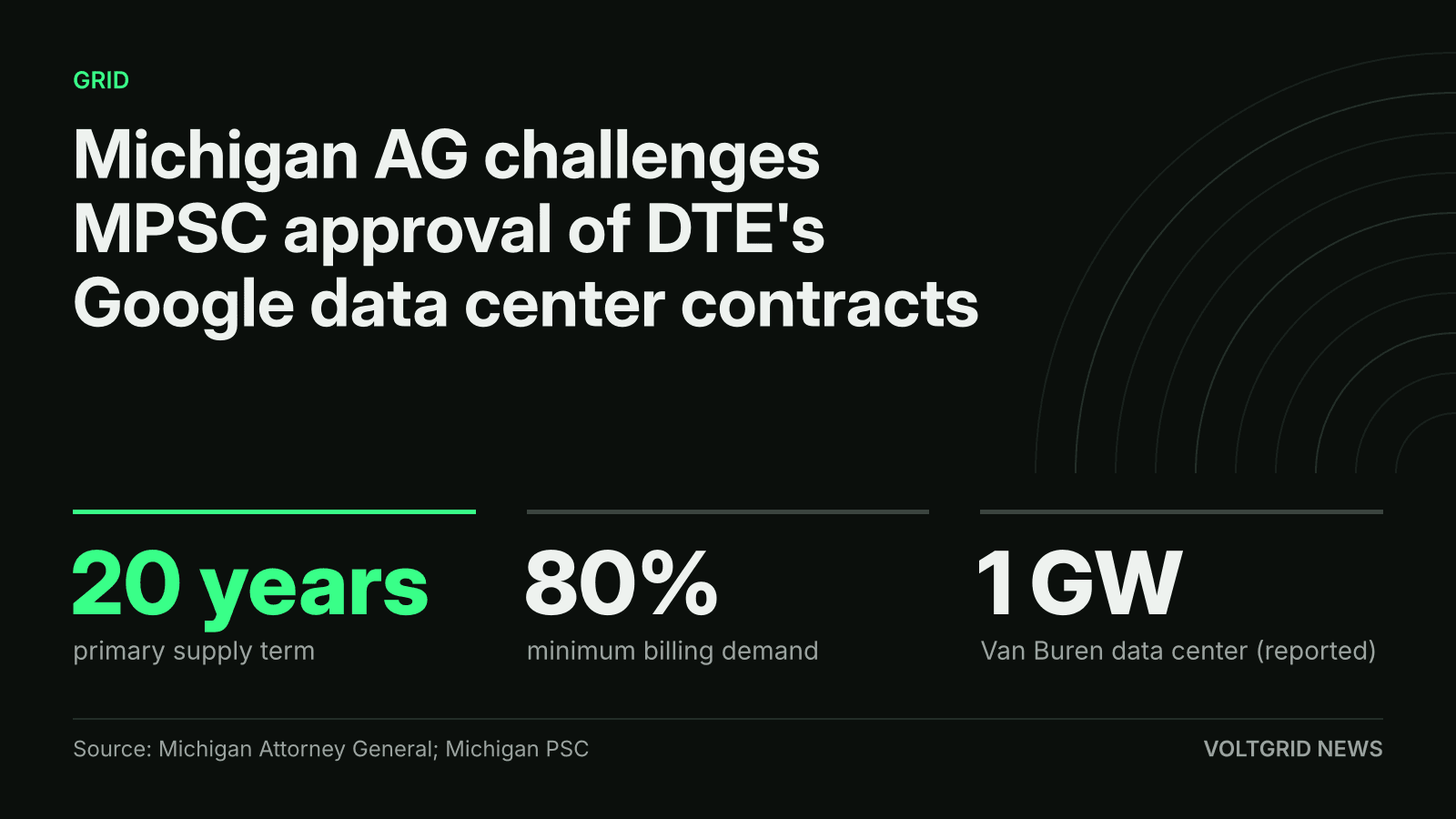
The 20-year supply term and 80% minimum billing demand are among the terms the MPSC approved on Oct. 1.
Illustration (AI-generated)
Michigan Attorney General Dana Nessel filed a petition on Oct. 30, 2026, asking the Michigan Public Service Commission (MPSC) to rehear its approval of DTE Electric's 20-year contracts to power Google's 1-gigawatt data center in Van Buren Township, in case U-22058.
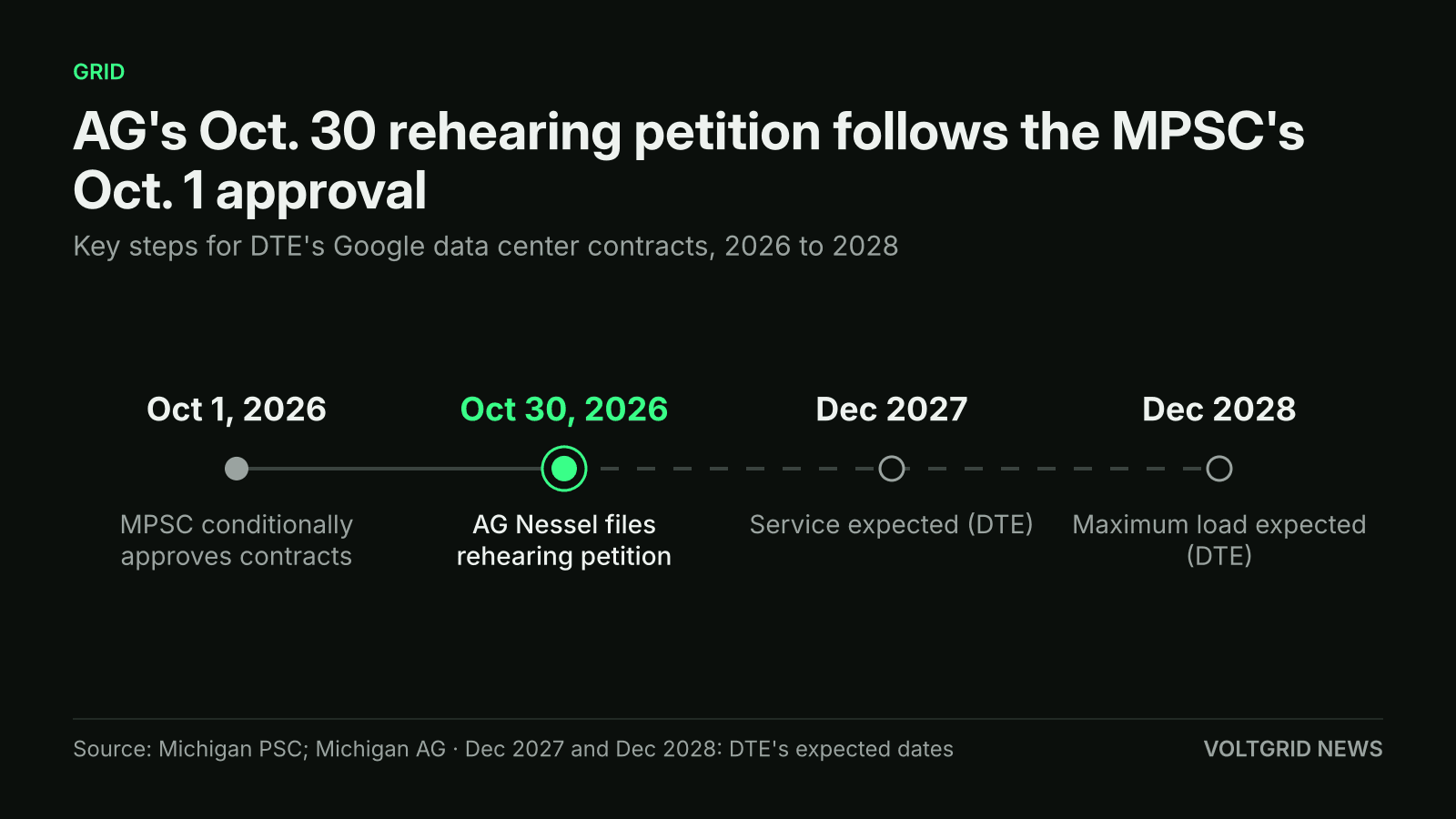
The attorney general's petition came on Oct. 30, a month after the MPSC's Oct. 1 approval; the 2027 and 2028 dates are DTE's expectations.
Illustration (AI-generated)
The commission granted conditional approval on Oct. 1, 2026, according to its own release and Planet Detroit. The MPSC said the conditions ensure no costs pass to DTE's other customers. Nessel's office says the order contains a "litany of errors", including an incorrect burden of proof and standard of review, and asks the commission to adopt her recommendations or reject the contracts outright.
Her central objection is how costs and benefits are counted. DTE proposed judging them in aggregate across the full 20-year term, and the commission accepted that approach. The attorney general's office says this tolerates years when other customers subsidize the site, and that the order itself concedes this for 2035 to 2038. Nessel wants costs and benefits reconciled annually. Michigan Public reported that the MPSC declined to comment on the petition and that Google did not respond to a request for comment.
What the MPSC approved
The primary supply agreement runs 20 years, against the 5-year contracts normally required under DTE's large-load D11 rate, the MPSC said. It sets a minimum billing demand of 80% of contracted use, compared with 50% to 65% in the general D11 rate, and an early termination payment covering at least 15 years of minimum monthly charges. Credit and collateral requirements apply as well.
A second contract, the clean capacity accelerator agreement, has Google pay for DTE to develop, own and operate up to 1,600 MW of renewable energy and 480 MW of battery storage. DTE told the commission the data center would begin taking service in December 2027 and reach maximum load by December 2028. DTE also contends the contracts will deliver a $1.7 billion benefit to other customers over 20 years; that figure is the utility's claim.
Why it matters for large-load tariffs
This is Michigan's first hyperscale data center contract decided through a full contested case, according to Planet Detroit. That makes the order a likely reference point for how regulators weigh a utility's long-run benefit projections against near-term cost risk for a gigawatt-scale load. For grid planners, the open question is not whether Google pays its own energy bill but who carries transmission and stranded-asset exposure if load falls short.
The attorney general's petition also takes aim at the collateral cap that limits the liability of Google and its parent Alphabet. It says the commission again ignored transmission costs that DTE has not accounted for, as it did in the contracts for the Saline Township campus serving Oracle and OpenAI. In that case the MPSC voted 3-0 on March 27 to deny rehearing requests, finding the opposing groups lacked standing, the Detroit Free Press reported.
Other Michigan load is waiting on similar questions. CMS Energy said a data center for Microsoft of up to 1 GW may advance after the midterm elections, and Voltgrid covered how Ohio's $16 billion data center power cost estimate rests on a national assumption.
What is not decided yet
The MPSC has not ruled on the petition, and Voltgrid found no scheduled date for a decision as of Oct. 31, 2026. The commission's authority in the case covers contract terms and customer protections, not whether or where a data center locates, the MPSC said. The 2035 to 2038 net-cost finding is the attorney general's description of the order.