FuriosaAI Raises $620M Series D at $2.9B Valuation for RNGD Chips
FuriosaAI closed a $620 million round at about $2.9 billion post-money, with Korea's National Growth Fund the largest investor, to lift RNGD output to over 40,000 chips in 2027.
2 min readAI-assisted
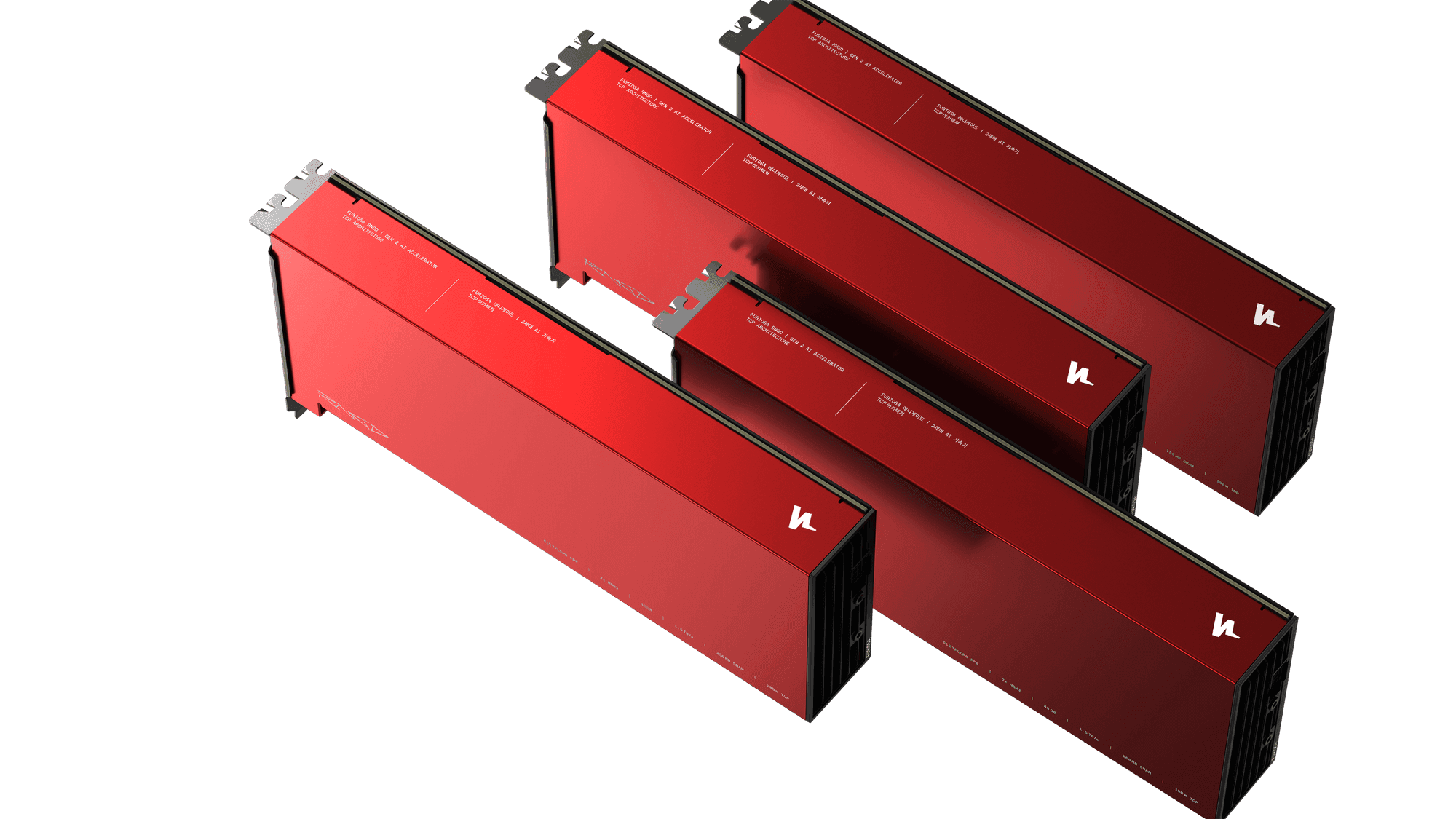
FuriosaAI's RNGD accelerator card, the second-generation inference chip the company says draws 180 W and is air-cooled.
Image: FuriosaAI
Source · Press image from the FuriosaAI newsroom, used for news reporting.
FuriosaAI, the Seoul-based AI inference chip company, said on Oct. 28 that it completed a $620 million (KRW 820 billion) Series D round at a post-money valuation of about $2.9 billion, according to its release distributed by Business Wire.
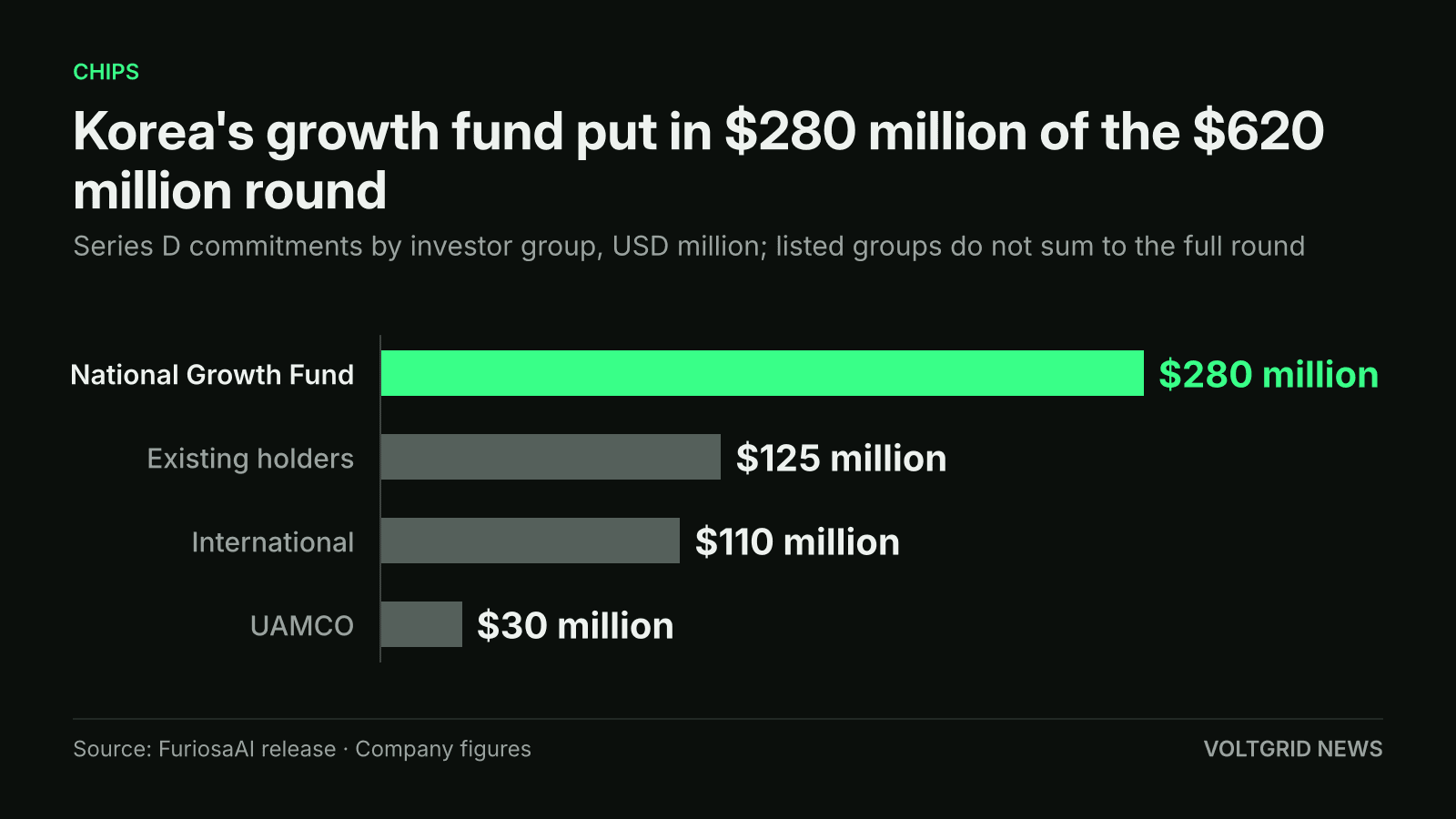
The National Growth Fund's $280 million is the largest single commitment in FuriosaAI's $620 million Series D, per the company; the groups shown do not add up to the whole round.
Illustration (AI-generated)
South Korea's National Growth Fund invested $280 million as the largest investor in the round, the company said. International investors contributed $110 million in total, and the US firm Infinitum was the largest of them. Cisco Investments, Jericho Capital, QUDA Capital Partners, NeoFort Holding and Worldline Capital also joined. Existing shareholders added $125 million, including $22 million from the Korea Development Bank, and the Export-Import Bank of Korea made its first direct startup investment. Bloomberg's headline said the valuation quadrupled.
The consequence for data centers is in the power budget. FuriosaAI says its 180-watt, air-cooled RNGD card delivers throughput comparable to a GPU drawing twice as much power or more. That is a vendor claim, and the release names neither the GPU nor the workload. If it holds, an operator could add inference capacity inside an existing rack's power and cooling limits instead of rebuilding for liquid cooling.
What the money buys
The company expects to produce 20,000 RNGD accelerators in 2026 and to more than double that to over 40,000 units in 2027. On the 180 W card rating, that is about 3.6 MW of card power for the 2026 volume and more than 7.2 MW for 2027, before servers, networking and cooling. That is Voltgrid's arithmetic, not a figure from the company.
RNGD is FuriosaAI's second-generation accelerator and entered mass production in January 2026. It uses what the company calls a Tensor Contraction Processor architecture and high-bandwidth memory. The release lists three deployments: LG Group runs its EXAONE models on RNGD, Upstage uses it for live search summarization, and Samsung SDS launched a commercial NPU-as-a-service on RNGD in July. The funds will also go to the software ecosystem and to a third-generation accelerator that FuriosaAI is developing with Broadcom for hyperscale infrastructure. The release gives no date or specification for that chip.
Where it sits among inference chip rivals
MoneyToday reported that Infinitum co-led Groq's $650 million round, so the investor is now in two of the NVIDIA challengers. Voltgrid reported that Dell's first Groq 3 LPU rack is due in the first quarter of 2027, the same year FuriosaAI plans its volume step-up.
How the dollar and won figures line up
The release states the round as $620 million, equal to KRW 820 billion, and the valuation as about $2.9 billion. MoneyToday, citing the company, put the pre-money valuation at about KRW 3 trillion and the post-money valuation at about KRW 3.8 trillion. Other outlets show smaller dollar totals, which are the same won amounts converted at a weaker exchange rate. The release's own dollar figures are used here.
What is not confirmed yet
Reports differ on who led the round. The release calls the National Growth Fund the largest investor and Infinitum the largest international investor, and it does not use the word lead. FuriosaAI has not published an independent benchmark behind its power comparison, and it has not said when the third-generation chip will tape out or ship. MoneyToday said the round began in January with a target of KRW 450 billion to 750 billion, and that demand pushed it past that range.