Dell Launches PowerEdge XE9810, Its First Groq 3 LPU Rack, Due Q1 2027
Dell's PowerEdge XE9810 packs 16 liquid-cooled trays of NVIDIA Groq 3 LPUs; LPU count, throughput and power draw are still unpublished, so facility sizing has to wait.
2 min readAI-assisted
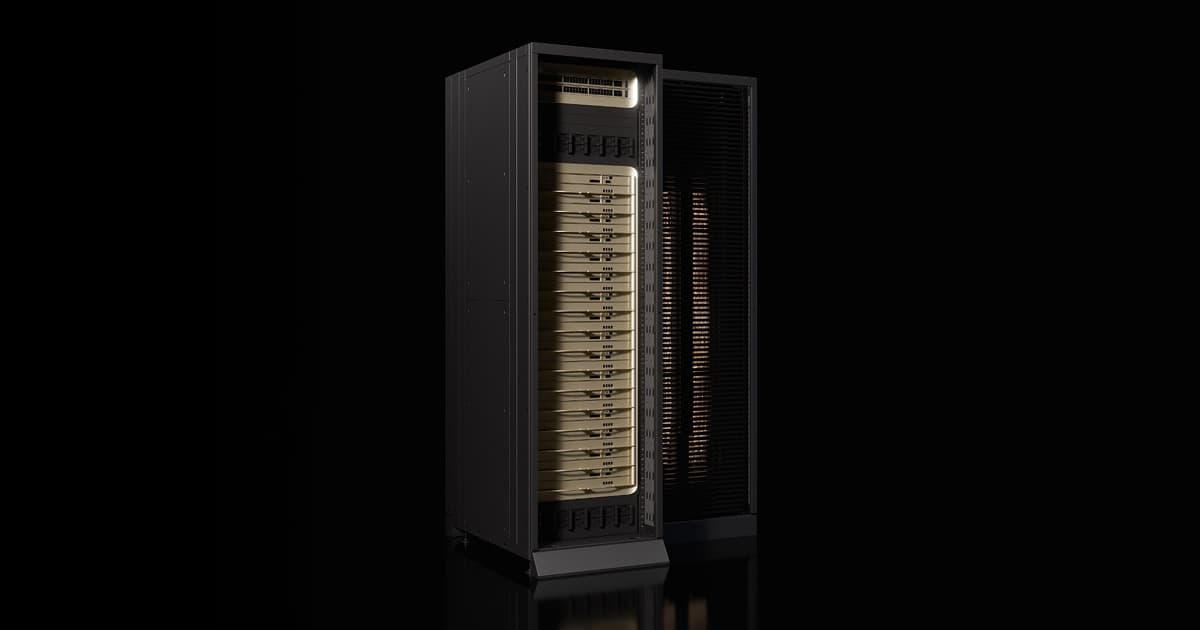
NVIDIA's LPX reference rack, which holds 256 interconnected LPUs. Dell has not published an LPU count for its own PowerEdge XE9810.
Image: NVIDIA
Source · Press image from the NVIDIA LPX product page, used for news reporting.
Dell Technologies introduced the PowerEdge XE9810 on Oct. 21 at NVIDIA GTC Berlin, its first rack-scale inference system built on NVIDIA Groq 3 language processing units (LPUs), with 16 direct-liquid-cooled compute trays and delivery in the first quarter of calendar 2027.
According to StorageReview, Dell sells the XE9810 as a disaggregated complement to GPU clusters for production agentic AI, with consistent time to first token at scale as the design target. Dell has not published the LPU count per tray, throughput figures or a full system configuration.
That gap matters for power planning. Dell gave no wattage for the rack, and the only hard numbers come from NVIDIA's own Groq 3 LPX reference design, so any facility sizing for the XE9810 has to wait for Dell's specifications. Dell does cool the trays with liquid directly, which puts the system on the same facility water and rack-density path as the GPU racks it is meant to sit beside.
What NVIDIA's reference rack specifies
NVIDIA's LPX product page describes a rack of 256 interconnected LPU accelerators. Each Groq 3 LPU carries 500 MB of SRAM (static random-access memory) with 150 TB/s of SRAM bandwidth and 2.5 TB/s of scale-up bandwidth, NVIDIA says. Across a rack, that adds up to 128 GB of SRAM, 40 PB/s of SRAM bandwidth, 12 TB of DDR5 memory and 640 TB/s of chip-to-chip scale-up bandwidth.
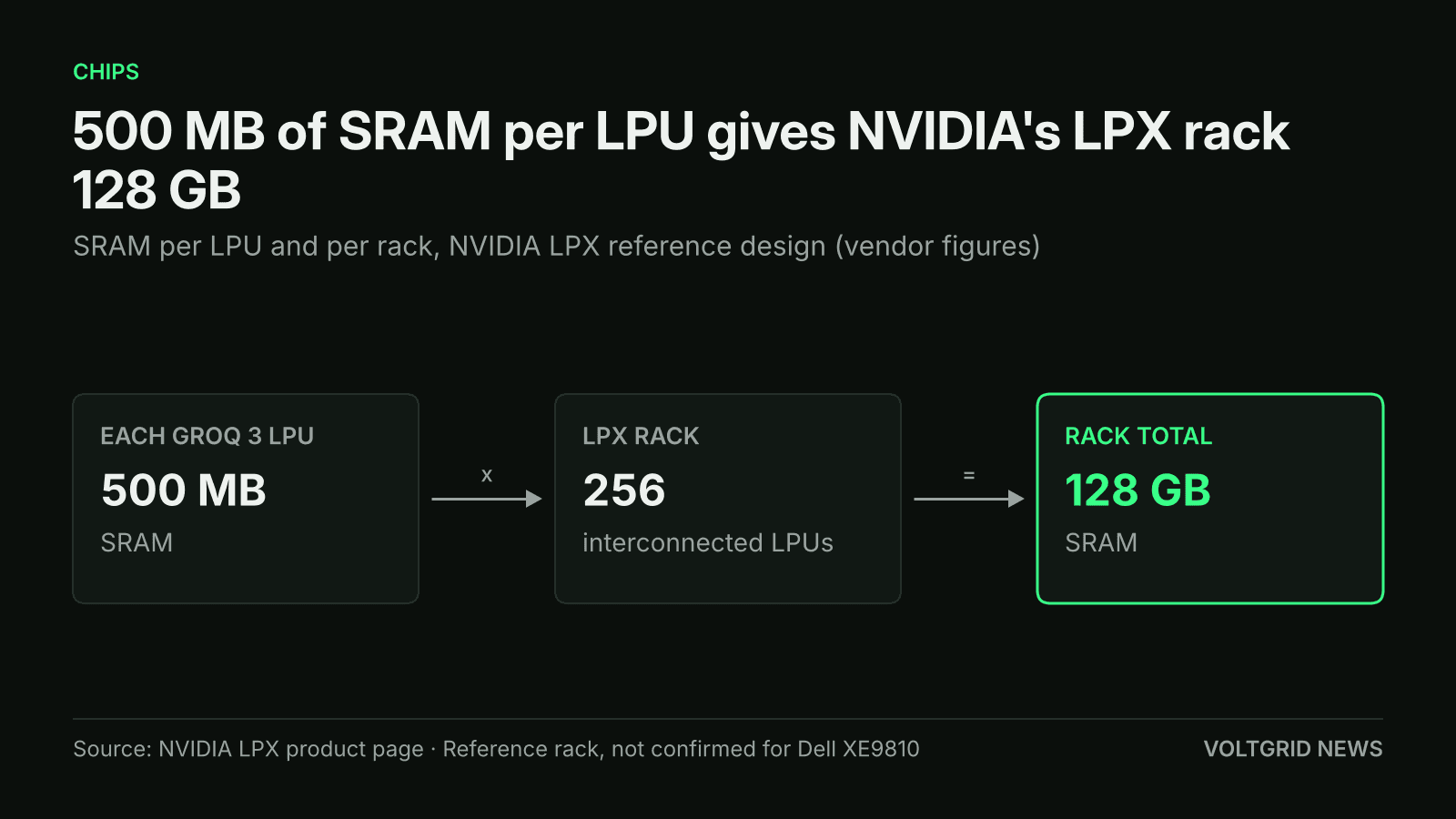
NVIDIA's LPX reference rack totals 128 GB of SRAM, according to the NVIDIA LPX product page; Dell has not confirmed its XE9810 matches it.
Illustration (AI-generated)
NVIDIA pairs the rack with Vera Rubin NVL72, where Rubin GPUs use high-bandwidth memory (HBM) and the LPUs use SRAM to generate output tokens. It claims the combination delivers up to 35x higher throughput per megawatt for trillion-parameter models. NVIDIA labels that figure projected and subject to change, so treat it as a vendor claim until a customer measures it.
How it fits Dell's wider launch
The XE9810 was one of several launches in the same Dell AI Factory expansion. Dell also showed a 48U rack holding 256 Vera CPUs, as Voltgrid reported, and a containerized DSX POD design that Dell says cuts deployment at a prepared site from six months to 14 days. Dell also said its AI Factory platform has passed 6,500 customers, up from 5,000 last quarter.
For NVIDIA, a Dell-built LPU rack is a channel for the Groq technology it now ships under its own name. Groq's next-generation memory plans are a separate question, covered in Voltgrid's report on Groq weighing 3D-stacked DRAM.
What is not confirmed yet
Dell has not said how many LPUs sit in each of the 16 trays, so it is unconfirmed whether the XE9810 matches NVIDIA's 256-LPU reference rack. It has also not published throughput, power draw or pricing. The XE9810 is due in Q1 CY27, and the first customer names and measured tokens-per-watt figures will show whether the LPU tier earns a place next to GPU racks.