Intel Agrees to Buy Classiq, With Close Targeted for H1 2027
Intel agreed on Oct. 26 to buy quantum-software firm Classiq and add QPUs to its CPU, GPU and ASIC lineup. Close is targeted for the first half of 2027. Calcalist reported $2.3 billion, which Intel did not state.
2 min readAI-assisted
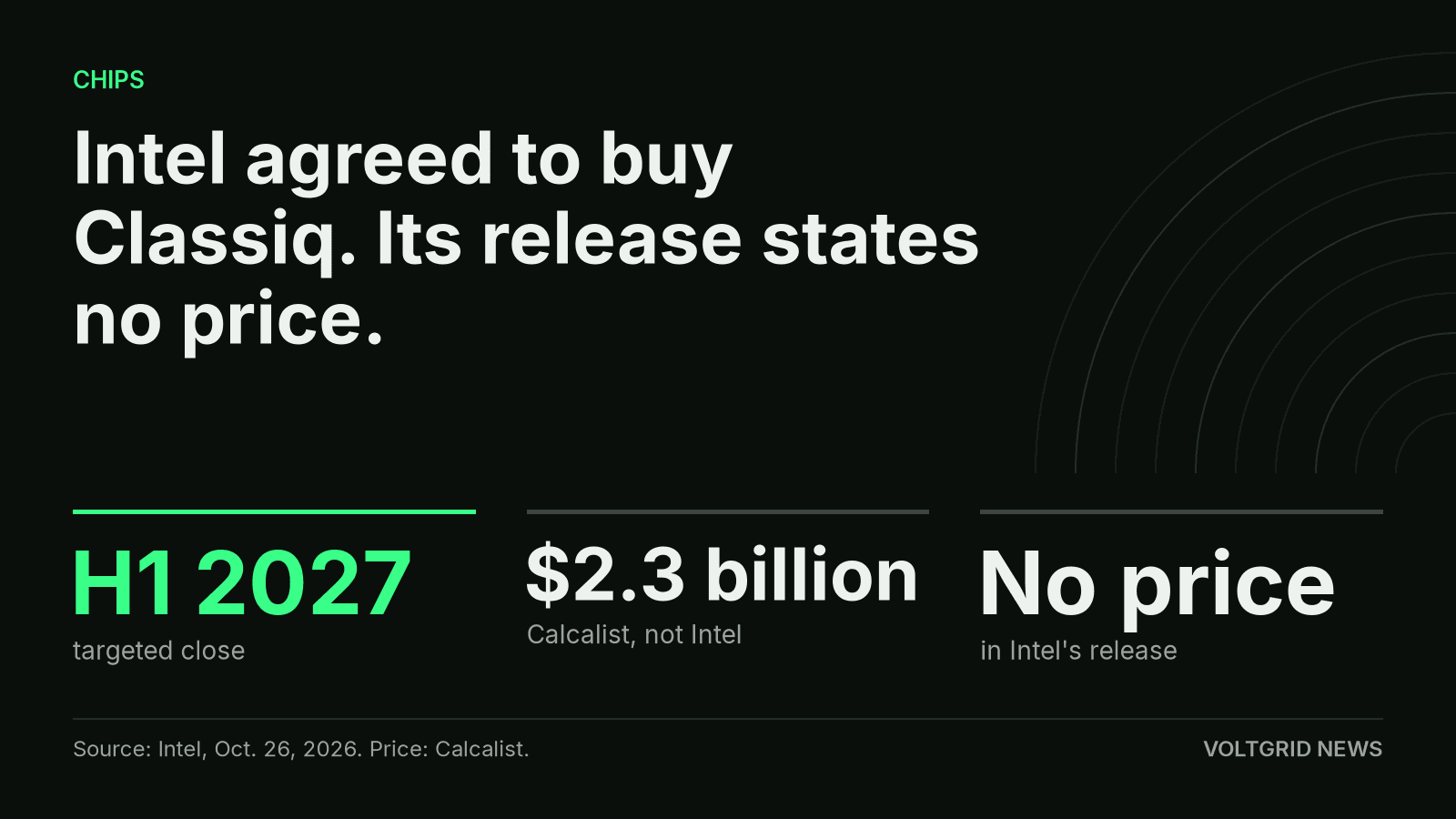
Intel's release page offered a logo, not a lab photo. The company did not state a price. Calcalist reported $2.3 billion.
Illustration (AI-generated)
Intel said on Oct. 26 it has signed a definitive agreement to acquire Classiq, a quantum-computing software company, and that it expects the deal to close in the first half of 2027 if regulators approve it and other customary conditions are met.
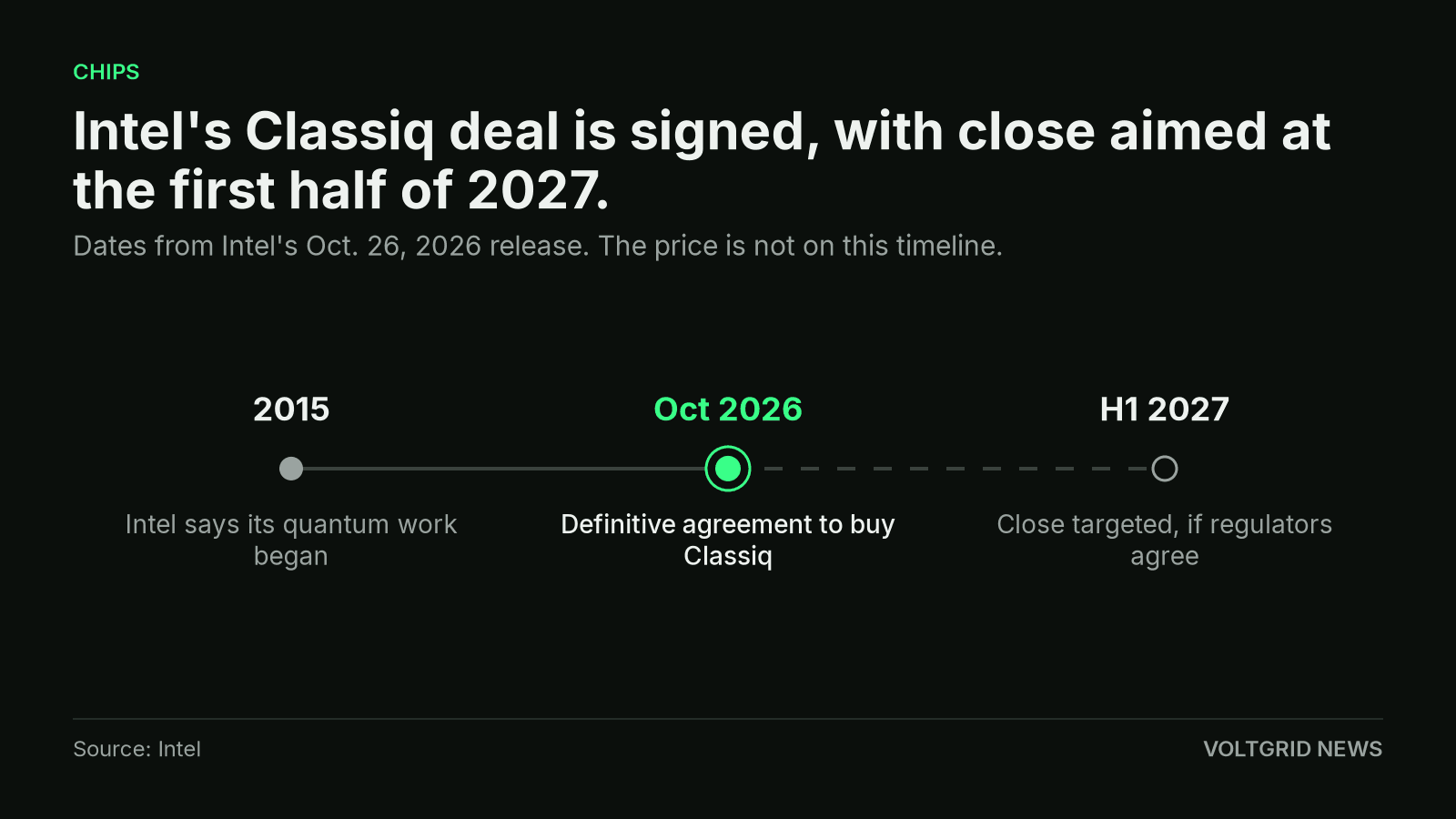
Intel said the companies keep operating separately until closing. Regulatory approval is still required.
Illustration (AI-generated)
Intel's announcement does not state a price. Calcalist reported the same evening that Intel is paying $2.3 billion in cash and stock, which Calcalist said would top IonQ's $1 billion purchase of Oxford Ionics last year. Calcalist also reported that Classiq employs about 150 people, that employees hold 10 percent of the shares, which it valued at $230 million, and that Intel has set aside more than $100 million in grants to keep staff. Until closing, Intel said the two companies will keep operating on their own. Intel said it intends to keep Classiq's tools working across other qubit types and other hardware, not only Intel silicon.
Spin-qubit chips plus a programming layer
Intel said the combination pairs Classiq's automated algorithm-synthesis platform with Intel's silicon spin-qubit technology and Intel's existing quantum software. The company said that would let it add quantum processing units to a lineup that already includes central processors, graphics processors and application-specific chips. Intel said it has funded quantum work since 2015, and that it is the only company making qubit chips and complex cryogenic control electronics at scale on tools and processes shared with ordinary silicon manufacturing. That scale claim is Intel's.
Chief executive Lip-Bu Tan said bringing Classiq in turns Intel's quantum group into a full-stack business. Classiq chief executive Nir Minerbi said the software is meant to let developers write quantum applications without laying out circuits by hand. Intel's release refers to Nir, Yehuda and Amir joining the company. Calcalist identifies the founders as Nir Minerbi, Amir Naveh and Prof. Yehuda Naveh.
A software purchase does not put a new accelerator in a rack, and it does not come with a wattage. The hardware consequence Intel is arguing for is different: spin-qubit chips made on a conventional line become a product only if customers can program them. The announcement gives no qubit count, no error rate, no cryogenic power draw and no fab.
What is not confirmed
Intel has not confirmed Calcalist's $2.3 billion figure, the employee share, or the retention grants. The deal can still fail regulatory review. Intel's release also flags the risk that the benefits do not show up, and the wider uncertainty about when quantum computing finds commercial use. No closing date inside the first half of 2027 is set.