Kioxia Revenue Hits ¥2.48 Trillion on AI Demand, Guides Flat
Kioxia posted July-September revenue of 2,480.0 billion yen and operating profit of 1,994.7 billion yen on AI data-center demand, and guided the next quarter flat as a stronger yen weighs.
Chips & Power DeskEdited by Ege Erten
3 min readAI-assisted
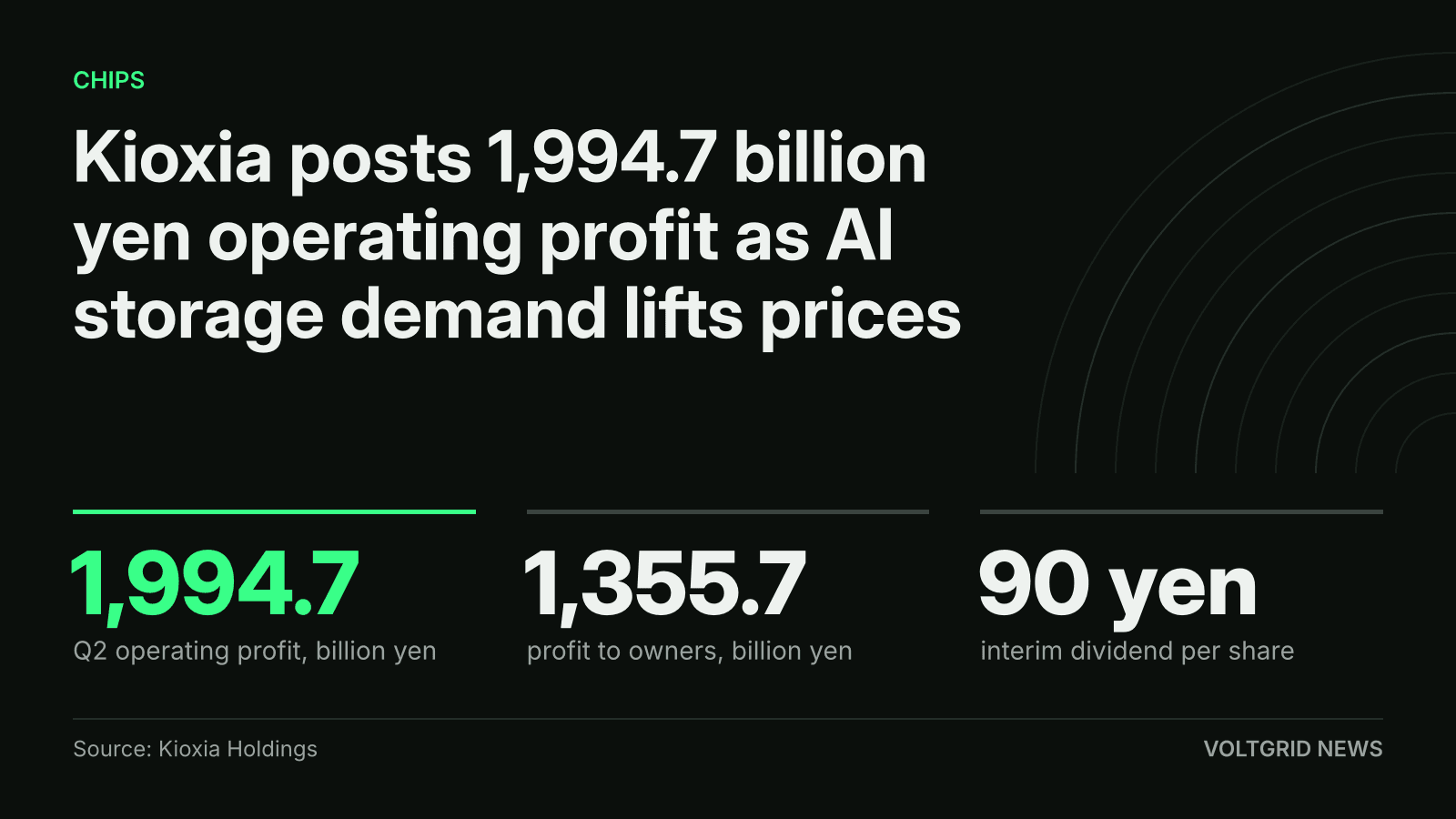
Kioxia's July-September results: operating profit, profit attributable to owners and the interim dividend, as reported by the company.
Illustration (AI-generated)
Kioxia Holdings reported revenue of 2,480.0 billion yen for the July-September quarter, up 712.9 billion yen from the prior quarter, and guided October-December revenue broadly flat, the company said on Oct. 30.

Kioxia's revenue rose to 2,480.0 billion yen in July-September and the company guides 2,500.0 billion yen for October-December, roughly flat.
Illustration (AI-generated)
Operating profit was 1,994.7 billion yen, up 724.7 billion yen from the quarter ended June 30, according to Kioxia's consolidated results. Profit attributable to owners of the parent reached 1,355.7 billion yen, up 513.5 billion yen. On the company's non-GAAP basis, which strips out items such as stock-based pay and litigation provisions, operating profit was 1,988.3 billion yen. Kioxia said the jump came mainly from much higher average selling prices, driven by data-center customers building generative AI, plus higher bit shipments.
Where the revenue came from
The SSD and Storage segment, which covers drives and memory for PCs and data centers, booked 1,616.0 billion yen, up 441.3 billion yen on the quarter. Smart Devices revenue was 788.9 billion yen, up 263.2 billion yen. The yen averaged 161 to the dollar in the quarter, against 160 in the prior one.
Kioxia's own read of the market is split. In its results commentary, the company said demand from smartphone and PC customers is trending down, while demand for AI servers at data centers and enterprise customers is rising and the overall flash market keeps growing. Price, not only volume, is carrying the numbers.
Guidance for October-December
For the third quarter of its fiscal year ending March 2027, Kioxia forecast revenue of 2,500.0 billion yen, operating profit of 1,995.0 billion yen and profit attributable to owners of the parent of 1,360.0 billion yen. Those figures sit within about 1% of the second quarter on revenue and operating profit. Kioxia said data-center demand should stay strong, but that factors including the negative effect of exchange rates would hold revenue and profit near second-quarter levels.
For Voltgrid readers, the message is that AI storage demand is lifting flash prices at this scale, yet the company is not guiding to further acceleration. Kioxia did not say in the documents Voltgrid reviewed how much of the spending behind AI storage is going into new capacity.
Capital, dividend and structure
Cash spending on property, plant and equipment was 135.3 billion yen for the six months to September 30, against 143.1 billion yen a year earlier, a small decline even as revenue surged. Kioxia spent 800.3 billion yen on treasury shares and 523.1 billion yen repaying long-term borrowings in the half. Its cash balance stood at 1,397.3 billion yen.
The board declared an interim dividend of 90 yen per share, set on the basis before its three-for-one share split of Oct. 1, with a total of 47,937 million yen payable on Dec. 8. Kioxia said it aims to hold a net cash position and to return 100% of excess funds to shareholders over the medium to long term. Separately, its main operating subsidiary will absorb Kioxia Iwate Corporation on April 1, 2027, a step the company said is meant to strengthen manufacturing scale for advanced flash as AI data-center demand grows.
Context and what to watch
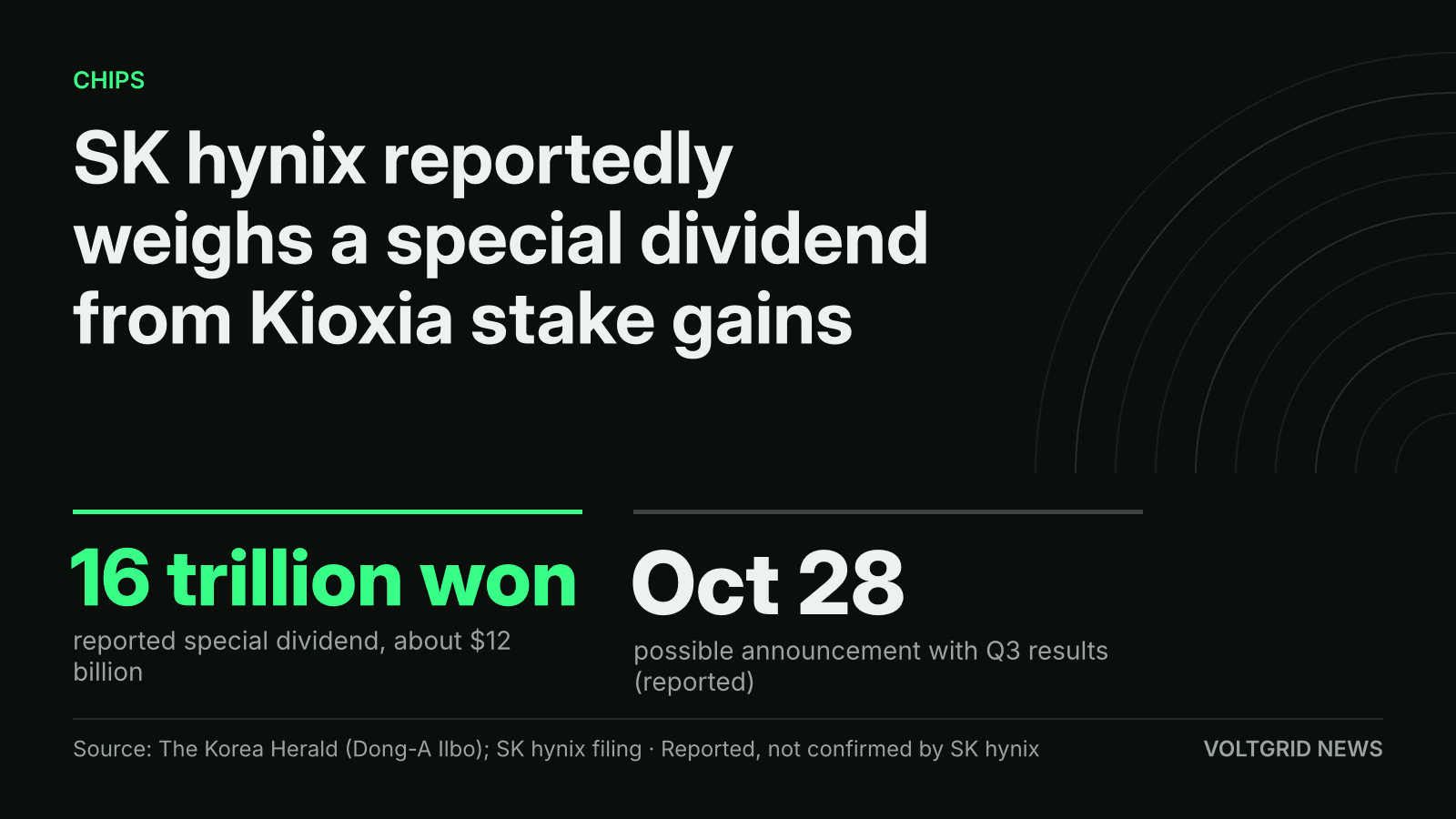
Sandisk, Kioxia's flash joint-venture partner, recently reported data center sales up 61%, so both makers are seeing the same AI-storage pull. Memory-chip makers' balance sheets are also moving: SK hynix was reported to be weighing a special dividend tied to gains on its Kioxia stake, a report that remains unconfirmed.
Several things are not settled. Kioxia gave no figure for bit shipments or price changes beyond its description of a significant ASP increase. Nikkei Asia and Bloomberg also covered the results, but Voltgrid relies here on Kioxia's own filings, and the figures above are the company's, unaudited and not reviewed by auditors. The next test is the December-quarter print: whether price gains hold once the yen effect is absorbed.