Intel Plans for About 10% Fewer PCs in 2027 as Memory Sets Demand
Intel's CFO expects PC units to fall about 12% in 2026 and roughly 10% in 2027 with no memory relief next year, even as its budget Wildcat Lake chip sells out. Memory now sizes the PC market.
Hardware & Analysis DeskEdited by Ege Erten
6 min readAI-assisted
Follows our story: Intel Q4 Revenue Guidance of $15-16 Billion Trails $17.07 Billion Estimate
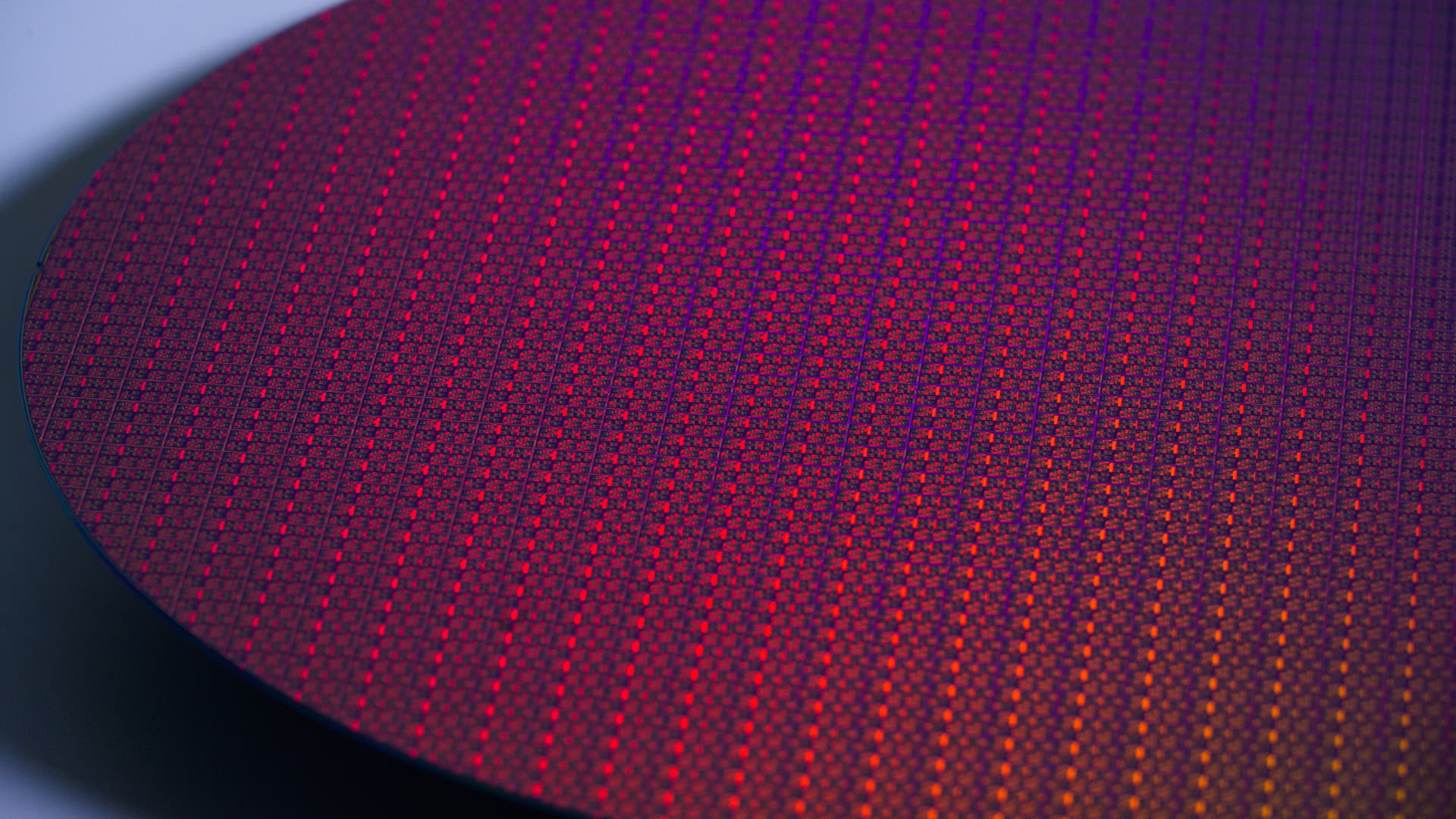
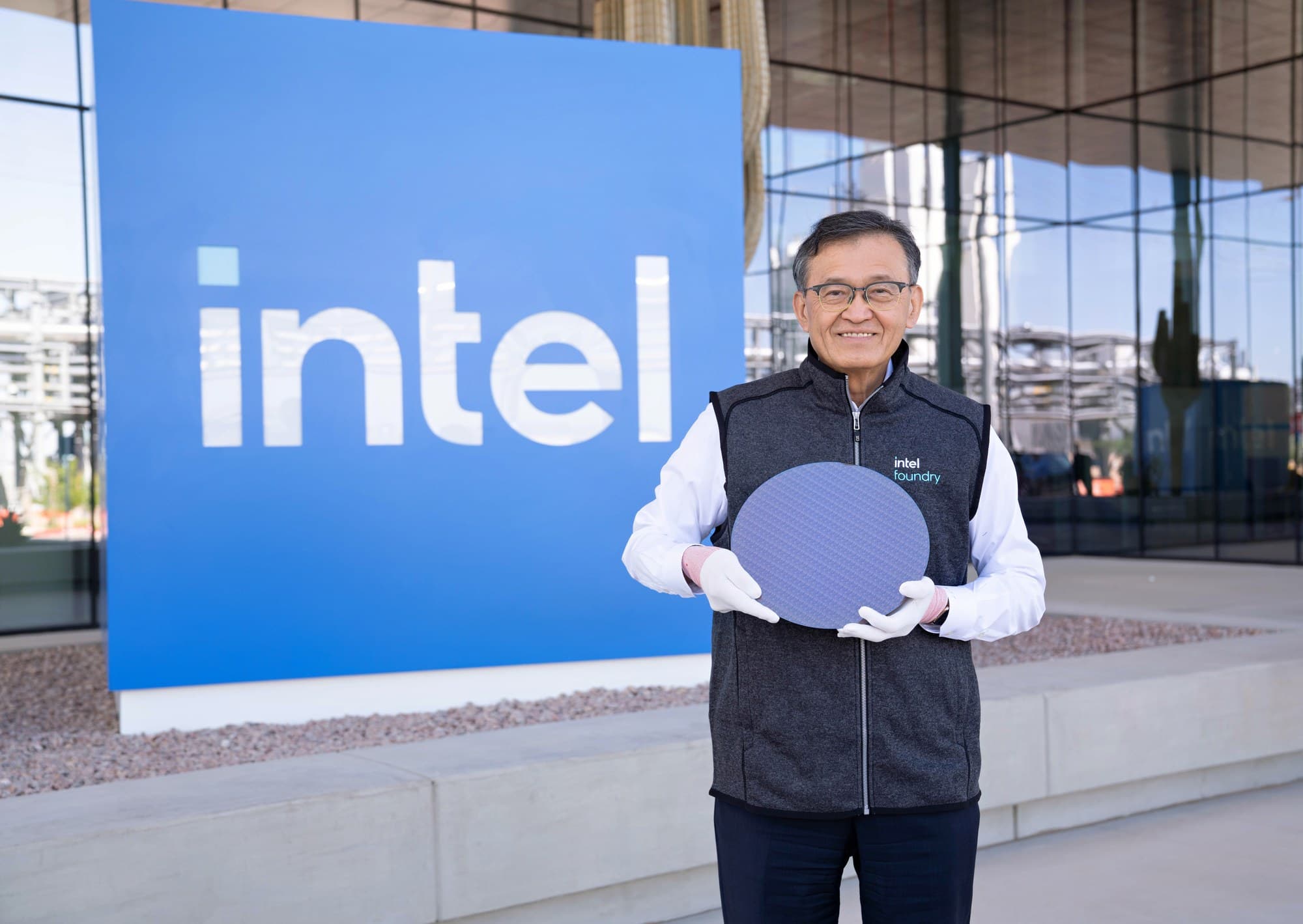
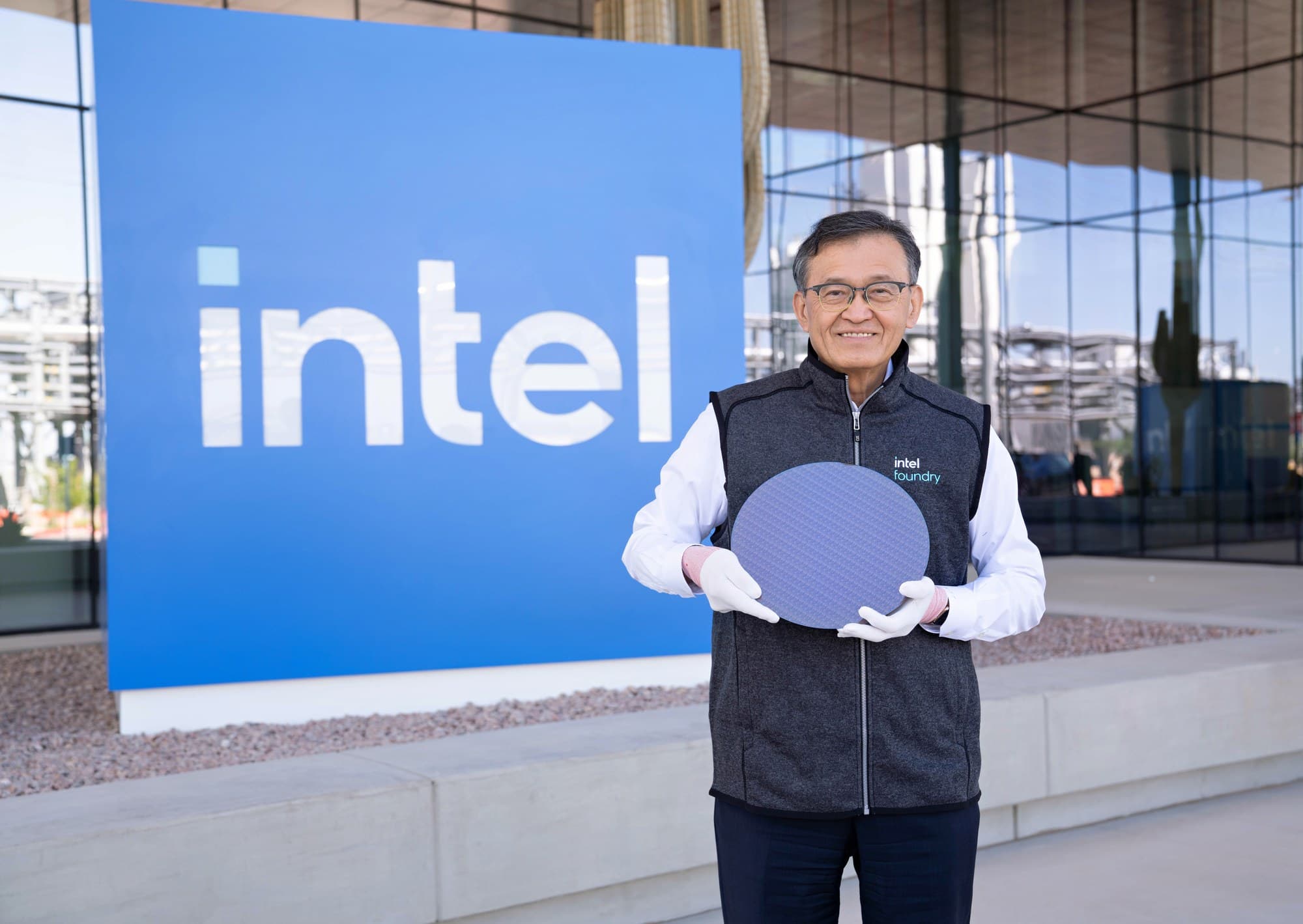
An Intel 18A wafer. Intel said on its Q3 call that 18A products are a third of client CPU revenue (Intel photo, illustrative).
Image: Intel
Source · Press image from the Intel newsroom, used for news reporting.
Intel is planning for the PC market to shrink for a second straight year, with chief financial officer David Zinsner telling analysts on the Oct. 29 third-quarter call that 2027 PC unit volume should fall roughly 10% after an expected 12% drop in 2026. The same call showed Wildcat Lake, its budget-focused 18A chip, sold out. Read together, Intel's numbers argue that memory supply, not processors, now sets how many PCs the world buys.
Voltgrid covered the headline figures in our Oct. 29 story on Intel's $15 billion to $16 billion fourth-quarter guidance, and the node news in our report on Nova Lake and 18A-P. This piece looks at what the call said about the size of the PC market and where Intel's client chips fit in it.
What Intel Said on the Q3 Call
Intel reported third-quarter revenue of $16.5 billion, up 21% from a year earlier, according to its earnings release filed with the SEC. The split was lopsided. Data Center and AI revenue rose 78% to $7.3 billion, while the Client Computing and Physical AI Group, the PC business, fell 5% to $8.1 billion. In the release, Zinsner said he sees the PC slowdown lasting at least through the first half of 2027, and Intel lists today's industry-wide memory and substrate shortages among its risks.
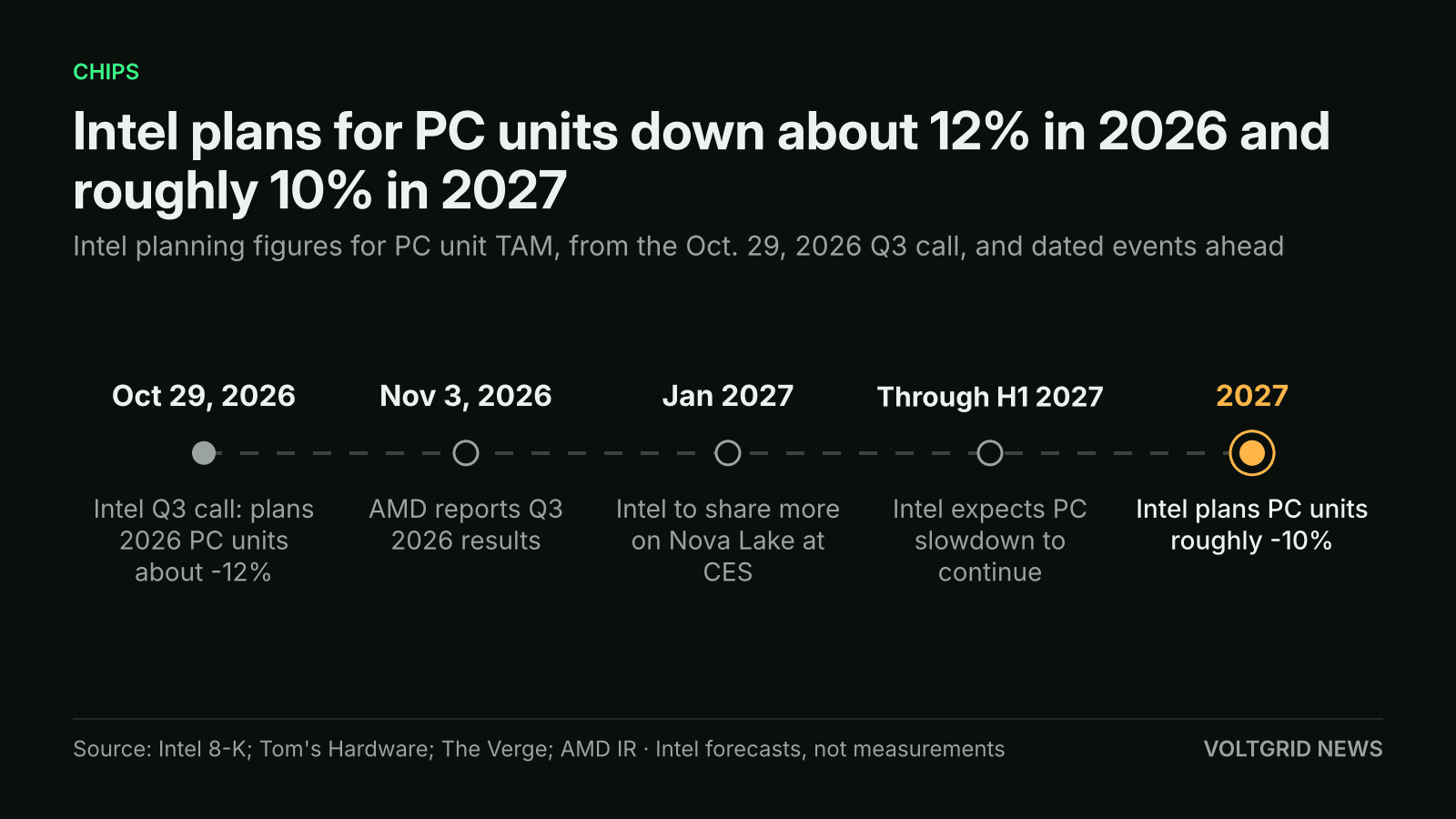
Intel's planning figures put PC units down about 12% in 2026 and roughly 10% in 2027; both are forecasts, not measurements.
Illustration (AI-generated)
On the call, Zinsner gave the market view behind that, as reported by Tom's Hardware. Intel expects 2026 PC units to fall about 12%, with second-half units down more than 20%. He said there will be no sustained recovery until memory becomes available and prices normalize, and that Intel is planning for 2027 units to fall roughly 10%. He also said Intel expects its client business to decline by more than 20% in the fourth quarter. Chief executive Lip-Bu Tan said PC makers are cutting inventory to match weaker sell-through.
Asked about memory, Zinsner was blunt, according to The Verge: Intel is "not optimistic about next year in terms of memory" and does not expect it to improve in 2027, leaving 2028 open. Zinsner also said Wildcat Lake chips are sold out, and Tan said demand for them is outstripping supply.
Why Memory Now Sizes the PC Market
The first step is the market data. IDC counted a 20.1% year-on-year fall in global PC shipments in the third quarter of 2026, a drop of 15.8 million units, Tom's Hardware reported on Oct. 9. Intel's forecast of second-half units down more than 20% points the same way, though the two measure different things: IDC counted third-quarter shipments, which it says early-2026 inventory pull-in also distorted, while Intel's figure is a forecast of total PC demand. Tom's Hardware also reported memory prices climbing by as much as 500%, as memory makers move capacity toward the high-bandwidth memory (HBM) that AI accelerators use.
The second step is Intel's own wording. Zinsner tied the recovery to memory supply and price, not to processor supply or to a new product cycle. Tom's Hardware read the remarks the same way: a pullback in spending by PC makers and IT buyers facing high memory prices, rather than a shortage of chips. If that reading holds, more CPU wafers would not sell more PCs.
The third step is what sells. Wildcat Lake, launched in April as Core Series 3, is Intel's value laptop chip on 18A: up to two performance cores and four low-power efficiency cores, a GPU with up to two Xe3 cores and a 15 W base, 35 W turbo power envelope, per Intel's specifications reported by Tom's Hardware. Its memory interface is narrow: it supports one channel of LPDDR5x-7467 or DDR5-6400, where the top Panther Lake part runs two. The Verge notes that Wildcat Lake laptops such as the new Dell XPS 13 and HP OmniBook 5 14 start at budget prices, often with just 8GB of RAM. Zinsner called the chip cost-optimized and well timed.
That suggests Intel is selling into a market that buys less memory per machine, and that the chip built for that market is the one in short supply. It also fits where 18A wafers are going. Intel said 18A products are now a third of client CPU revenue, up from under 5% in the first quarter, yet Zinsner said Intel is taking 18A wafers that were generally going to make Panther Lake offline "to put Intel 3 into Oregon", freeing capacity for more data-center wafers. A company that expected a client rebound in 2027 would be unlikely to move capacity that way.
A memory channel is the data path between a processor and its RAM. Wildcat Lake supports one channel of LPDDR5x-7467 or DDR5-6400, while the top Panther Lake configuration has two, per Intel's specifications as reported by Tom's Hardware (v2, r1). At the same speed grade, one channel moves less data per second than two, so the channel count limits how fast the chip reaches memory, not how much memory a laptop carries.
Capacity is the laptop maker's choice. The Verge reports that Wildcat Lake laptops such as the Dell XPS 13 and HP OmniBook 5 14 often ship with 8GB (f12). Tom's Hardware reports memory prices up by as much as 500% (f19). A narrow, cheap chip with little RAM suits buyers facing those prices, which is how a sold-out budget chip can sit inside a market Intel plans to shrink roughly 10% in 2027 (f7).
The Case Against a Memory-Led Slump
Intel itself does not frame this as retreat. Zinsner said he sees a market-share-gain environment and expects the PC to go through a renaissance despite the memory shortage. A shrinking market can still pay Intel well. Tom's Hardware reported in September that Zinsner credited a 13% year-on-year rise in second-quarter client revenue to higher average selling prices, not volume, and that DigiTimes, citing supply-chain sources, reportedly said Intel plans a CPU price increase of about 10%, without naming products.
The memory outlook is also contested. Acer chief executive Jason Chen has said shortage fears are overstated and that PC prices could fall in the second half of 2027 as Chinese memory capacity comes online, according to Tom's Hardware. If he is right, Intel's 2027 plan is too cautious. At the other end, The Verge notes that SK hynix expects the RAM shortage to last through 2030, longer than Intel's 2028 horizon.
Finally, the 12% and 10% figures are Intel's planning assumptions for the whole market, not measured results, and Intel has not given Wildcat Lake unit volumes. "Sold out" describes Intel's supply against orders, not how many laptops reach buyers.
What It Means for PC Makers, Rivals and Memory Suppliers
For Dell, HP and Lenovo, Intel's plan implies another year of selling fewer machines at higher prices. IDC's third-quarter count already had HP shipments down 30.9%, Dell down 25% and Lenovo down 22.6%, per Tom's Hardware. Low-memory laptops built around single-channel chips are one way to hold a price point, at the cost of machines that The Verge says Windows can struggle on.
For AMD, which reports on Nov. 3, Intel's view sets the bar: a client segment that grows against a market down more than 20% in the second half would point to share gains or price, not demand. For memory makers, Intel expects no memory improvement in 2027, which implies, by our reading, that PC demand will not free up supply from AI servers, a view consistent with NVIDIA's Jensen Huang gave when he said he sees no 2029 memory glut.
What to Watch Next
AMD's third-quarter results on Nov. 3, after the US market close, give the first rival read on client demand. Intel's Nova Lake details at CES in January will show whether its next desktop platform is built for a memory-constrained market. Intel's next quarterly report will test the more-than-20% client decline it guided for the fourth quarter. If memory contract prices ease before mid-2027, the thesis weakens; if Intel moves more 18A wafers from client to data center, it strengthens.
Sources
- 01Intel launches Wildcat Lake as Core Series 3Tom's Hardware · tomshardware.com
- 02Intel confirms Nova Lake CPUs will use advanced 18A-P node, more details at CES — company says it's taking Panther Lake capacity offline to build more Granite Rapids data center CPUsTom's Hardware · tomshardware.com
- 03Intel Reports Third-Quarter 2026 Financial ResultsIntel · sec.gov
- 04Intel's CFO says it's 'not optimistic about next year in terms of memory.'The Verge · theverge.com