AMD Loom 0.1 SDK Targets CPUs, GPUs and NPUs Without a ROCm Install
AMD's first tagged Loom release, hrx-loom 0.1.0, compiles and serves models on CPUs, AMD GPUs and AMD XDNA NPUs on Linux and Windows 11. It is early access, with no independent benchmarks yet.
Chips & Power DeskEdited by Ege Erten
3 min readAI-assisted
AMD's press image of a Ryzen AI Max Series processor, the kind of hardware Loom targets; it is not a picture of the Loom software.
Image: AMD
Source · Press image from the AMD website, used for news reporting.
AMD released hrx-loom 0.1.0 on PyPI on Oct. 29, the first tagged version of its Loom SDK, a single package that compiles and serves AI models on CPUs, AMD GPUs and AMD XDNA neural processing units (NPUs).
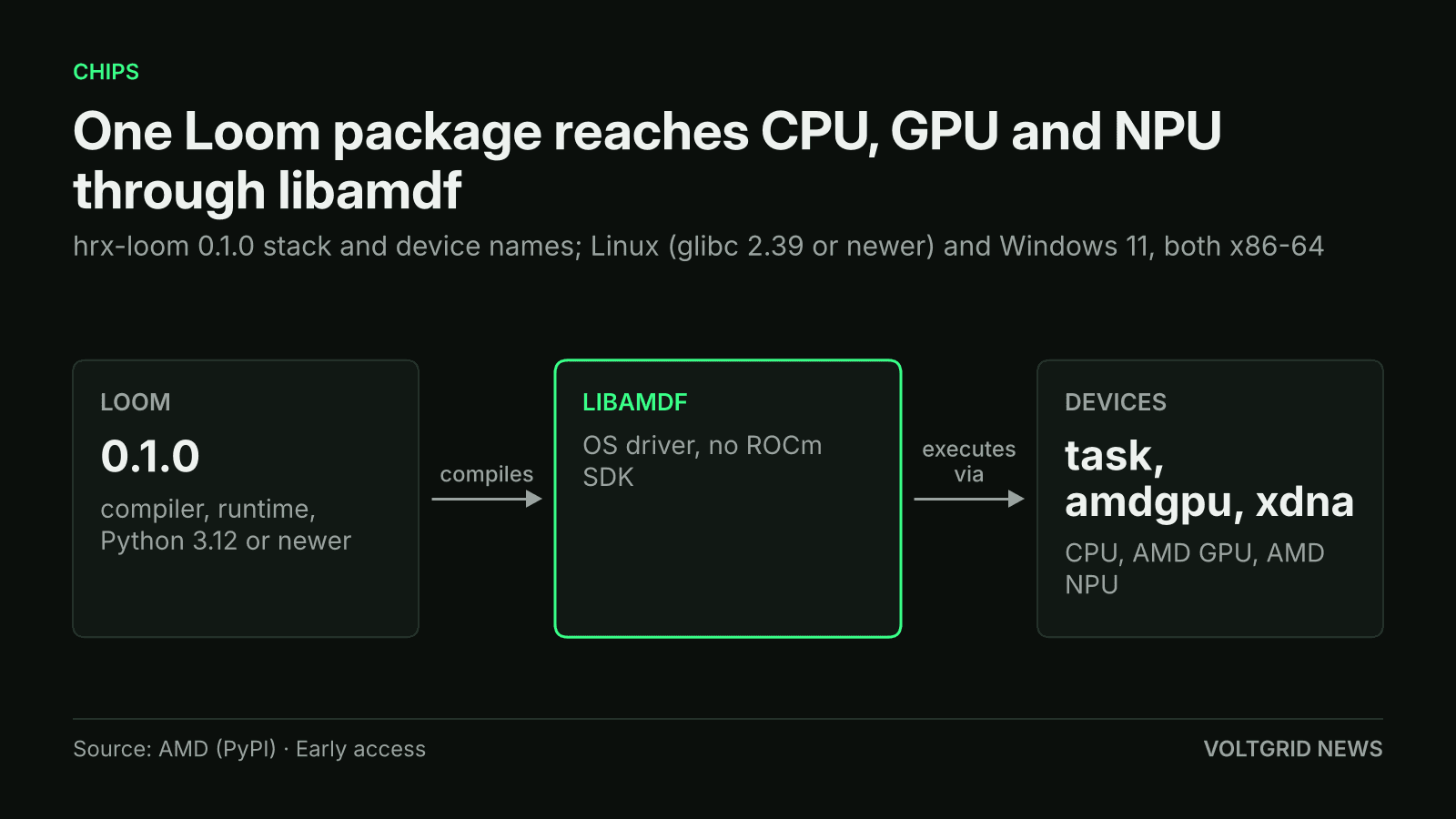
Loom 0.1.0 runs on AMD hardware through libamdf and an OS driver, with no ROCm SDK install; AMD lists Linux and Windows 11 as the initial platforms.
Illustration (AI-generated)
According to AMD's PyPI page, the package holds the Loom compiler, a runtime, model tools and Python APIs. Wheels cover Windows 11 on x86-64 and x86-64 Linux with glibc 2.39 or newer, and need Python 3.12 or later. AMD says no ROCm SDK installation is required: execution on its hardware goes through a library called libamdf and only needs a supported operating-system driver and device access. A developer picks the target with a device flag, task for the CPU, amdgpu for the GPU or xdna for the NPU. The code is licensed under Apache-2.0 with the LLVM exception, and model weights are downloaded separately.
The release extends AMD's effort to make its chips easier to program for AI. Voltgrid reported on Oct. 21 that AMD is folding its ZenDNN library into Intel's oneDNN so PyTorch gets one CPU inference path on x86 servers. That move was about server CPUs. Loom reaches the GPU and the NPU as well, and it targets Windows PCs as well as Linux.
What Loom and HRX are
Loom is the compiler and intermediate-representation layer of ROCm HRX, short for HIP Runtime Extended, Phoronix reported. Two command-line tools carry the workflow: loom-fetch installs a model's programs and assets from a catalog, and loom-serve answers requests over HTTP. Phoronix said Loom emits AMDGPU HSA code for GPUs and SPIR-V for Vulkan as a portable path, while its x86 and WebAssembly back ends are still maturing.
HRX itself is, in the words of AMD's GitHub README, an alternative implementation of HIP, the CUDA-style programming interface that ROCm ships. Its public package includes a compatibility copy of libamdhip64.so, so an existing HIP program can be routed through HRX by preloading that library, with no relinking. The README's example build names three GPU targets, gfx942, gfx1151 and gfx1201, and turns on the XDNA NPU engine by default.
The point is a lighter runtime for client machines. In September, Phoronix quoted AMD engineer Stella Laurenzo saying ROCm was built mainly for the data-center market and often faces headwinds on client operating systems, and that HRX is a smaller subset with eventual inclusion in ROCm proper in view. The README now says HRX is not an official ROCm component. If Loom matures, a pip-installed compiler that reaches both the GPU and the NPU would matter most on unified-memory machines such as Ryzen AI Max, which AMD sells with up to 128 GB of LPDDR5x and an XDNA 2 NPU it rates at up to 50 TOPS, without naming the precision. That is Voltgrid's reading: PyPI names no supported products.
Why a Compiler Stack Spans CPU, GPU and NPU
A compiler turns a model's operations into instructions a specific chip can run. Normally each chip type needs its own path. AMD's PyPI page says Loom compiles programs for CPUs, AMD GPUs and AMD NPUs, and one command, loom-serve, serves a model on whichever device the model supports: task for the CPU, amdgpu for the GPU or xdna for the NPU.
Phoronix reported that Loom emits AMDGPU HSA code for GPUs and SPIR-V for portable Vulkan runs, with x86 and WebAssembly still maturing. The consequence is for client machines, where AMD's Laurenzo said ROCm, built mainly for the data center, often faces headwinds. A smaller runtime that needs no ROCm SDK is AMD's attempt to fix that. Nothing has been measured yet.
What is not measured yet
No independent benchmark of Loom 0.1 exists, and Voltgrid has not tested it. Neither AMD's PyPI page nor Phoronix gives performance figures for this release. The only number in circulation predates it: Laurenzo projected a possible 30% to 50% gain in prompt-processing speed for an HRX llama.cpp backend over the existing Vulkan and HIP backends, a prefill projection from one proposal covering one model (Qwen3-30B-A3B Q4_K_M) on the Radeon PRO W7900 and Strix Halo, not a result for Loom 0.1.
AMD's own caveats are plain. The HRX README calls the code early access, warns that APIs and packaging will change, and says it is not an official component of the ROCm stack. PyPI does not list which GPU or NPU models version 0.1 supports. The next dated checkpoint is AMD's third-quarter report on Nov. 3, though nothing says it will cover Loom; the more telling one will be the first outside benchmarks of Loom-compiled models on Radeon, Ryzen AI Max and XDNA hardware.