AMD EPYC Will Power Oracle's OCI E7 Agent CPU Tier, but Arm Is the Threat
AMD's 6th Gen EPYC will run OCI Compute E7, Oracle's CPU tier for AI agents. TrendForce sees server CPU shipments up 31% in 2026, but NVIDIA's Arm-based Vera went live on the same cloud the same day.
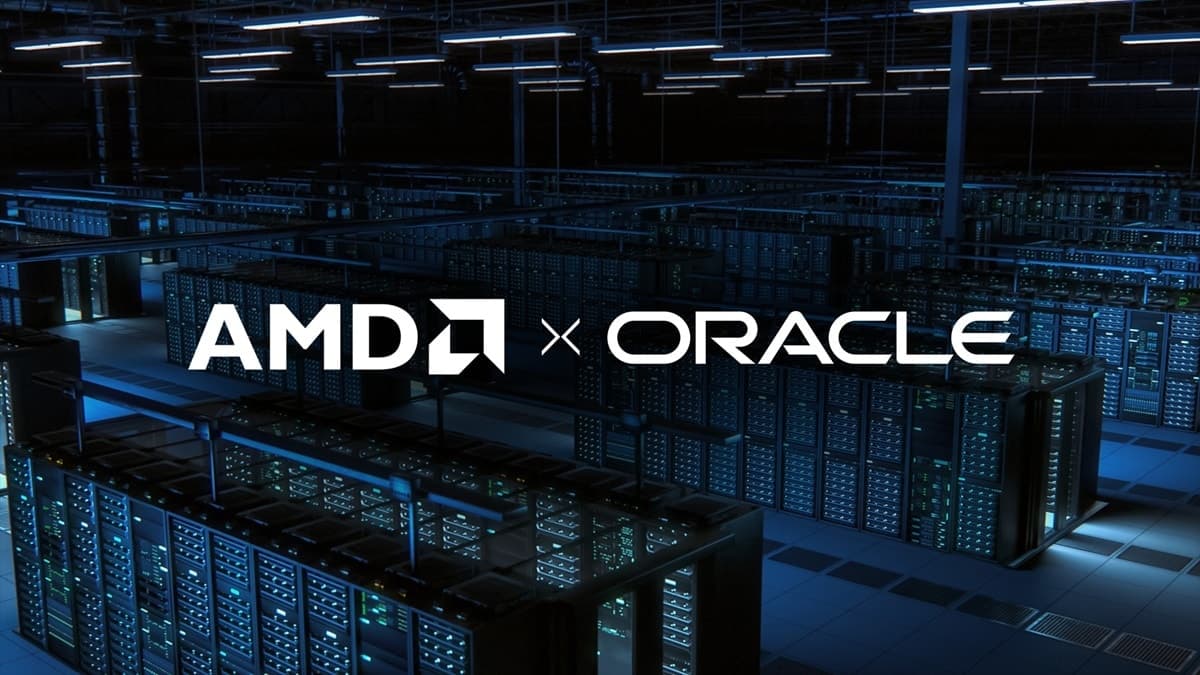
AMD's press image for its Oct. 27 Oracle announcement; it shows a data center hall, not the EPYC 9006 chip or E7 hardware.
Image: AMD
Source · Press image from the AMD newsroom, used for news reporting.
AMD said on Oct. 27 that its 6th Gen AMD EPYC processors will power Oracle Cloud Infrastructure's upcoming Compute E7 instances, a tier Oracle is aiming at the CPU work that surrounds AI agents. The deal supports a thesis this piece argues: agents are making the server CPU a growth market again, AMD is the x86 vendor best placed to take that growth, and its bigger threat is Arm, led by NVIDIA's Vera, rather than Intel.
What happened
At Oracle AI World 2026, AMD said E7 will run enterprise applications and the services around AI models: agent orchestration, concurrent agent sandboxes, retrieval, in-memory caches, and web and API tiers. AMD also said Oracle's Acceleron converged network cards use AMD Pensando data processing units (DPUs) on OCI's AMD CPU and GPU instances, moving networking, storage and security work off the host processor. The release gives no core counts, shapes, regions, prices or launch date, and carries Oracle's standard disclaimer that product direction is not a commitment.
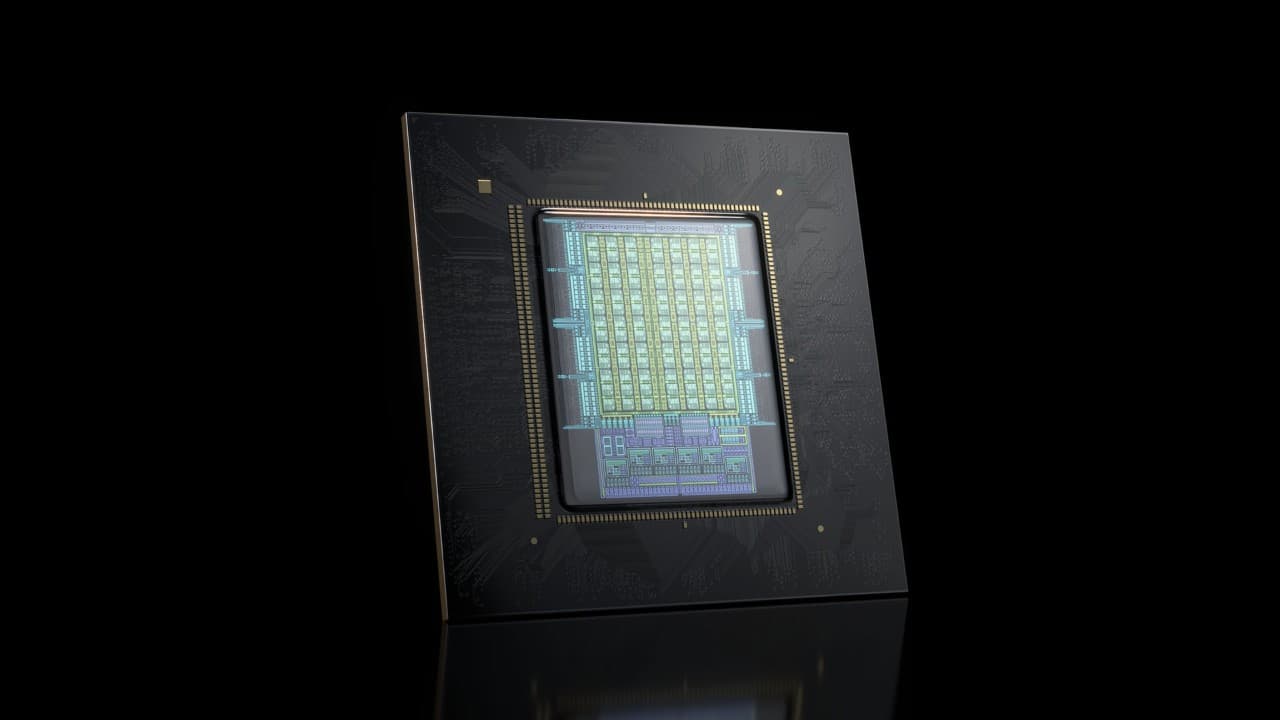
AMD's 6th Gen part is the EPYC 9006 family, formerly code-named Venice. AMD's own launch material from July lists up to 256 Zen 6 cores and 512 threads per socket on TSMC's 2 nm process, up to 16 DDR5 memory channels and PCIe Gen 6. AMD has not said which 9006 parts E7 will use.
The same day, NVIDIA and Oracle said Vera CPUs are generally available on OCI, alongside Vera Rubin NVL72 racks that Oracle plans to grow to multi-gigawatt scale. OpenAI, an early-access customer, said it is bringing Vera into production on OCI for its agentic sandbox workloads. The same day, Intel and Oracle outlined a multiyear Xeon plan, as Voltgrid reported on the Diamond Rapids-based X14 offerings. One cloud announced CPU deals with all three big merchant server CPU vendors in the same week.
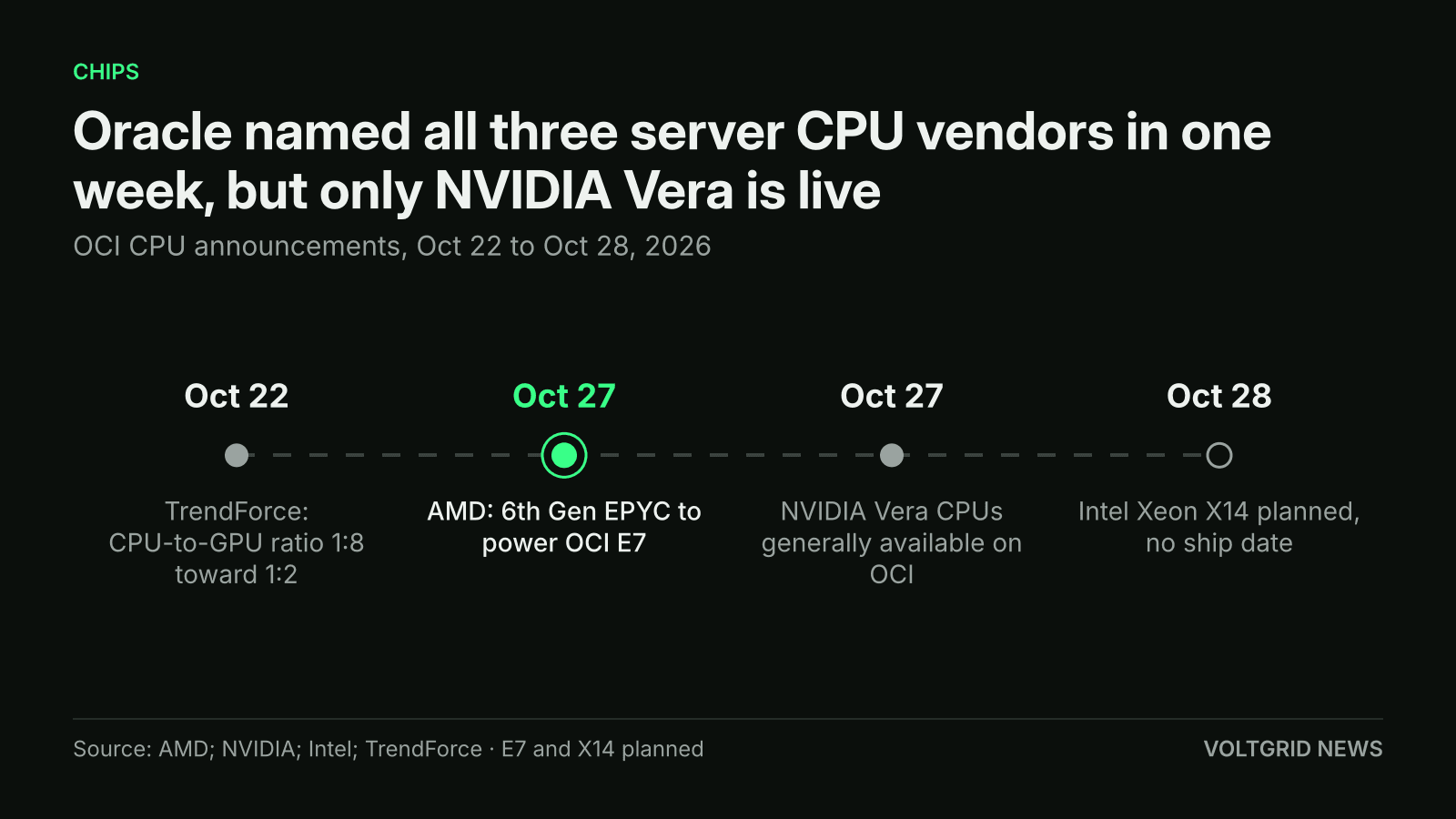
Oracle announced CPU plans with AMD, NVIDIA and Intel within a week; only NVIDIA Vera is generally available, while E7 and X14 are planned.
Illustration (AI-generated)
Why it matters
The one idea behind the deal is the ratio of CPUs to accelerators. TrendForce describes the traditional ratio as one CPU to eight GPUs or ASICs, because the CPU mostly feeds data to the matrix engines. An agent is different: between model calls it runs code, calls tools, searches indexes and queries databases, and all of that runs on CPU cores. TrendForce said on Oct. 22 that, based on the rack plans of major providers, the CPU-to-GPU or ASIC ratio is moving from 1:8 toward 1:2, or even 1:1. If that holds, each new accelerator would bring more CPU demand with it than in the training era.
TrendForce puts numbers on the turn. It forecasts server CPU shipments up 31% in 2026 and more than 40% in 2027. That is the market E7 is built for, and the reason Oracle is selling a CPU tier sized apart from its GPU racks.
AMD enters that market with momentum. Its Data Center segment earned $6.7 billion in the second quarter, up 107% year on year, on demand for both EPYC and Instinct, AMD said on Aug. 4. AMD does not split CPU from GPU revenue in that segment. Mercury Research figures, as reported by HotHardware in May, gave AMD a record 46.2% of server CPU revenue in the first quarter of 2026, up from 39.5% a year earlier, on a 33.2% unit share.
Intel, meanwhile, is short of supply. TrendForce says process and packaging challenges with Intel's new products have delayed shipments, leaving it on Emerald Rapids and Granite Rapids, and that limited internal capacity keeps it from filling all orders. It estimates AMD's share of the server CPU market rising to about 27% in 2026, with more gains when AMD launches new products in the first half of 2027. TrendForce's figure covers all server CPUs, Arm included, so it should not be read against Mercury's numbers, which use a different base.
AMD's performance case for agents is, so far, its own. In a July blog, AMD said internal tests across the CPU stages of an agent pipeline showed a geometric-mean uplift of 174% for EPYC 9006 over the 128-core Xeon 6980P; AMD ran the 256-core EPYC 9996 at 600 W Default CPU Power. The blog does not say which 9006 part the 174% describes. The comparison covers Intel Xeon and AWS Graviton5. It does not include Vera, and Voltgrid found no independent like-for-like test of the three.
AMD's headline result compares chips of different sizes. In its July test, the Intel Xeon 6980P has 128 cores, while the EPYC 9996 that AMD ran at 600 W has 256 cores, AMD's blog says. Agent pipeline stages such as web gateways, databases and sandbox replays run many tasks at once, so more cores mean more tasks in flight.
That makes the 174% geometric-mean uplift an AMD claim about a top-core-count part, not a per-core or per-watt verdict. NVIDIA's Vera has 88 cores and was not tested. Until an independent lab runs equal power or equal cost systems, buyers should treat the figure as AMD's best case for the CPU tier.
The case against
The strongest counter-argument is that the new CPU demand is not x86 demand. TrendForce says Arm passed 10% of server CPUs only recently and expects it above 20% in 2026 and about 30% in 2027, with the 2027 rise driven mainly by the ramp of NVIDIA's Vera and other Arm chips from Google, AWS, Microsoft, OpenAI, Huawei and Alibaba. On OCI, Vera is generally available now, while E7 is still described as upcoming. OpenAI said it is bringing Vera into production on OCI for its agentic sandbox workloads. And Modal's own agent benchmark found Vera with up to twice the throughput of an equivalent Intel machine under heavy load, as Voltgrid reported on Oct. 20, though that test used one server and current x86 parts.
NVIDIA also controls the host slot inside its own systems. Even where it uses x86, it did not pick AMD: the planned HGX Rubin NVL8 platform on OCI pairs eight GPUs with two 64-core Intel Xeon 6 processors. And AMD has a supply limit of its own. TrendForce says tight TSMC capacity limits AMD's ability to take extra orders, and that Venice is only in small-scale mass production in 2026, with the older Genoa and Turin generations carrying the volume.
That suggests a narrower reading of the deal: E7 confirms AMD's place on OCI's general-purpose CPU tier rather than proving that AMD wins the new agent workloads.
What it means for AMD, NVIDIA and Intel
For AMD, the bet is breadth. E7 pairs EPYC with Pensando DPUs, and AMD's Helios racks carry 18 EPYC Venice CPUs, one per compute tray, beside its Instinct GPUs, so AMD can sell the host CPU, the agent CPU tier and the network card in one account. If the CPU-to-accelerator ratio moves as TrendForce expects, AMD gains from the AI build-out even where an NVIDIA GPU wins the accelerator socket.
For NVIDIA, Vera turns the CPU from a part of its racks into a product sold on its own, and OCI gives it a cloud shelf beside AMD and Intel. For Intel, the Oracle plan keeps Xeon on the menu, but X14 has no ship date and TrendForce sees Intel's next generation in limited supply.
Our verdict: AMD is the x86 vendor best placed for agent-driven CPU growth, on share and a 2 nm part in small-scale mass production, though TrendForce says tight TSMC capacity limits its supply. The growth will not be AMD's alone, though. Arm is taking the faster-growing slice, and AMD has not yet shown, outside its own labs, that EPYC beats Vera on the sandbox work OpenAI is bringing to NVIDIA's Vera on OCI (the release names no prior CPU).
What to watch
On Nov. 3, after the US market close, AMD reports third-quarter results, with a call at 5 p.m. ET. It guided company revenue to about $13 billion, plus or minus $300 million. Signs that would support the thesis are EPYC growth called out separately from Instinct, a firmer Venice ramp, and an E7 availability date. AMD then presents at the UBS conference on Dec. 1 and the Barclays conference on Dec. 9. Beyond that, the tests that matter are an independent, like-for-like benchmark of EPYC 9006 against Vera on agent workloads; Modal's promised retest of newer AMD and Intel chips; and AMD's new products in the first half of 2027, which TrendForce expects to lift its share further.
Sources
- 01NVIDIA and Oracle Expand NVIDIA Vera Rubin to Multi-Gigawatt Scale and Bring NVIDIA Vera CPU to Oracle Cloud InfrastructureNVIDIA Newsroom · nvidianews.nvidia.com
- 02Server CPU Shipments Projected to Grow Over 40% YoY in 2027, with Arm-Based Products Continuing to Gain Market Share, Says TrendForceTrendForce · trendforce.com
- 03AMD Expands AI and Cloud Infrastructure Collaboration with OracleAMD · newsroom.amd.com
- 04AMD Reports Second Quarter 2026 Financial ResultsAMD · ir.amd.com