Broadcom's $43B Anthropic Backstop Puts Chip Growth on Its Balance Sheet
Broadcom's 8-K caps its Anthropic backstop, a residual-value guarantee on the $63 billion rack lease, at about $43 billion. Custom-chip growth now carries customer credit risk, though it is contingent.
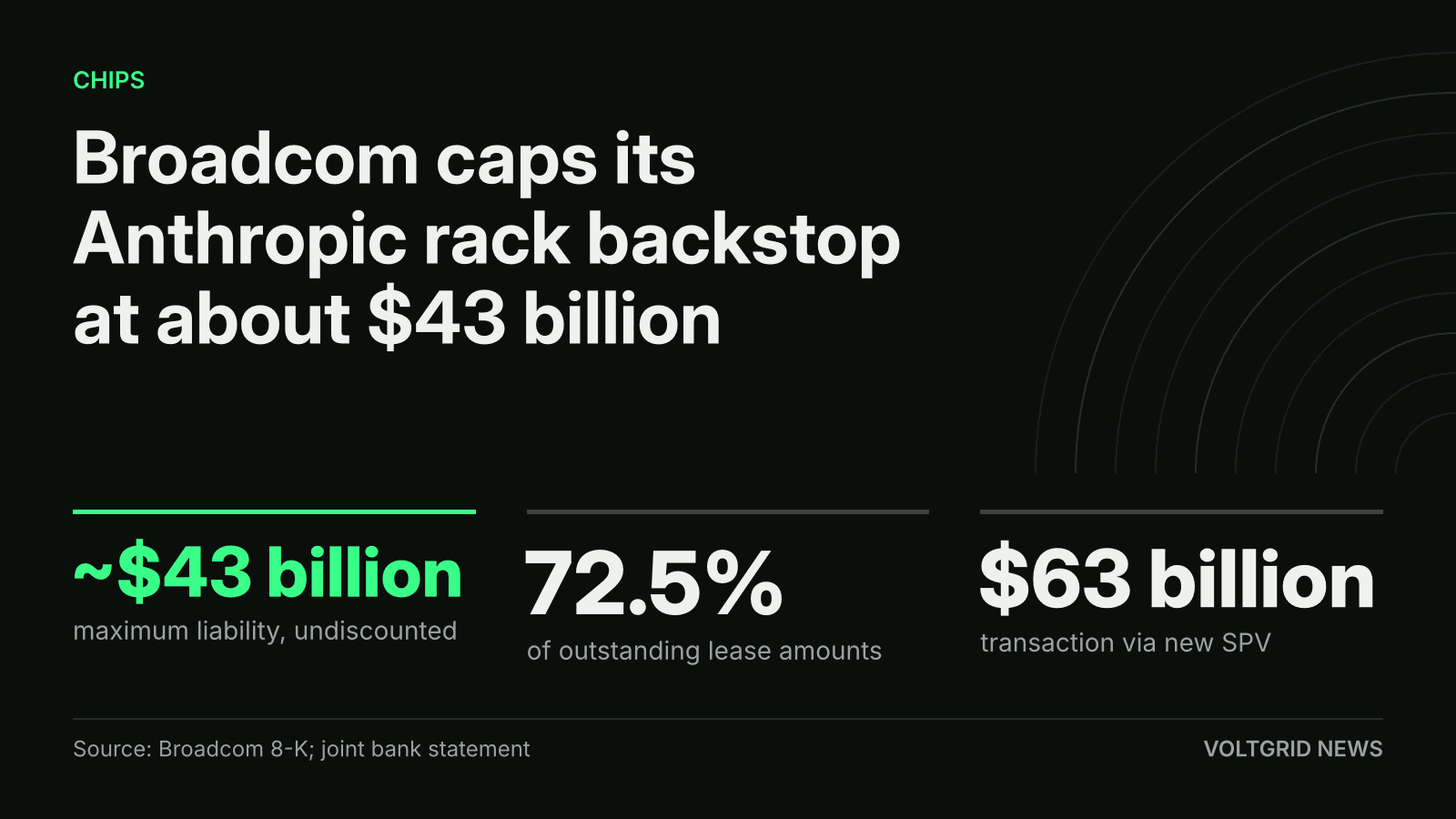
Key facts from Broadcom's Oct 27, 2026 8-K: maximum liability is about $43 billion, undiscounted, upon deployment of the racks.
Illustration (AI-generated)
Broadcom said in an Oct. 27 filing that its backstop on the custom AI racks leased to Anthropic could leave it owing up to about $43 billion, a payment it calls low-probability. The 8-K points to a shift in how Broadcom grows: part of its custom-chip business now runs through its own balance sheet.
What Broadcom's 8-K Says About the $43B Backstop
In an 8-K dated Oct. 27, covering an event on Oct. 26, Broadcom said it had arranged for financial partners to take over part of its agreements to buy AI racks built on its custom accelerators, along with the matching leases to its customer. Broadcom gives the new special purpose vehicle what it calls residual value support. The filing puts its maximum potential liability, once the racks are deployed, at approximately $43 billion on an undiscounted basis.
The filing also sets out the formula. If the customer defaults, Broadcom owes the gap between 72.5% of the lease balance still owed and what the racks fetch when they are sold. The exposure grows as racks are delivered and shrinks as lease payments come in. Broadcom's remedies on a default are to take over the lease, sell the racks back to the seller at a fixed price under certain conditions, or arrange a sale.
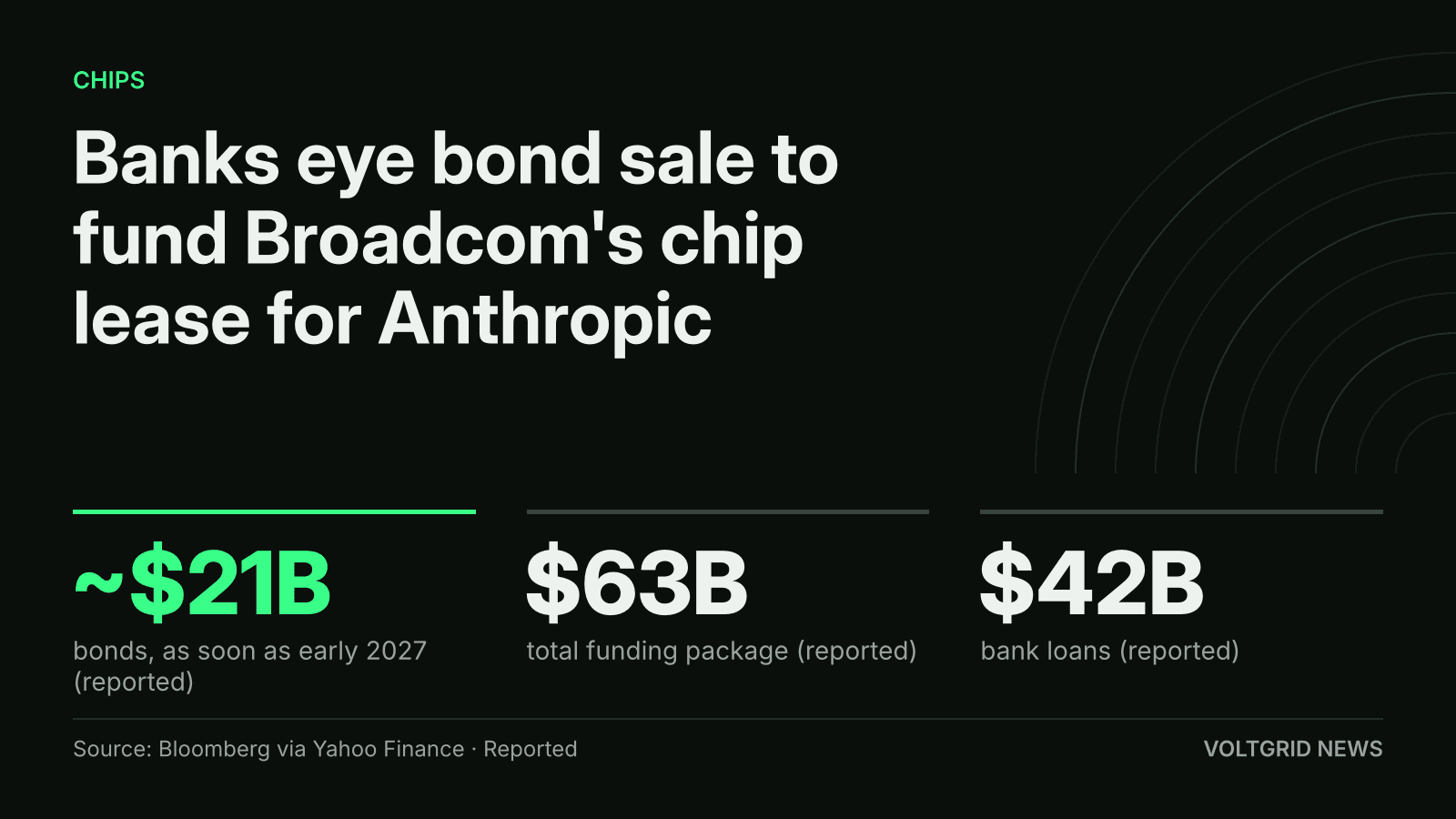
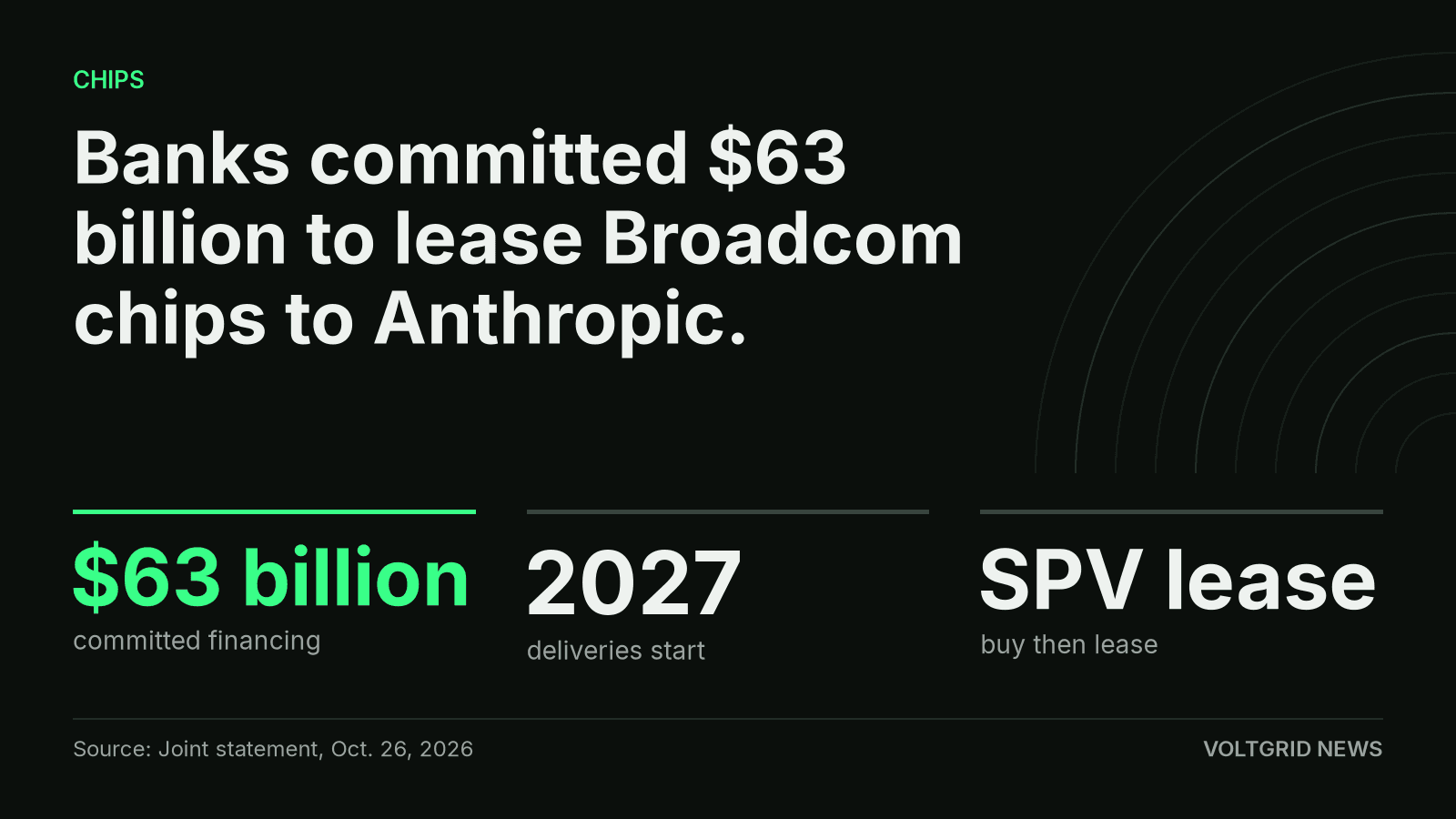
The 8-K names neither Anthropic nor the $63 billion vehicle; the link rests on the joint statement, which describes the same residual value support. That statement, from Bank of America, Blackstone, Citi and Morgan Stanley on Oct. 26 does: a $63 billion vehicle that buys Broadcom XPU accelerators and networking gear and leases them to Anthropic, with Broadcom's support equal to the first-lien portion of the financing. As Voltgrid reported on the $63 billion lease, that statement gave no size for the first lien. Reuters, citing two people familiar with the deal, reported the senior debt at about $43.5 billion. Bloomberg put the bank loan at about $42 billion, and reported that banks plan up to about $21 billion of bonds to refinance part of it. Those tranche sizes are reported, not filed; the 8-K gives only the cap.
Why the Backstop Is a Balance-Sheet Risk
In a straight chip sale, the seller is paid on delivery and carries no later claim on the hardware's value. Here Broadcom's exposure runs for the life of the lease.
This is not a one-off. Broadcom's 10-Q for the quarter ended Aug. 2 describes an "AI XPV platform" set up with financial partners that it says is meant to scale to more than 20 gigawatts of compute on its XPUs for frontier AI labs through 2028. It launched in June 2026 with a $35 billion first tranche for more than 1 gigawatt for one customer, carrying a backstop with a maximum of approximately $29 billion over 5-year lease terms. That earlier backstop is measured against 85% of the lease balance, not 72.5%. The 10-Q does not name the customer; The Edge Malaysia lists the deal, which it calls Big Sky, as a US$29 billion Broadcom backstop for Anthropic, in a report whose dateline omits the year.
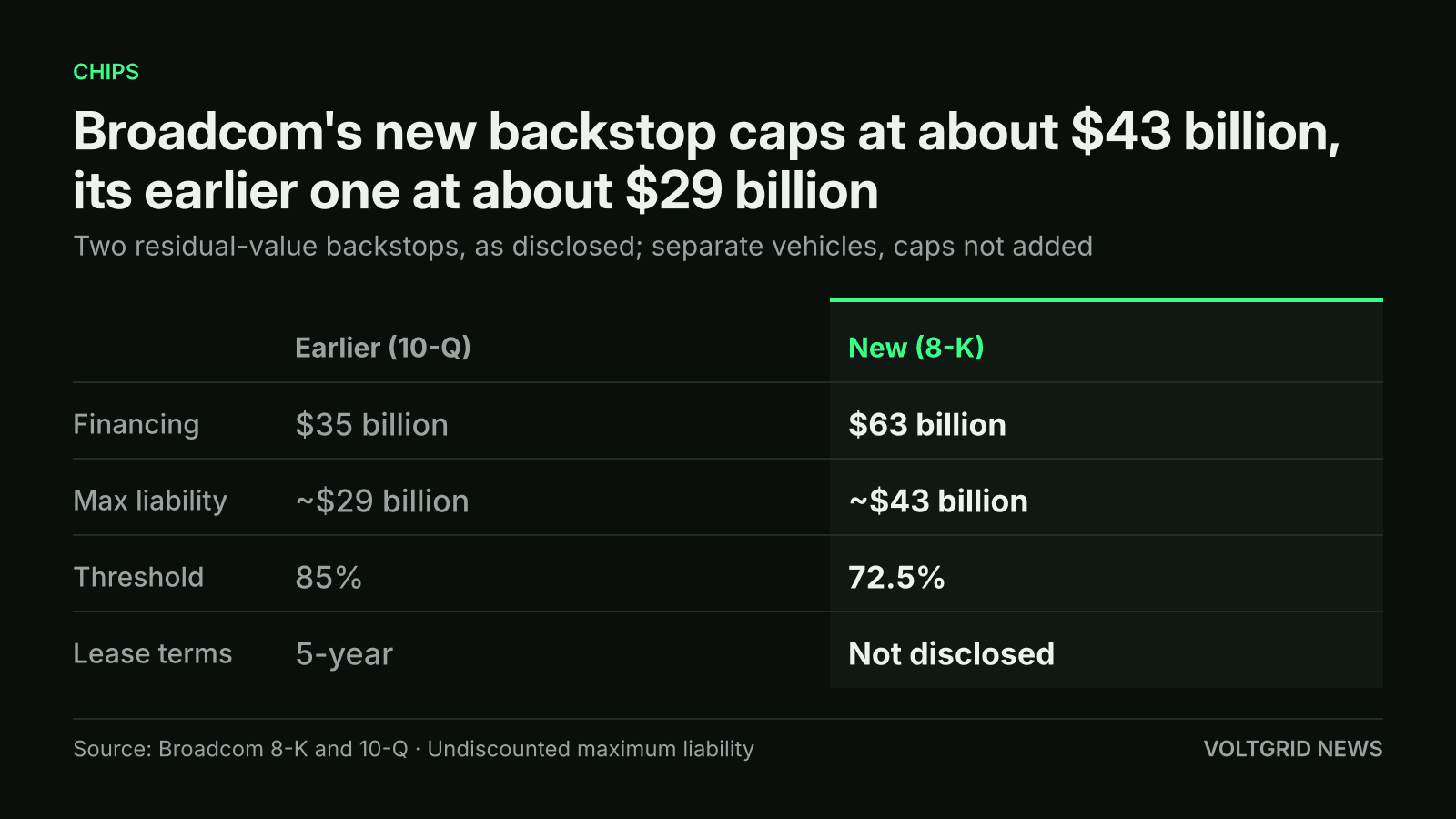
The two caps cover different vehicles, are undiscounted maximums and are not added together.
Illustration (AI-generated)
The same 10-Q also lists a separate facility under which the customer may issue Broadcom convertible notes of up to $42 billion, to be used only for its lease obligations. None had been issued by Aug. 2. In its risk factors, Broadcom says that lease and deferred-payment models could add counterparty credit risk, lower gross margin and cash flow, and mean it may not earn the revenue or free cash flow investors expect.
Put together, the filings suggest that Broadcom's AI growth now depends partly on Broadcom standing behind its customer's credit. In fiscal Q3, its AI semiconductor revenue was $16.7 billion, up 221% from a year earlier, and it guided to $21.7 billion for fiscal Q4. If a growing share of that demand arrives through leased racks, then the AI business carries asset-value and customer risk that a straight chip sale does not.
How a Residual Value Backstop Works
A residual value backstop is a promise about what hardware will be worth later. In this structure a special purpose vehicle buys the racks and leases them to the customer, and the lease payments repay the lenders. If the customer defaults and the racks sell for too little, Broadcom pays the gap between 72.5% of the lease amounts still owed and the sale price, its 8-K says.
The exposure moves with the build-out. It rises as racks are delivered and deployed and falls as the customer pays, and the 8-K puts the maximum at approximately $43 billion on an undiscounted basis. For a chip vendor, that makes the resale value of used accelerators a balance-sheet question: a fall in rack prices below the threshold lands on Broadcom, up to the cap.
Why the Backstop May Be a Small Risk
The strongest counter-argument is in the same filings. The backstop is contingent: nothing is owed unless Anthropic defaults and the resale price falls short. It is capped. It shrinks with every lease payment. Broadcom says it believes the chance of payment is low, citing the customer's expected profitability and the lasting value of the racks. Under the 10-Q, the earlier backstop's fair value was not material and nothing had been paid.
Broadcom can also carry it. In fiscal Q3 it generated $13.7 billion of free cash flow, 46% of revenue, and ended the quarter with $24.0 billion of cash against about $59.4 billion of debt. On that reading, Broadcom is lending its balance sheet so lenders accept the customer's lease, and the risk is small.
The two caps are not additive. They cover different vehicles with different thresholds, and no filing says whether the rack fleets overlap or how the exposures interact. Adding $29 billion to $43 billion gives a figure no filing supports.
What the Backstop Means for Lenders and Chip Rivals
For lenders, the backstop is what makes the structure work: the first lien leans on Broadcom's credit, not only Anthropic's. For other chip vendors, it is one of two ways to finance demand. In the same week, NVIDIA said it will put $3 billion into Meta's equity offering and AMD said it will invest $1 billion. Those are equity stakes with a known price. Broadcom instead guarantees the value of its own hardware, an exposure that moves with the lease balance and the resale market.
The scale is what makes the thesis hard to dismiss. The new cap alone is more than three times Broadcom's fiscal Q3 free cash flow and about 1.8 times its quarter-end cash. That suggests Broadcom's custom-chip margin story will increasingly be read alongside its contingent liabilities, not apart from them.
What to Watch After Broadcom's Fiscal Q4
Broadcom's fiscal Q4 ends Nov. 1, and the date of its results and 10-K has not been announced. They should show how the backstops are accounted for and how much exposure has built up as racks ship. Deliveries under the $63 billion vehicle start in calendar 2027, the joint statement said, so the new cap only begins to fill then. The planned bond sale, reported for as early as the first quarter of 2027, will show what price investors put on Broadcom's support.
Sources
- 01Broadcom Inc. Announces Third Quarter Fiscal Year 2026 Financial ResultsBroadcom (SEC filing) · sec.gov
- 02Broadcom Inc. Form 8-K, Item 2.03: Creation of a Direct Financial Obligation or an Obligation under an Off-Balance Sheet ArrangementBroadcom (SEC filing) · sec.gov
- 03Bank of America, Blackstone, Citi and Morgan Stanley Announce Landmark $63 Billion Financing Structure to Enable AI Compute Capacity in Partnership with BroadcomBank of America · newsroom.bankofamerica.com