NVIDIA RTX 5080 Price Hits $1,999 as Memory Makers Favor AI
Tom's Hardware found the cheapest in-stock RTX 5080 for delivery from a reputable seller at $1,999 on Oct. 29, against a $999 launch price. Our reading: memory makers' AI focus, more than NVIDIA, appears to set GeForce prices.
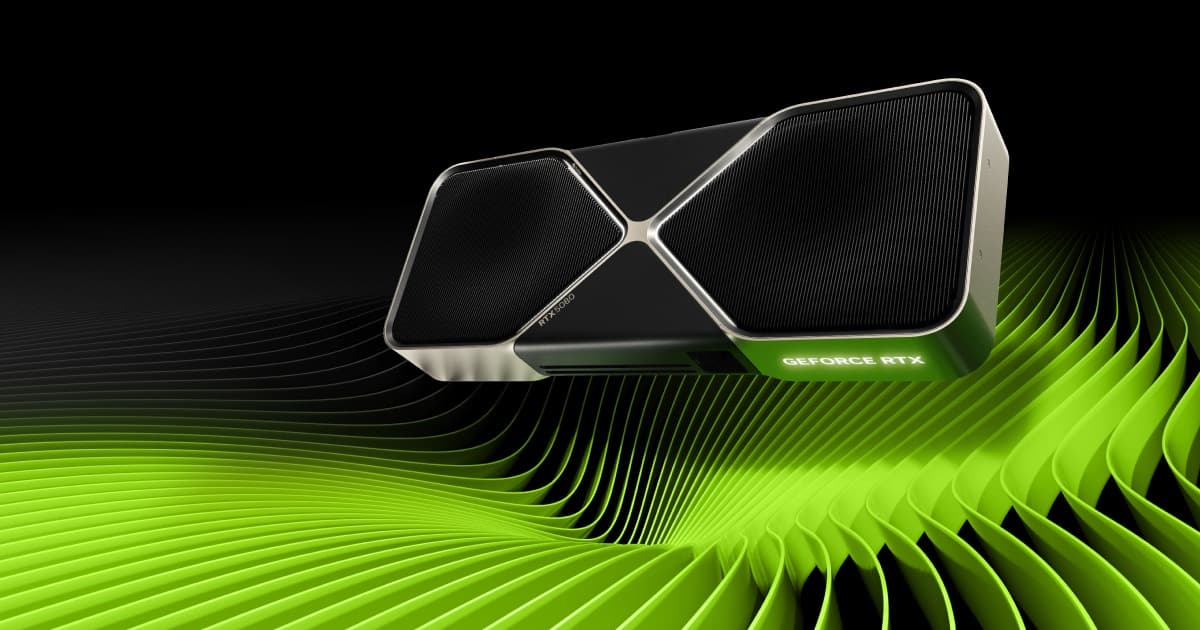
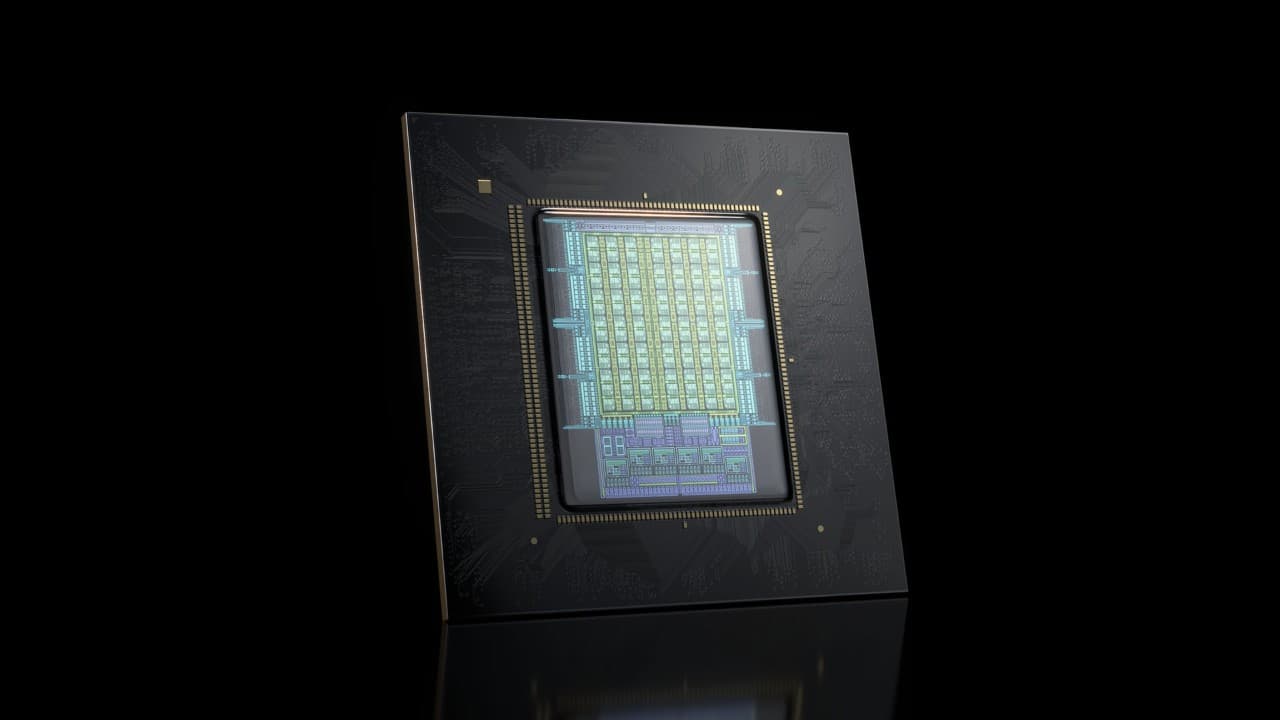
NVIDIA's GeForce RTX 5080, launched at a $999 list price; product image from NVIDIA's RTX 5080 page.
Image: NVIDIA
Source · Press image from the NVIDIA website, used for news reporting.
The cheapest in-stock NVIDIA RTX 5080 available for delivery from a reputable US seller cost $1,999 on Oct. 29, Tom's Hardware found, about double NVIDIA's $999 launch price. That matches the RTX 5090's list price. Our reading: NVIDIA does not appear to set what a high-end GeForce card costs. The memory market seems to, and it is pricing gamers against AI data centers.
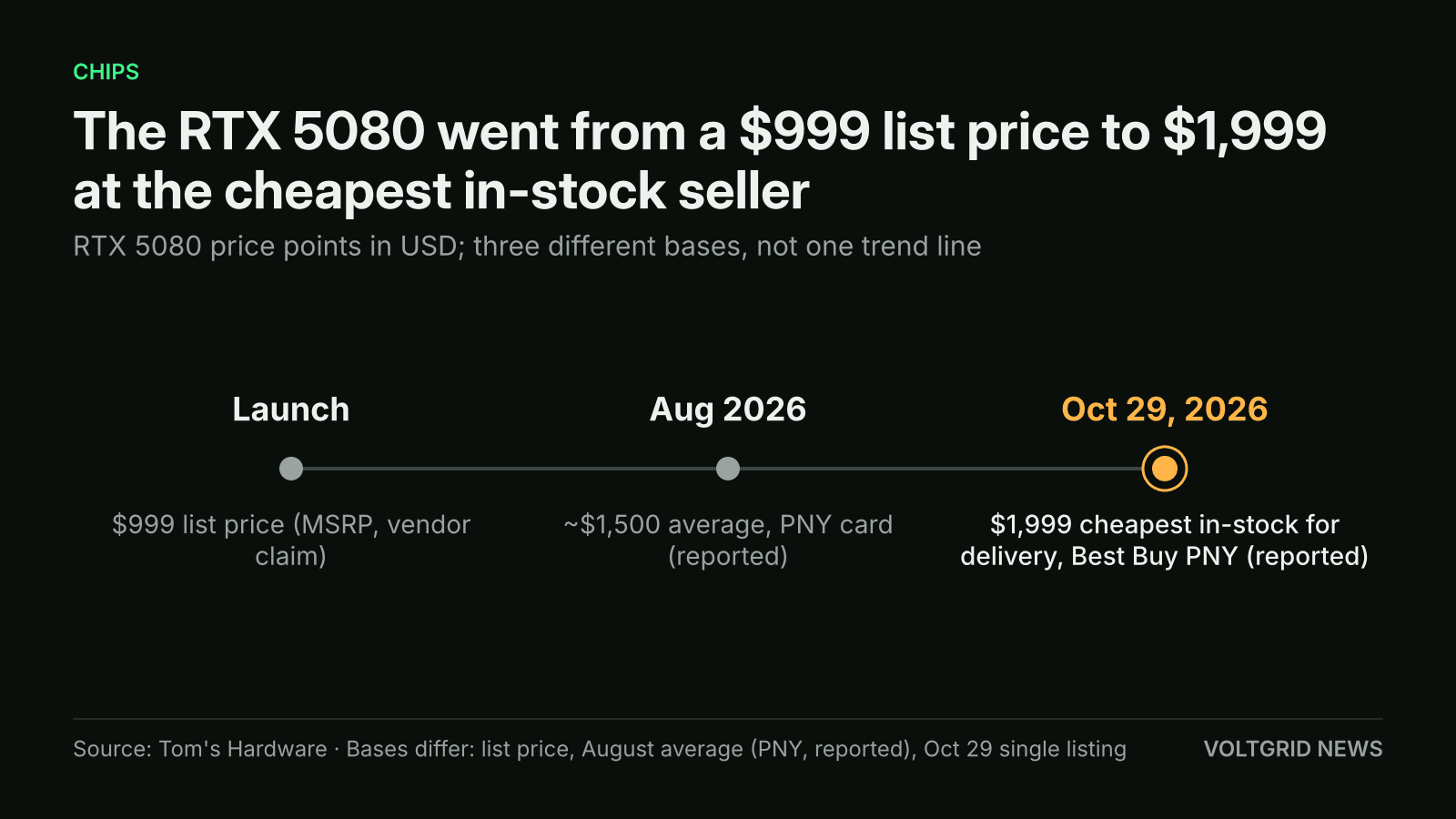
Three different bases, per Tom's Hardware: the cheapest reputable in-stock RTX 5080 for delivery reached $1,999 on Oct 29, against a $999 list price.
Illustration (AI-generated)
RTX 5080 Prices at US Retailers
Tom's Hardware found a PNY RTX 5080 at $1,999 at Best Buy, with an Asus ROG Astral model at $2,299.99 on Newegg and a Gigabyte card listed at $2,983.23 by MemoryC. Micro Center listed a Gigabyte card in store for $1,979.99, which depends on location. Tom's says the same PNY card sold for around $1,500 on average in August. RTX 5090 listings, against a $1,999 list price, now run as high as $12,000, up from a $9,500 peak a month earlier.
The RTX 5080 pairs NVIDIA's GB203 GPU and its 10,752 CUDA cores with 16 GB of GDDR7, the graphics memory soldered around the chip on the board. Tom's Hardware blames two shifts: NVIDIA's own focus on enterprise products, and memory makers moving DRAM allocation and production lines toward high-bandwidth memory (HBM) for AI accelerators.
Supply rumors have run ahead of the facts. On Oct. 28 Palit denied a Spanish report that it had closed its Galax factory for lack of NVIDIA chips; it said no plant had shut and Galax cards remain on sale at home and abroad. On the RTX 5090, NVIDIA senior vice president Jeff Fisher reportedly told Taiwanese outlets 4Gamers and SJTV that production has not been discontinued and shipments will continue, while conceding supply is somewhat constrained, according to Tom's Hardware. NVIDIA itself has issued no statement on street prices or kit allocation.
Why it matters: the memory makers have chosen
The memory makers have said, in their own words, where their output goes. Samsung's third-quarter release on Oct. 29 says its memory business managed its product mix around AI products under capacity constraints and that HBM4 sales scaled up significantly, as Voltgrid reported from its results.
Micron's chief executive, Sanjay Mehrotra, said on its fiscal fourth-quarter call that demand will exceed supply in both 2027 and 2028, more tightly than in 2026, and that Micron cannot see when balance returns. Tom's Hardware reports that Micron expects NAND and DRAM shipments to grow in the low-to-mid 20s percent for the next two years, with HBM growing faster than conventional DRAM, and it guided fiscal first-quarter revenue to a record $61.5 billion of revenue at an 86.25% gross margin.
The step from there to the RTX 5080 is an inference, not a reported fact. HBM and GDDR7 are different products: HBM is DRAM stacked in towers beside an accelerator in one package, while GDDR7 is single chips on a graphics board. One does not replace the other. The link is upstream. Both come from the same suppliers' DRAM wafer starts, and every wafer allocated to HBM or server DRAM at today's margins is a wafer not offered for graphics memory. If that allocation holds, a GPU board's memory cost follows AI pricing whatever NVIDIA charges for the GPU die.
The closest public price data is for older GDDR6, not the GDDR7 on the RTX 5080, so it is context rather than proof. TrendForce, citing China's MyDrivers, reported on July 3 that consumer GDDR6 spot prices had tripled from about $2.5 to about $7.5 per GB as wafer capacity moved to HBM and server DRAM. The same report said AMD reportedly planned to raise its GPU-plus-memory kit prices to board partners by about 10% from July, its second memory-driven rise in six months, and that NVIDIA had reportedly raised kit prices for the RTX 5090 and RTX 5090D V2. Neither company confirmed those figures.
The case against
Retail prices are a weak gauge of cost. A single in-stock listing can reflect a thin channel, scalpers and third-party sellers more than any bill of materials, and Tom's Hardware notes that much remaining stock sits with third-party sellers. TrendForce, citing TechPowerUp, adds that the kit is only part of a board partner's cost and does not necessarily make up the majority, so kit increases need not pass through one for one. Demand matters too: AI buyers who use gaming cards as cheap inference hardware compete for the same boards.
Nor is supply simply being cut. Palit says its factories run normally, and NVIDIA's reported position is that the RTX 5090 continues. No official GDDR7 contract price is public, so the direct cost of the RTX 5080's 16 GB cannot be measured from sources.
What it means for NVIDIA, AMD and board partners
For NVIDIA, gaming boards now carry a memory cost it does not control, and retail prices far above list damage the brand without lifting its own revenue. AMD faces the same squeeze on Radeon kits, which suggests the cause is shared memory supply, not one vendor's pricing. Board partners such as Palit sit between rising kit costs and buyers who balk at $2,000 cards. Memory makers are the winners. Even inside Samsung the split shows: its DX division posted a KRW 0.8 trillion operating loss in the same quarter its memory business set records.
What to watch
Three signals will test the thesis. NVIDIA's next quarterly report will show whether gaming revenue and commentary point to memory-limited supply. Any official GDDR7 contract price or a statement from NVIDIA on kit allocation would replace inference with numbers. And if Micron and Samsung add DRAM capacity faster than AI demand absorbs it, RTX 50 street prices should ease first at the RTX 5080 tier; if they keep climbing, the allocation argument holds.
Sources
- 01Micron projects tightening RAM shortages through 2028 as it generates record profitTom's Hardware · tomshardware.com
- 02Nvidia GeForce RTX 5080 prices hit $2,000, costing more than the RTX 5090 did at launch and with limited stock available — original $999 MSRP long forgotten, with prices now 2-3x higherTom's Hardware · tomshardware.com
- 03Nvidia RTX GPU vendor Palit denies its Galax factory has closed due to a shortage of chipsTom's Hardware · tomshardware.com
- 04AMD Reportedly Raises GPU-GDDR Kit Prices by 10% for AIB Partners, Effective Jul 2026TrendForce · trendforce.com