NVIDIA Vera CPU Specs: 88 Olympus Cores, 430-440 W Each in Tests
Vera CPUs went live on Oracle Cloud on Oct. 27. New tests by Tom's Hardware and Phoronix show a memory-bandwidth lead over x86 and clean two-socket scaling, at about 430-440 W per CPU.
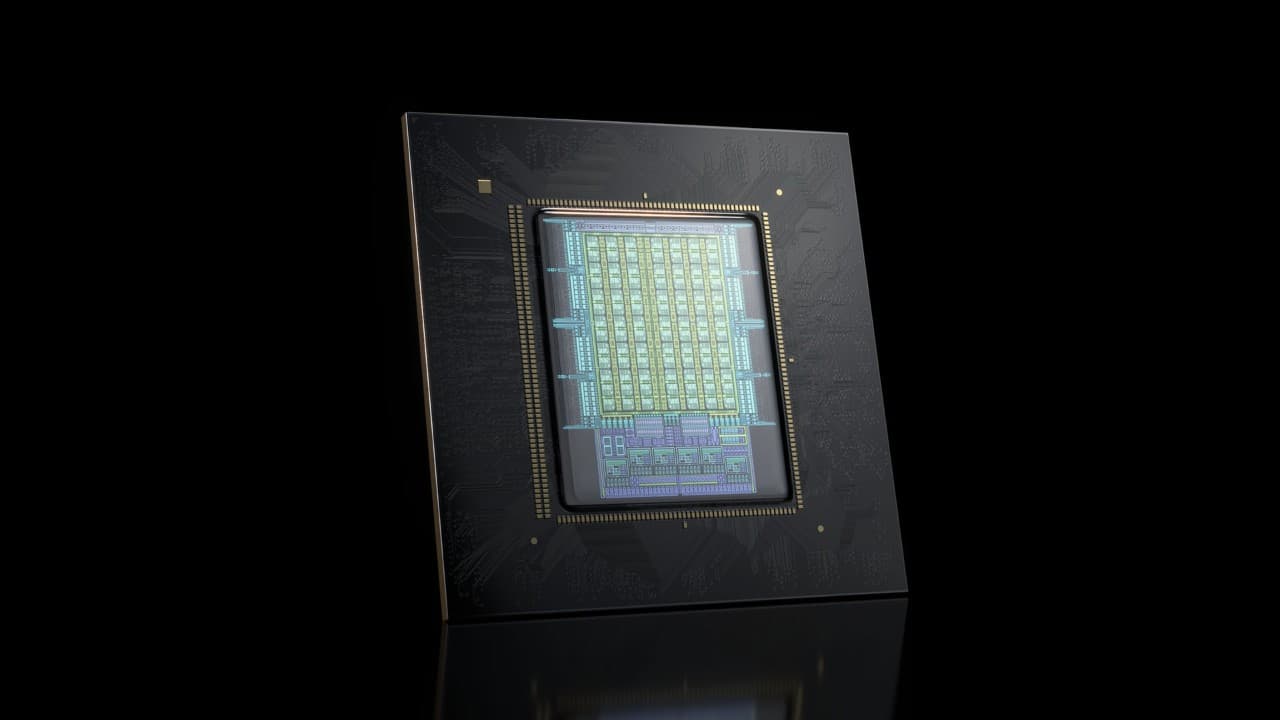
NVIDIA's official image of the Vera CPU, a render from the company's product page; it is not a photo of a shipping part.
Image: NVIDIA
Source · Press image from the NVIDIA website, used for news reporting.
Independent tests of NVIDIA's 88-core Vera CPU back its memory story. In a Stream triad test on a local Vera server (not OCI), Tom's Hardware measured more than double the bandwidth of a dual Xeon 6980P with 8,800 MT/s MRDIMMs, and Phoronix logged about 430-440 W per CPU under load.
Both sets of results were published within 48 hours of Oracle Cloud Infrastructure (OCI) making standalone Vera CPUs generally available on Oct. 27: Tom's Hardware ran its test on Oct. 28 on a local server, and Phoronix published on Oct. 29 using data it collected earlier. Voltgrid's Oct. 28 report on the Oracle deal covered the multi-gigawatt Vera Rubin build-out. This file covers the chip itself: what is inside, what outside labs measured, and what is still unproven.
Vera is NVIDIA's own data-center CPU. It is the host processor in Vera Rubin racks, but NVIDIA also sells it on its own for the CPU side of AI work: running agent tool calls, compiling generated code, sandboxing and reinforcement-learning loops. Tom's Hardware called the OCI launch NVIDIA's first standalone CPU push into the hyperscale data center. On OCI Superclusters the only other Arm option is Ampere Altra, Tom's Hardware said. Neoclouds Nscale, CoreWeave and Nebius already offer Vera.
Vera CPU Specs: Inside the 88-Core Design
NVIDIA specifies 88 custom Olympus cores, and its Spatial Multithreading splits them into 176 threads. Memory is LPDDR5X on field-replaceable SOCAMM2 modules, which NVIDIA says uses significantly less power than traditional server memory. NVIDIA rates it at up to 1.2 TB/s of bandwidth and up to 1.5 TB of capacity per CPU.
The one design choice that matters is the single compute die. Vera puts all 88 cores, a 164 MB unified L3 cache, the memory controllers and the I/O on one die, joined by a mesh NVIDIA calls the Scalable Coherency Fabric, rated at 3.4 TB/s of bisection bandwidth. NVIDIA argues that avoiding cross-chiplet traffic keeps latency predictable when every core is busy. Tom's Hardware drew the contrast: AMD and Intel keep memory control and system-level cache centralized, while Vera spreads them across the die. NVIDIA says the design keeps thousands of parallel software environments responsive; that is NVIDIA's pitch, not a measured result.
NVLink-C2C, NVIDIA's chip-to-chip link, carries up to 1.8 TB/s of bidirectional coherent bandwidth to Rubin GPUs, NVIDIA says, and also joins the two sockets in dual-Vera servers. NVIDIA offers Vera in single- and dual-socket servers and in a dense liquid-cooled rack of 256 CPUs, a format Dell has already packed into one 48U rack due in Q1 2027.
What the Stream Benchmark Measures
Stream measures how fast a CPU can read and write large arrays in main memory, with little arithmetic in between, so the result reflects memory bandwidth rather than core speed. Tom's Hardware ran the triad test, which it calls the most demanding of Stream's four operations, and found Vera delivered more than double the bandwidth of a dual Xeon 6980P system with 8,800 MT/s MRDIMMs. It credits Vera's LPDDR5X-9600 memory and its distributed cache mesh.
NVIDIA rates Vera at up to 1.2 TB/s per CPU and says that bandwidth keeps thousands of parallel software environments responsive. Tom's ran one local server, not OCI, and has not published its setup, so the size of the lead in real agent workloads is unproven.
What reviewers measured so far
Tom's Hardware ran Vera on a local server, not on OCI, ahead of a full review. In the Stream triad memory test, Vera delivered more than double the bandwidth of a dual Intel Xeon 6980P system fitted with 8,800 MT/s MRDIMMs, with similar leads in Stream's add, copy and scale. The outlet tied the result to Vera's LPDDR5X-9600 memory and its distributed cache mesh. It said the OpenMP spread policy, which binds processes as far apart as possible, gives Vera a massive boost in bandwidth. It also found Vera strong in Python tests against chips it called much more powerful on paper, and said the SQLite queries are bound by data movement. Exact figures appear only in its charts, and the test setup is still to be published.
Phoronix, on Oct. 29, published single-socket against dual-socket results gathered during its earlier Vera testing, on Ubuntu 24.04 LTS with the Linux 6.17 64K-page kernel. Across a geometric mean of dozens of multithreaded, NUMA-friendly benchmarks, the second socket scaled in line with expectations, with no scaling problems on the dual 176-core, 352-thread system. Phoronix's first page says 172 cores; its seventh page and NVIDIA's 88-core specification give 176.
Phoronix also logged power and clocks. Each Vera averaged about 430-440 W, with a 535 W peak, across the benchmark mix, and held a 3.2 GHz average and 3.3 GHz peak clock in both configurations. These are CPU power-monitoring readings, not wall power, but they are an independent per-socket figure a planner can use. Phoronix measured about 430-440 W per CPU on average; the page does not say whether that includes the LPDDR5X modules, and system power was not measured.
Vera CPU vs AMD EPYC Venice and Other x86
Tom's Hardware is clear about Vera's limit: AMD and Intel lead on cores per socket, and AMD's 6th Gen EPYC (Venice), launched in July, reaches 512 threads in one socket. The early results suggest Vera's case rests on memory bandwidth and consistent latency, not on raw thread count.
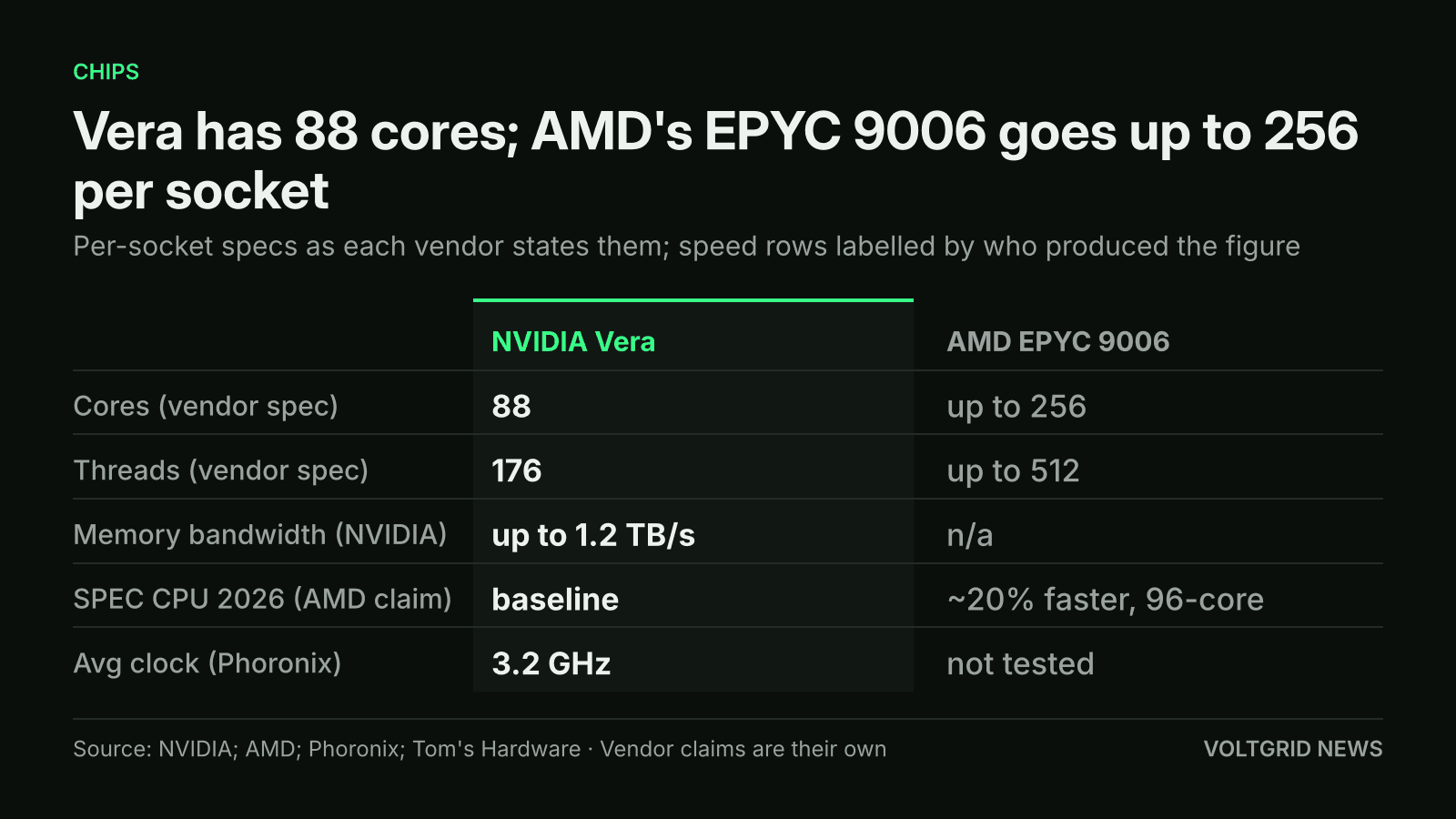
Vera has 88 cores against up to 256 for AMD's EPYC 9006; the SPEC CPU 2026 gap is AMD's own claim, the 3.2 GHz clock was measured by Phoronix.
Illustration (AI-generated)
AMD's rival case is its own. In a September white paper, AMD claimed its 256-core EPYC 9996 Venice is 2.24 times faster than Vera in SPEC CPU 2026 integer rate, and that a 96-core high-frequency Venice is about 20% faster per core than Vera's 88 cores in SPEC CPU 2026 Integer Rate. Tom's Hardware flagged three caveats: AMD mixed data sources for Vera, set its GCC 16.1 results against NVIDIA's GCC 15.2 figures, and gave no power budget in the white paper, though AMD's earlier SPEC numbers gave the 96-core model the same 600 W as the 256-core while the 96-core high-frequency SKU tops out at 500 W. Until a lab tests shipping Venice and Vera under the same compiler and power limits, those ratios are vendor claims. NVIDIA's own numbers, up to 2 times faster on agentic workloads and up to 1.8 times on code compilation, Python tool chains and code analysis against leading x86 CPUs, are claims too. The closest agent-specific data so far is Modal's own test as a customer, which found up to 2x the throughput of an Intel server on one machine.
Price, availability and what to watch
Vera is generally available on OCI Superclusters from Oct. 27, alongside Vera Rubin NVL72. Oracle has not published per-hour pricing for Vera instances, and NVIDIA lists no chip price. Oracle will also offer HGX Rubin NVL8 servers with a dual 64-core Intel Xeon 6 host and 4 TB of DDR5; Tom's Hardware described Oracle as approaching the deployment cautiously.
Three things will settle Vera's position. Tom's Hardware has promised its full review with the test setup shortly. Wall-power measurements under sustained load are still missing. And no independent lab has yet put Vera against shipping EPYC Venice parts. Beyond Vera, NVIDIA's CPU roadmap names the Rosa CPU and its Rigel core, with no date given.
Sources
- 01Nvidia and Oracle bring Vera CPU instances online in multi-gigawatt deploymentTom's Hardware · tomshardware.com
- 02NVIDIA Vera CPUNVIDIA · nvidia.com
- 03NVIDIA Vera Single vs. Dual Socket CPU PerformancePhoronix · phoronix.com
- 04AMD targets Nvidia with first official benchmarks for EPYC 'Venice' CPUsTom's Hardware · tomshardware.com