Snapdragon X2 Plus Surface Laptop 13 Runs 18.8 Hours in Lab Test
Notebookcheck measured 18 h 50 min of Wi-Fi use and a 22 W sustained limit on the Snapdragon X2 Plus X2P-42-100, but a lower Cinebench 2024 multi-core score than last year's chip; Geekbench multi-core rose. NPU throughput is still unmeasured.
Chips & Power DeskEdited by Ege Erten
3 min readAI-assisted
Follows our story: Snapdragon X2 Elite 'Performance' Cores Look Like Efficiency Cores, Lab Says
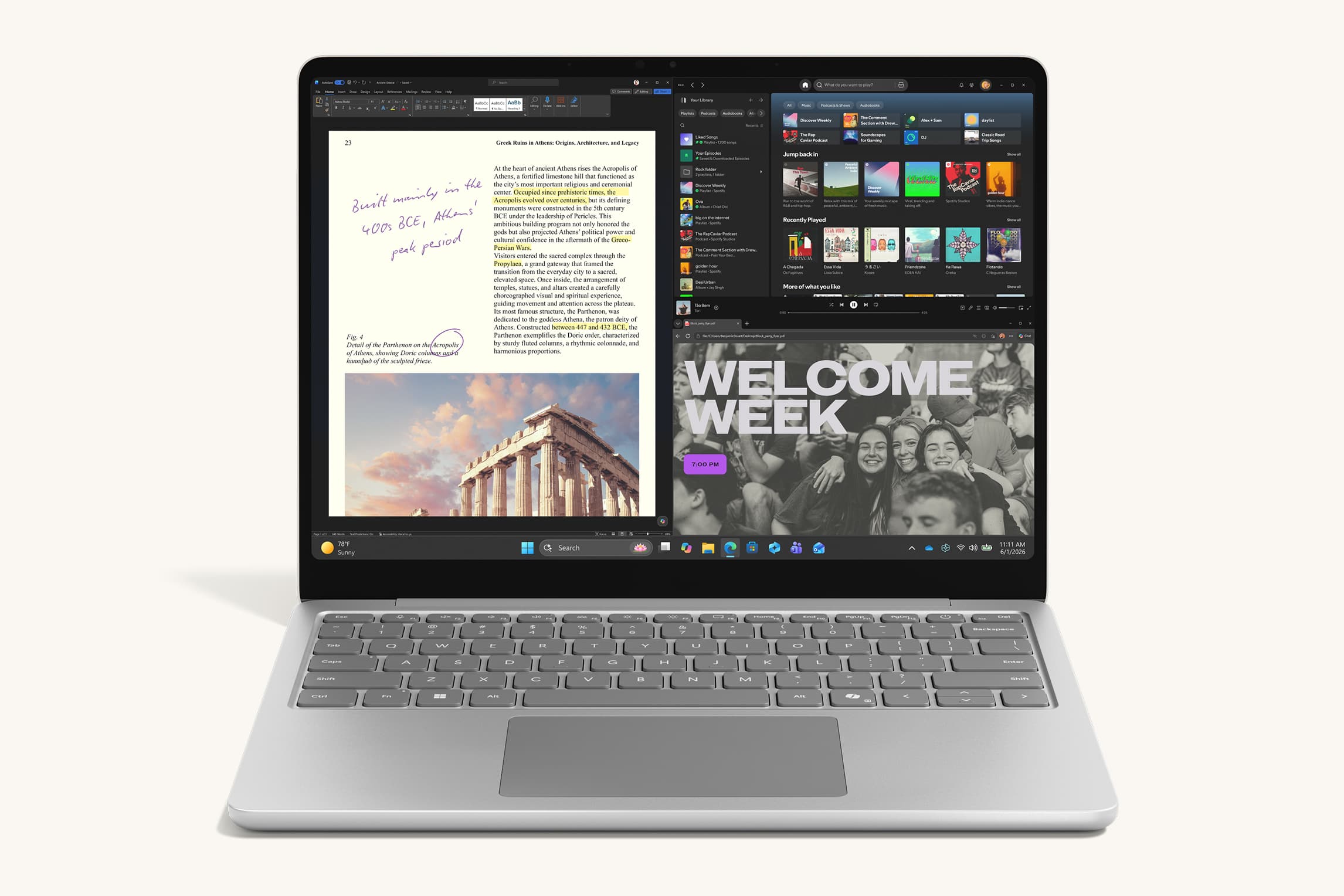
The Surface Laptop 13 as pictured on Microsoft's Surface Laptop page; the image is a product photo, not Notebookcheck's review unit.
Image: Microsoft
Source · Press image from the Microsoft Surface product page, used for news reporting.
Microsoft's 2026 Surface Laptop 13 with Qualcomm's six-core Snapdragon X2 Plus X2P-42-100 ran for 18 hours 50 minutes on Notebookcheck's Wi-Fi browsing test at 150 nits, the lab reported on Oct 28.
The review, published Oct 28, puts numbers on the six-core X2 Plus part. Voltgrid reported on Oct 25 that the six "Performance" cores in the Snapdragon X2 Elite Extreme look like efficiency cores, and that no lab had yet put that cluster on a power meter. This review does not close that gap. Notebookcheck lists all six X2P-42-100 cores as Oryon Gen 3 Prime cores at up to 4.0 GHz, so by its listing this part has no such cluster to measure.
Power Limits and Fan Noise
What it does show is a chip held to a tight power budget. Notebookcheck lists a 28 W short-burst limit and a 22 W sustained limit, and measured the chip levelling off at about 22 W under sustained CPU load. In its combined CPU and graphics stress test, the chip started at 32 W, fell to 21 W and settled at 17 W. The whole laptop drew 14.7 W to 54.8 W at the wall under load, and the lab recommends a 65 W charger. The fan peaked at 29 dB(A) in the stress test, and Notebookcheck says it never heard it during everyday work.
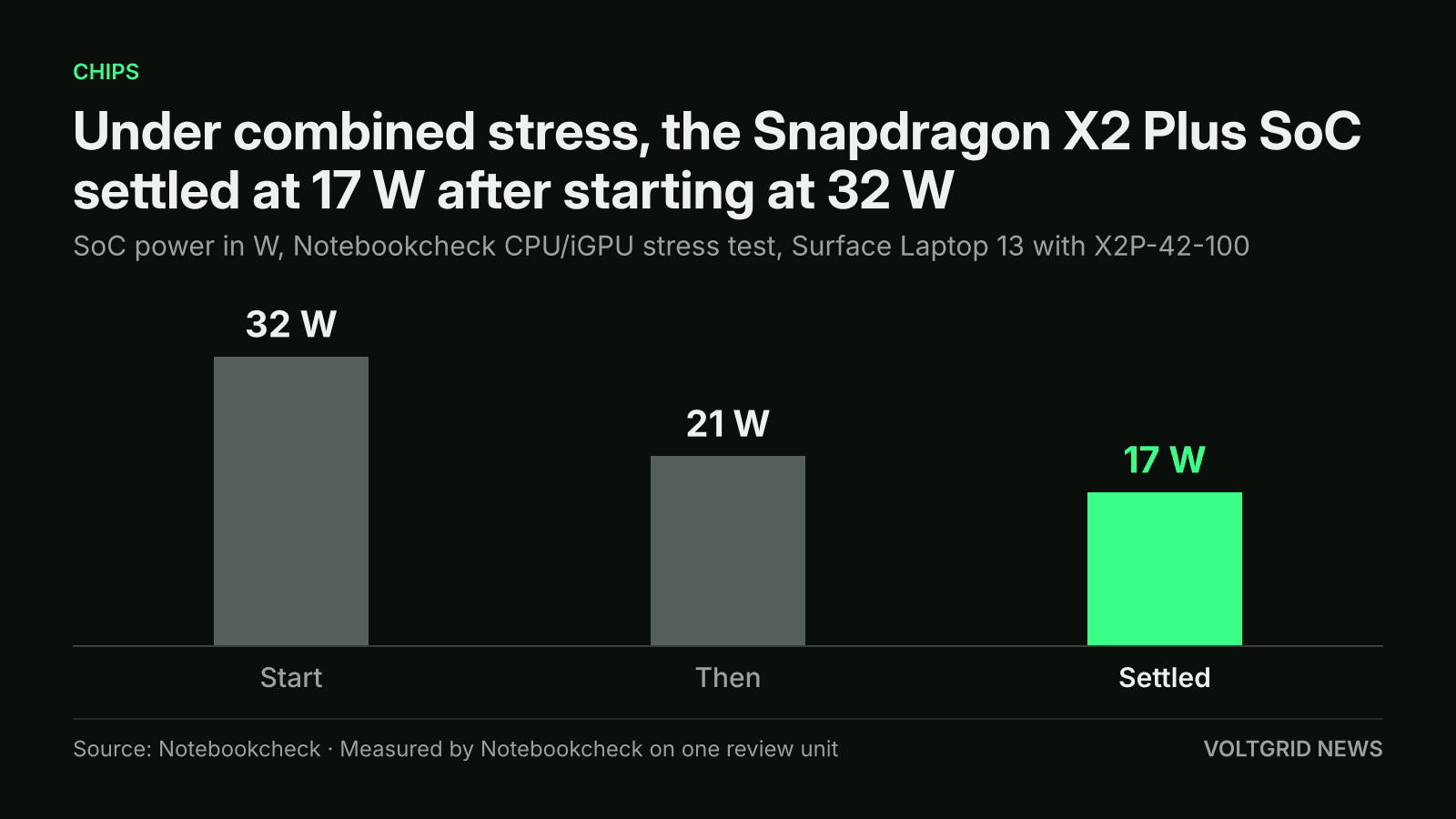
In Notebookcheck's combined CPU and graphics stress test, the Snapdragon X2 Plus X2P-42-100 started at 32 W, fell to 21 W and settled at 17 W.
Illustration (AI-generated)
Snapdragon X2 Plus Benchmarks and Battery Life
Single-core speed is where the new chip gains most. Notebookcheck measured 3,269 points in Geekbench 6.7 single-core, against 2,287 for last year's Surface Laptop 13 with the Snapdragon X Plus X1P-42-100. Apple's MacBook Air 13 with the M5 scored 4,185 in the same test.
Multi-core is a different picture. In Cinebench 2024 multi-core, the X2P-42-100 scored 669 points, below the 723 the lab recorded for last year's X1P-42-100. The 10-core X2P-64-100 in the larger Surface Laptop 13.8 scored 854 and the M5 scored 957. In Geekbench 6.7 multi-core the new chip led its predecessor, 12,070 to 11,125. Across its native CPU tests, Notebookcheck rates the X2P-42-100 11% behind the X2P-64-100.
Battery life is the clearest gain. Both Surface Laptop 13 generations carry a 50 Wh battery, and last year's model ran 16.7 hours in Notebookcheck's same Wi-Fi test at 150 nits. The MacBook Air 13 M5, with a 53.8 Wh battery, ran 16.2 hours; these are Notebookcheck's own tests and are not comparable with other outlets' battery results. Cinebench multi-core fell against the predecessor while battery life rose, and Geekbench multi-core rose. The lab's numbers do not show whether one caused the other, and a second test could change the picture.
Why Sustained Power Limits Matter in Laptops
A laptop chip works within two power limits. The short-burst limit lets it draw extra watts for a few seconds, and the sustained limit is what the cooling can hold. Notebookcheck lists 28 W and 22 W for the X2P-42-100 and measured it levelling off at about 22 W under sustained CPU load.
In its combined CPU and graphics stress test the chip fell from 32 W to 17 W, so long loads run well below the burst figure. The whole laptop peaked at 54.8 W at the wall, which is why the lab recommends a 65 W adapter. For buyers and fleet planners, that sustained wattage, not the peak, is the number to compare.
What Is Not Measured Yet
Qualcomm's X2 Plus page lists an 80 TOPS Hexagon NPU, cache of up to 34 MB across the family, and 10-core or 6-core parts. The page does not state the precision behind the TOPS figure, and Notebookcheck did not measure NPU or local-AI throughput. Microsoft dropped last year's 8 GB model, so the Surface Laptop 13 now starts at $1,199 with 16 GB of memory and 256 GB of storage.
Voltgrid News also covered how Surface Laptop Ultra reviews judged the GPU and display. All the measurements here come from one lab and one unit, a 16 GB, 512 GB configuration running Windows 11 Home. A second lab's power and efficiency test would show whether the 22 W sustained figure and the battery result hold beyond this sample.