Surface Laptop Ultra Reviews Back RTX Spark's GPU, Fault Its Display
Surface Laptop Ultra reviews from Notebookcheck, Computerwoche and PCWorld find strong RTX Spark graphics and AI throughput, but a CPU behind Apple's M5 Pro and a Mini-LED panel with no local dimming.
5 min readAI-assisted
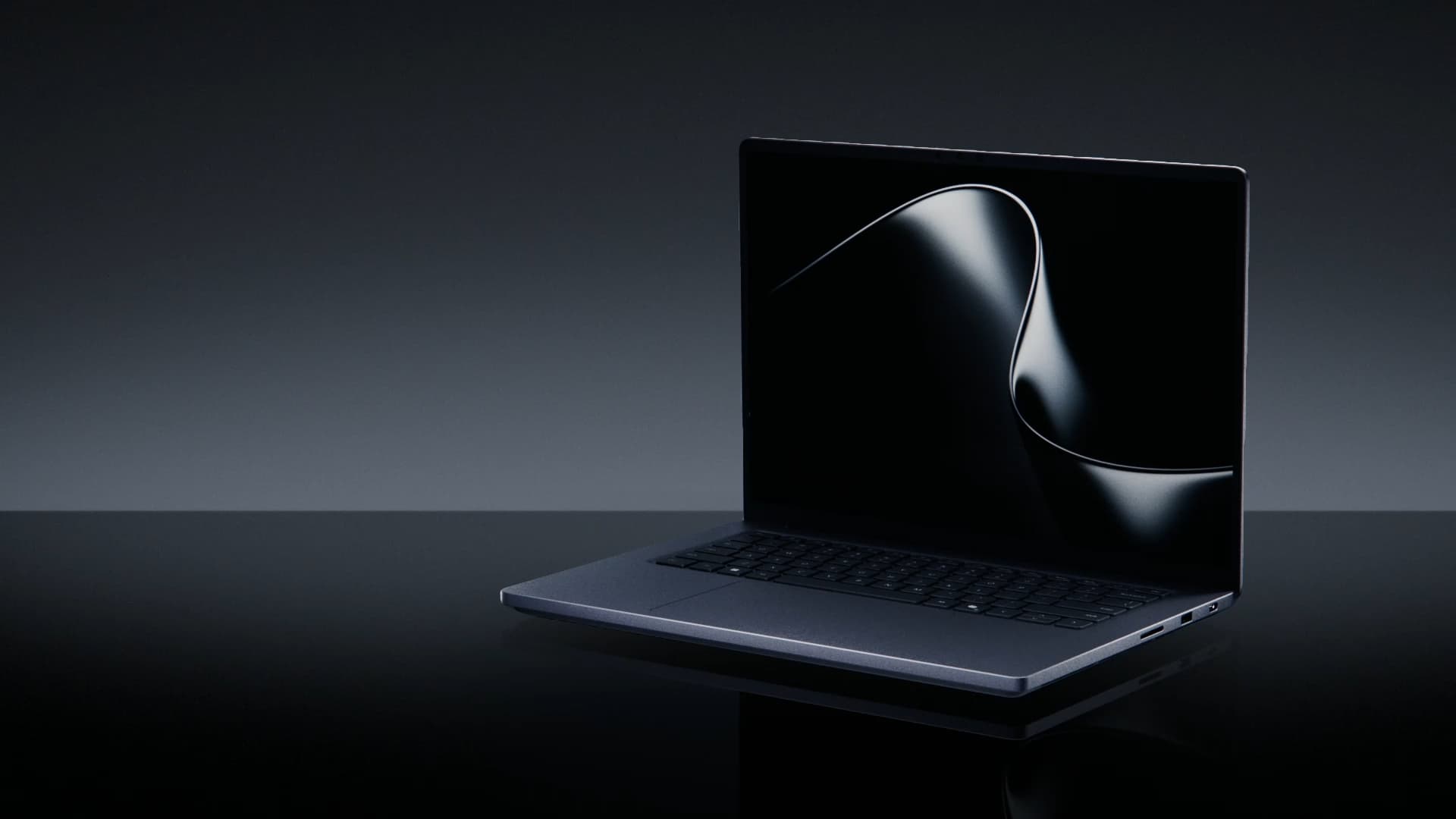
Microsoft's own product image of the Surface Laptop Ultra, the 15-inch Mini-LED laptop built on NVIDIA's RTX Spark N1X.
Image: Microsoft
Source · Press image from the Microsoft Surface product page, used for news reporting.
Three reviews of Microsoft's Surface Laptop Ultra find NVIDIA's RTX Spark N1X strong in graphics and local AI, with Notebookcheck measuring 54.6 fps in Cyberpunk 2077 at QHD Ultra, but fault its CPU and display.
Each outlet tested a different configuration, so the figures below stay with the machine that produced them. Notebookcheck used a 20-core, 64 GB unit priced at 4,959 euros. Computerwoche tested the top 128 GB model at 6,879 euros. PCWorld used a 32 GB unit at $3,699.99 and did not say which chip variant it had. Microsoft sells 18-core and 20-core versions, and Computerwoche's German price list shows 32 GB with both. Voltgrid did not test the laptop; every number belongs to the outlet named.
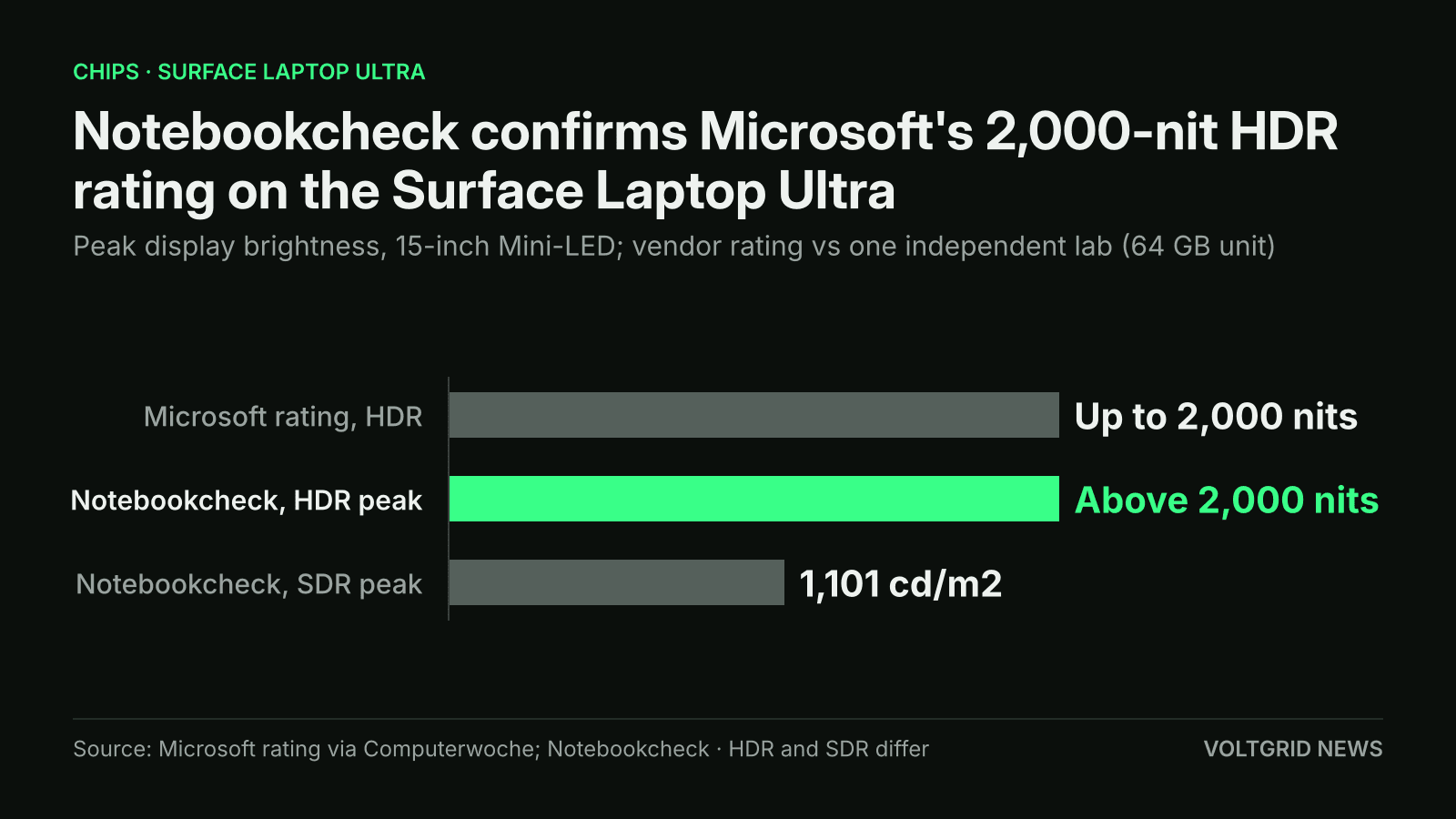
Notebookcheck's HDR peak matches Microsoft's rating; the Mini-LED panel's SDR peak was 1,101 cd/m2 (one lab, 64 GB unit).
Illustration (AI-generated)
Microsoft's headline claims are a 15-inch Mini-LED touchscreen rated at up to 2,000 nits of HDR brightness and 120 Hz. Computerwoche says the configurations support up to 128 GB of unified memory shared by CPU and GPU, while NVIDIA lists 128 GB only for the 20-core version and up to 64 GB for the 18-core one. US prices run from $2,599.99 to $5,899.99, PCWorld reported. In Germany, Computerwoche lists 2,899 to 6,879 euros.
What the reviews measured
Graphics are the strength. On its 64 GB unit, Notebookcheck measured 3,134 points in 3DMark Steel Nomad and 54.6 fps in Cyberpunk 2077 at QHD Ultra in Windows' Best Performance profile (80/62 W). It called the GPU very close to a GeForce RTX 5070. On battery it still measured 2,981 points and 52.9 fps. Computerwoche, on its 128 GB unit, measured 30.31 fps in 3DMark Speed Way against 19.72 fps for an ASUS ROG Flow Z13 with AMD's Ryzen AI Max+ 395. PCWorld put the Surface in a higher tier than an RTX 5060 laptop on ComfyUI's built-in text-to-video benchmark, closer to an RTX 5090 gaming laptop, but published no timings.
On AI work, Computerwoche's preliminary results showed 2,703 points in UL Procyon AI text generation with Phi 3.5, about 33% ahead of a Lenovo IdeaPad Pro 5 with an Intel Core Ultra X9 388H. In MLPerf's Flux 2 Klein 4B image test it measured 26.97 images per minute against 9.96 for the Lenovo IdeaPad Pro 5. It also ran the Hermes agent locally with Qwen3.8-27B, which built a Word report from an Excel table in about five minutes. None of the three reviews reported a tokens-per-second figure for a large language model.
The CPU is the weak side. Notebookcheck measured 1,682 points in Cinebench 2024 multi-core, put it at a similar level to ASUS's ProArt P16 (1,726 in Notebookcheck's database) and ahead of Intel Panther Lake and AMD Zen 5 laptops, and said Apple's M5 Pro and M5 Max are clearly faster. PCWorld called it surprisingly average and said Settings menus felt slow.
Where reviewers disagree
Battery life looks like a disagreement but comes from three different tests on three different machines. Notebookcheck measured 10.5 hours in its Wi-Fi test at 150 nits and 4.5 hours at full SDR brightness. Computerwoche measured 14 h 35 min in PCMark video playback. PCWorld measured about 10 hours in its office benchmark. None of these can be ranked against the others.
On CPU standing, Computerwoche measured 6,787 points in Cinebench 2026 multi-thread, slightly ahead of the Flow Z13's 6,546, and 99% of that on battery. Notebookcheck's comparison set was Apple's M5 chips, which it found clearly faster. Both can be true, because the rivals differ. Computerwoche's Cyberpunk 2077 result of 71.05 fps does not state its settings, so it cannot be set against Notebookcheck's QHD Ultra figure.
The display is the sharpest split from Microsoft's marketing. Notebookcheck confirmed HDR peaks above 2,000 nits but found no way to turn on local dimming, so the panel behaves like an IPS screen with a 0.61 cd/m² black level and 1,736:1 contrast. It also measured a 57.2 ms black-to-white response and saw ghosting even at 120 Hz. Computerwoche described the display as bright and high in contrast but published no panel measurements.
How Unified Memory Shapes Local AI
Unified memory means the CPU and GPU draw on one pool of LPDDR5X instead of the GPU keeping its own video memory. NVIDIA lists up to 128 GB for the 20-core, 6,144-core version of RTX Spark N1X and up to 64 GB for the 18-core, 5,120-core one. PCWorld, whose unit had 32 GB, notes that the pool is split between the CPU and GPU, where a gaming laptop's graphics chip has its own VRAM.
The payoff is model size: NVIDIA says up to 128 GB fits models of up to 120 billion parameters, and Computerwoche ran a 27-billion-parameter model on its 128 GB unit. The cost is power, since Notebookcheck measured up to 145 W for the whole laptop in its stress test, against NVIDIA's 45-80 W rating for the chip alone.
What it means for local-AI buyers
The defining choice is unified memory: the GPU draws on the same pool of LPDDR5X as the CPU instead of its own small graphics memory. Computerwoche ran a 27-billion-parameter model locally on its 128 GB unit. Memory size separates a 32 GB model from a 128 GB one, and the 128 GB tier comes only with the larger 6,144-core GPU. PCWorld argues the cheaper models are better seen as ordinary laptops.
Power is the other cost. Notebookcheck measured up to 145 W in its stress test, settling at about 130 W, within the 140 W power supply. PCWorld caught about 130 W while gaming and suspects heavy LLM work will draw as much, though no outlet measured power under a local-AI load. At maximum load Notebookcheck measured 46.2 dB(A) of fan noise, about 5 dB(A) quieter than the thinner ProArt P16.
Software still limits the platform. PCWorld needed a beta of Adobe Premiere, because the standard version reported an unsupported GPU. Notebookcheck found Call of Duty, Battlefield 6 and F1 25 incompatible and said most games run under emulation.
Verdict and what to watch
This piece follows Voltgrid's ASUS ProArt P16 review roundup, which looked at the same chip in a different chassis and centred on GPU power in games. The Surface reviews add Microsoft's own design choices to that picture: a very bright Mini-LED panel without local dimming, a 2 kg body and a price ladder that starts with an 18-core chip. They also confirm the trade-off Voltgrid described when NVIDIA launched RTX Spark N1X: strong graphics, with a CPU behind Apple's M5 Pro and M5 Max.
The Surface Laptop Ultra suits developers and creators who need a large shared memory pool and CUDA tools on a Windows laptop. It suits those who need fast single-core response, broad x86 app support or an accurate HDR panel less well. Still unproven are measured tokens per second on large models, power under sustained AI load, and whether a firmware update enables local dimming; no fix had been reported by Oct 25. A like-for-like local-AI test across RTX Spark laptops is the next measurement worth waiting for.
Sources
- 01Microsoft Surface Laptop Ultra: KI-PC mit RTX Spark im TestComputerwoche · computerwoche.de
- 02Microsoft Surface Laptop Ultra RTX Spark im Test: Das Mini-LED-Panel mit 2000 Nits ist ein ProblemNotebookcheck · notebookcheck.com
- 03I tested Microsoft's $2,600 Surface Laptop Ultra with RTX Spark: 8 things I learnedPCWorld · pcworld.com